


[js]
Prior to this dish, we've never prepared duck at home. Or at least, I don't recall working with duck at all.
For this blog -- oh, the things we do for this blog! -- we wanted to explore the world of duck and come up with interesting and hopefully delicious duck applications to enjoy.
Seared duck breast is one of the first things that came to mind. I've seen many shows on TV how they sear duck breasts and it seemed like it was very, very doable.
And so, onward march, to hunt ducks.
We want some great-looking, meaty duck breasts, like those seen on TV.
The problem was, when I see these duck breasts, they can run up to $9.99, $15.99, $19.99, or even $24.99 per pound. Eh, twenty-something bucks for a couple of duck breasts? Seems a little bit too much to be spending on merely the breasts. A whole duck perhaps for that amount and I will consider.
I know sometimes our super-duper-convenient Chinese supermarket sells these so-called frozen "utility" ducks for very, very cheap.
In fact, these ducks were so cheap that some time ago (probably six months ago) a Chinese woman was even surprised.
I was standing in front of the meat counter, thinking of what meat I should get when I heard this woman mutter to herself.
"1.09 per pound for this duck? How come so cheap?"
She started inspecting the duck, although of course she couldn't see anything of the duck because it was enclosed in an opaque plastic film. I suppose she was feeling the duck up, checking to see if all the parts were there.
I read the sign that explained the classification "utility" for the consumer. The sign assures us that these ducks have passed all inspection by the Canadian Food Inspection Agency and are marked as "utility" because they have some part of them missing, like the wingette or the leg or some other part beside.
The woman finally chose a duck she liked and proceeded to talk to the clerk behind the meat counter.
"Hi. Could you cut this duck up into parts?"
The meat clerk looked at her and said, "No."
"Please, I want this duck, but I just need it cut up. You can just divide it into quarters."
"No, I can't. We don't cut frozen items."
"Please, okay? Just cut it in half. I'm going to buy it already."
"No, I can't cut it up for you. We don't do that. Once we cut it, we can't sell that duck anymore."
"Oh no. I really want it and I'm getting it for sure. Just cut it in half for me."
"No, I can't do it."
"I guarantee you that I will get the duck."
"No, sorry, I already told you I can't do that."
At this point, I had already chosen and left the section. I never knew if the woman's persistence paid off and she did get her duck cut up into sections.
Lesson learned: the frozen utility ducks are cheap but you can't ever get the meat department to cut it into parts for you.
No matter, I thought. We wanted a whole duck to experiment with, so I got one for a measly $4.83. For a whole duck! It sold for $1.09 a pound.
We were excited at the possibilities and we had all sorts of things planned for the duck. We can sear its breasts and confit its legs.
A whole new world of duck goodness awaits and for so little a price!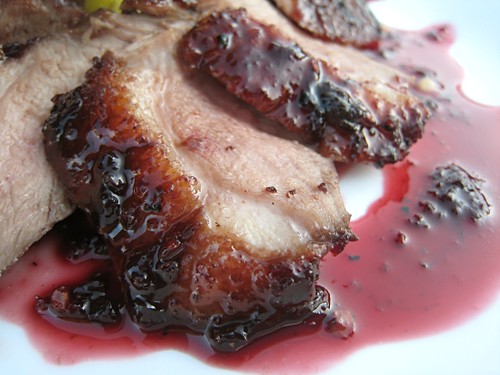
[ts]
A funny thing about this utility duck: it was not bred to be busty! Good thing for MACRO photography, like the photo above! ;D
Yes, this utility duck had no breasts. They wouldn't even fill an A cup. Looky here: they were only about 4x as thick as the dull end of the knife blade.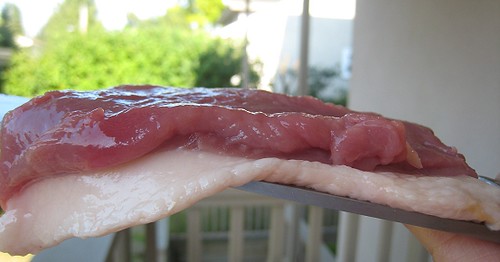
[js]
These ducks are probably the breed that make Chinese roasted barbecued ducks, so they're not overly busty. These specific utility ducks are probably ducks that did not make the cut, perhaps not gaining the requisite weight to be serving ducks.
For those interested in eating locally, ducks are bred in the Lower Mainland and most of them are consumed locally as well.
[ts]
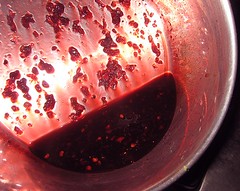
Our dish was dead simple. First, a pomegranate-chipotle glaze. That simply called for reducing pomegranate juice with chopped chipotles, then seasoning the glaze to taste.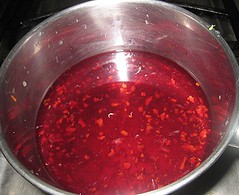
[ts]
I had planned to render the fat off the breasts on the stovetop and finishing the cooking in the oven. I had planned to keep the breast medium-rare. However, since they were so small, I just did all the cooking on the stovetop. I also had to keep the duck cooking past medium-rare to render off as much fat as possible.
How I cooked them: I scored the fat on the duck breasts, then, starting with a cold pan, placed the breasts skin-side down. I turned the heat to low and waited for the fat to trickle out. When I rendered off as much fat as I could, I turned the breast over and started glazing the skin side.
Let me show you again how small these breasts were. That there is one duck breast beside a half a lime. A regular-sized lime.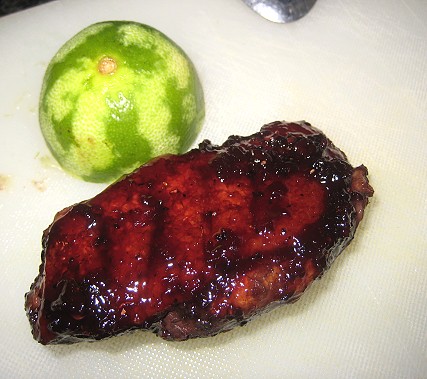
[ts]
Whereas one duck breast would be a good size for an entree, this was definitely appetizer-sized. I sliced the breast and served with the Guava-Jalapeño Salad and more pomegranate-chipotle glaze. Ta da!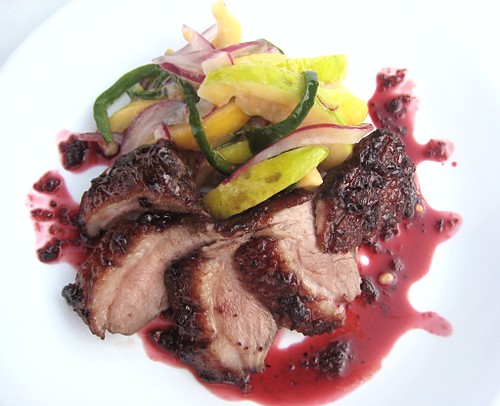
[ts]
The breasts were about medium-well, but still succulent. This whole dish was delish! (It rhymes!)
Not bad for a $5 bird!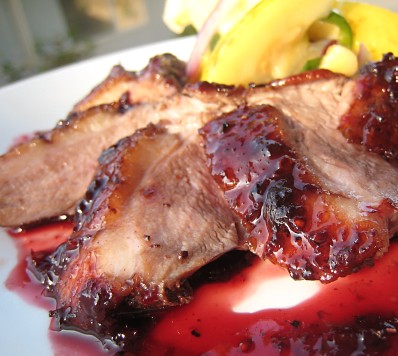
We have so much more in store for this little ducky.
$5 Utility Duck Series
All the following made from one duck!
Duck Breast with Pomegranate-Chipotle Glaze and Guava-Jalapeño Salad
Duck (Interim)
Roast Duck Legs with Cabbage-Portobello Pappardelle
Duck Fat Potatoes
Duck Tortellini in Brodo
Other [eatingclub] vancouver Duck dishes:
Duck Shepherd's Pie, or "Duck Coop Pie"
Duck and Orange Crêpes with Orange-White Wine Sauce
Duck Stock Risotto with Portobello & Chard, with Hazelnut Gremolata
Shredded Duck and Rice Noodle Soup
Duck Enchiladas with Chipotle Peanut Salsa
Thursday, August 28, 2008
Duck Breast with Pomegranate-Chipotle Glaze and Guava-Jalapeño Salad


Subscribe to:
Post Comments (Atom)


That looks fantastic...such a beautiful color.
ReplyDeleteohoho i havent tried handling ducks too! and i am so gonna!
ReplyDeletethanks for the inspiration...now...where can i find cheapy duckies around here :)
That duck looks fantastic. I never thought of pomegranate sauce for duck - it is more interesting than orange sauce.
ReplyDeleteThanks for the tip on the utility duck. I've seen them in the supermarket but never bought them. I want to try making duck confit.
I'm another one who does no duck at home though I eat it. Yours is such winner! Love the sound of that glaze...it MUST BE great on the duck. Lucky duck!
ReplyDeleteI love the idea of the pomegranate and the chipotle glaze. what a great flavor combo!!
ReplyDeleteBeautiful!
Um, yea - you got a deal. I've never prepared duck at home and you did a spectacular job! I mean, for real - that's awesome!
ReplyDeleteNow...what time is dinner again?
-DTW
www.everydaycookin.blogspot.com
Your sauce looks so luscious! I do love duck. But I wouldn't be cutting up a frozen duck for the lady either - it sounds like a whole lot of work.
ReplyDeleteGreat job and the presentation is gorgeous!
ReplyDeleteIs it wrong that I want to roll around in that glaze?! I can't wait to see you make confit!
ReplyDeletemmm... I've never made anything using duck yet. That looks spectacular!
ReplyDeleteLooks wonderful! Nice use of "Young Duck - Parts Missing"! I always smile when I see that on the label.
ReplyDeleteThis looks wonderful, and I covet your inexpensive ducks! I love pomegranate, although I've never tried it with chipotles. It matches really well with duck for some reason.
ReplyDeleteThis looks totally gorgeous! I so envy you the utility ducks, we only have complete and very expensive duck here. :)
ReplyDeletelovely presentation and that duck looks sooo good!
ReplyDeleteI haven't cooked duck in years! Those breasts sure do look tiny.. Really really tiny!
ReplyDeleteAll in all, a great looking dish I have to say!
great post. so funny, that woman at the counter... reminded me of my mother.
ReplyDeleteyour $5 was well spent! great work. looks delish. small - but delish...
This sounds so good!! I have been wanting to try cooking and eating duck and I really like the sound of the chipotle and pomegranate combo!
ReplyDeleteHey, nothing wrong with A cups!
ReplyDeleteBut, this is delicious, as I would expect from such a pair (especially since you one Dhanngit's challenge.) thanks.
The end result looks mighty yummy. I've never tried cooking duck but I definitely want to now. I wish I knew how to cut the duck's breast like that.
ReplyDeleteWoa'.. i never seen a $5 duck before! You did a great job with it and the title reads so fancy. You should open a restaurant and sell it for $35. Money, money, money. :-)
ReplyDeleteThat guava-jalapeno salad looks delicious too!
That pomegranate glaze sounds just perfect for duck, Yum-o!
ReplyDeleteYou guys did a great job with a $5 bird.
I'm not a duck lover but your dish tell me different,make me wanna to grab a piece now!!.Very creative mix with vibrate sauces!!
ReplyDeleteI'm convinced that you sisters are operating a 5 star restaurant kitchen in your home ... just look at the good food u whipped up with the gorgeous presentation! :D
ReplyDeleteOnly one word can best describe your duck breast. It's yummy. It looks perfectly caramelized.
ReplyDeletecan i just have some of that glaze to pour down my gullet? it sounds amazing, and it's beautiful to behold. excellent, excellent dish. :)
ReplyDeleteThis sounds like a really fantastic dish--lots of strong and exciting flavors! Also, good note about "utility ducks"--I was never aware of the distinction.
ReplyDeleteI guess good things do come in, ahem, small packages. :)
ReplyDeleteWhat a great way to serve duck. I made my first duck this summer and I was surprised at how little meat it had. One duck really just served two people!
ReplyDeleteFabulous recipes, I'll be back to delve into the archives!
ReplyDelete
ReplyDeleteKC:
You may need to get at least 2 ducks first, just to render out the fat. Maybe 3. =)
Foodycat:
Haha... And I think they were thinking that for the deal the duck was, the woman could dut it up herself. ;)
Tom Aarons:
Maybe we'll buy an expensive duck. Or at least, duck breasts. Then we can make a proper "seared duck breast" dish.
Ruy:
Just like taking breasts off chicken as well. I don't know exactly how to describe it. But, our butchering is bad too. We don't care too much... as long as the food comes out good to eat. =)
nicisme:
Thanks!! =)
Hola again! As I told you I had some duck breasts waiting in the fridge and I still have the bill. Wanted to show you how much it costed me here: 2 breasts weight 400 grs. each cost 10,5 Euros.
ReplyDeleteIf I buy the whole duck is cheaper but I don't have the prices here. These ducks are raised in an open farm in "some kind of freedom".
If your duck tasted as good as it looks in the pictures... :D
Wow, talk about food porn....I'm craving duck at 8am in the morning. That dish looks so professional, from the crisp skin to the pretty red glaze, to the Guava Jalapeno Salad! It just rocks!
ReplyDeleteLooks mighty tasty. May I ask where one would find such utility ducks in Vancouver?
ReplyDelete
ReplyDeletenuria:
Haha, "some kind of freedom." =D
jessica:
Thanks!
karen:
Hi Karen! We got ours at T&T.
Now I know where to go to get cheap ducks.It looks incredible.
ReplyDeleteAgain, you're fueling my desire to cook duck and you confirm my suspicions to buy and butcher a duck from the Asian store (cheaper).
ReplyDeleteEveryone has said it already...but what gorgeous photos! I've never made duck and now I'm very tempted. I wonder where I can find "utility ducks" here in Halifax.
ReplyDeleteWorst case scenario, I'll be making the pomegranate chipotle glaze for chicken.
Thanks so much for sharing.
Save the bones for the very best stock ever. Way better than chicken stock. I buy utility ducks mainly for the duck fat, crispy skin and the stock--anything else is bonus.
ReplyDelete