


[ts]
Well, I don't know if we're back-back, but seeing how much we've been cooking for the past week, JS & I figure we'd document it. To simplify things, we'll be posting via Instagram, and the feed will be displayed right here in this one blogger post.
Of course, we can all simplify things if we just follow our IG. ;)
Saturday, April 04, 2020
eatingclubvancouver during COVID


Saturday, July 26, 2014
Garlic-Worcestershire Butter Prawns

This is one of our archived dishes that is just now coming out!
TS
This is an attempt to recreate a childhood favorite.
When we were growing up, our family would get invited by this other family who held quite the gatherings. From what I remember, they had an expansive buffet with various stations set up on their lawn. One of the stations was the griddled prawn station.

TS
This being the Philippines, when we say prawns, we mean actual prawns as large as one's hands, maybe larger. A lot of "prawns" we see in North America are merely shrimp.
At this magical griddled prawn station, each prawn would be butterflied at the back, then put on the griddle, basted with the heavenliest of concoctions.

TS
When we saw these Thai blue prawns, we thought it was time we attempted a re-creation.
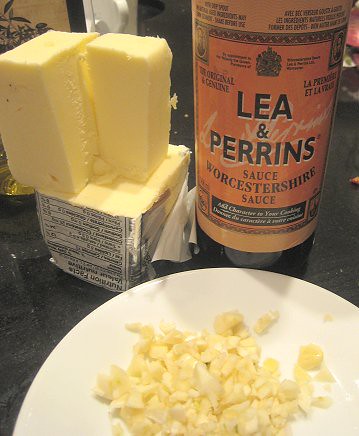
Of course, JS and I don't actually know what went into making that dish. Thinking back, our best guess is this.
TS
A whack-load of butter, garlic, and Worcestershire sauce.
We were aiming to capture that elusive flavor from the past, and did not bother so much with sticking to the griddle method. Perhaps it's because we didn't have a griddle large enough to hold all the prawns, and that would have resulted in dreaded batch-cookery.

TS
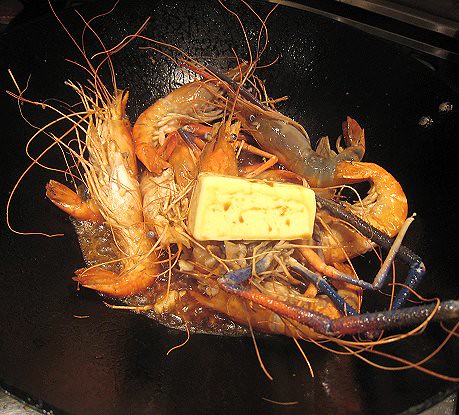
For simplicity's sake, we threw in the butter, garlic and Worcestershire sauce into a wok and added the prawns. They needed to be tossed around quite a bit for each one to have a turn cooking in the butter/sauce. Maybe we needed to batch-cook them after all.
TS
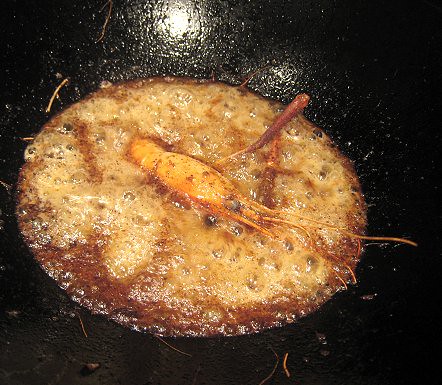
Along the way, we seemed to have determined that the dish needed even more butter.
TS
After making sure the final guy had a dip in the garlicky, Worcestershire-y butter, the dish was done.

TS
Of course, being drenched in butter, garlic, and Worcestershire sauce, this could only be fantastic!
But, is this the same dish as the one at that griddle station?
I don't know. I think we probably did not re-create that same dish. I have a nagging feeling that our attempt falls a little bit short. Or, maybe this dish is actually better than the griddled prawns of our childhood. I truly can't say.
Such is nostalgia.
Recipe
Garlic-Worcestershire Butter Prawns
This dish can be done to taste. Use as much or as little of each ingredient as you wish.
prawns or shrimp (or even mussels or clams)
butter
garlic, minced
Worcestershire sauce (be aware of the salt content in this ingredient)
Pan/Wok
Heat your pan or wok. Add the butter, garlic, and Worcestershire sauce. When the butter has melted, add the prawns.
Toss until the prawns have turned color.
Serve.
Griddle
Melt the butter and mix together with the garlic and Worcestershire sauce.
When the griddle is hot, put your prawns on it and pour the flavored butter over them. One can also baste the prawns with the flavored butter.
Turn the prawns over to cook both sides.
When both sides of each prawn have turned color, take them off the griddle. Serve.
Monday, April 07, 2014
Porchetta... and etcetera (2011 Canada Day Event at The Boulevard)
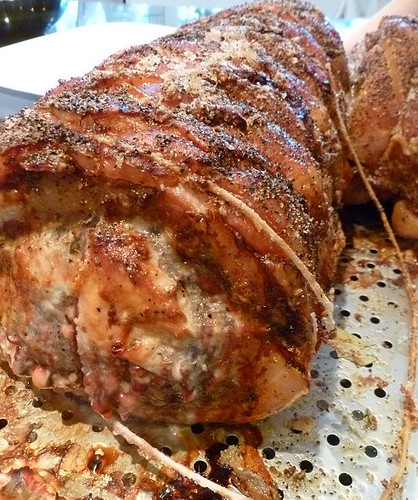
Pork! Pork! Pork!
TS:
Having recently tried porchetta at a local sandwich shop, JS and I left reminiscing about our own porchettas from the past.
Surprisingly, it seemed that we had quite a porchetta spree in 2011. And perhaps 2012 as well!
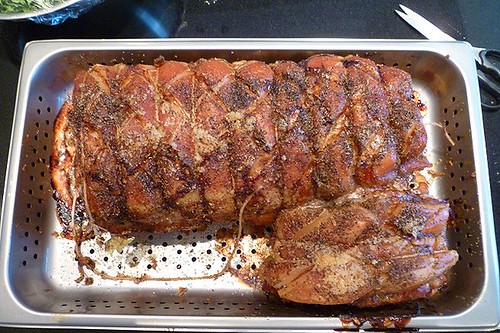
Pork!
TS:
One such occasion -- it may actually have been the first time -- was during the 2011 iteration of our Annual Summer BBQ Event. (See the event from 2010.)
We are usually leery calling this summer party a "BBQ", as guests would undoubtably expect our oh-my-god-it's-so-good Philippine Pork BBQ Skewers. JS and I have not had the time nor energy for such a feat in years. This is, of course, because we would have had to make an obscene number of skewers to satisfy the crowd!
So, in 2011, JS came up with a new concept: a do-it-yourself sandwich bar! We can cook off huge hunks of meat and that would be that! (Well, and make all the sides and condiments, too, of course. I mean, we're not slackers or somethin'.)
DIY Sandwich Bar, aka "TJ's Sammie Shop"
a 2011 Canada Day Event at The Boulevard
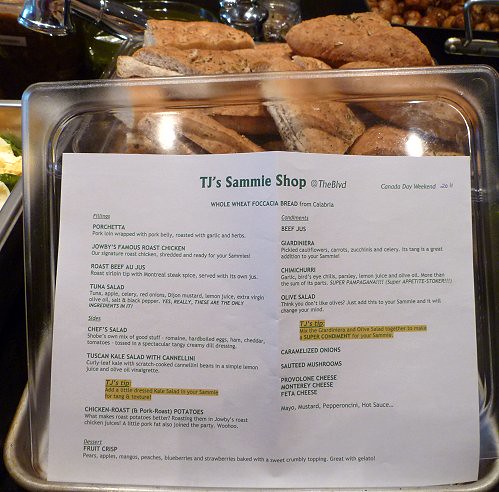
WHOLE WHEAT FOCCACIA BREAD
We've used the foccacia from Calabria Bakery many times before
Fillings
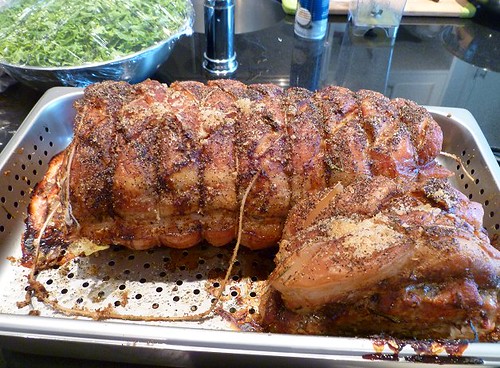
PORCHETTA
Pork loin wrapped with pork belly, roasted with garlic and herbs.
There are more gratuitous shots of the porchetta below. Don't you worry.
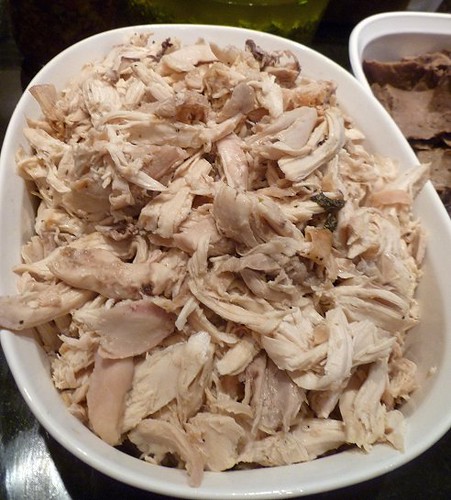
JS’ FAMOUS ROAST CHICKEN
Our signature roast chicken, shredded and ready for your sandwiches!
ROAST BEEF AU JUS
Roast sirloin tip with Montreal steak spice, served with its own jus.
(Pictured in photo of entire buffet, after a few scrolls down.)
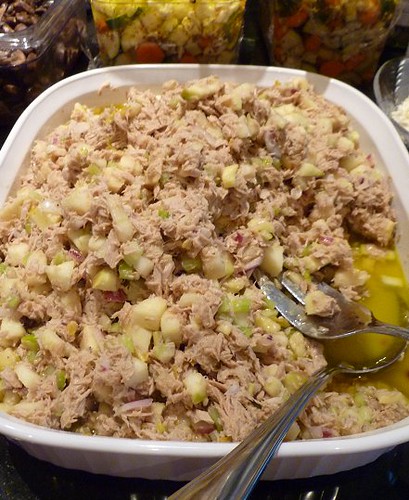
TUNA SALAD
Tuna, apple, celery, red onions, Dijon mustard, lemon juice, extra virgin olive oil, salt & black pepper.
I have been accused on more than one occasion of withholding some secret ingredient(s) and/or method. But, once again, I say,
"YES, REALLY, THESE ARE THE ONLY INGREDIENTS IN IT!"
Sides
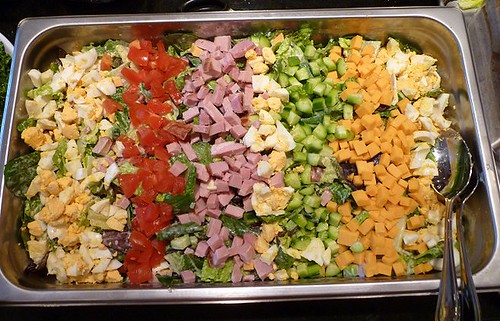
CHEF’S SALAD
TS’ own mix of good stuff – romaine, hardboiled eggs, ham, cheddar, tomatoes
– tossed in a spectacular tangy creamy dill dressing.
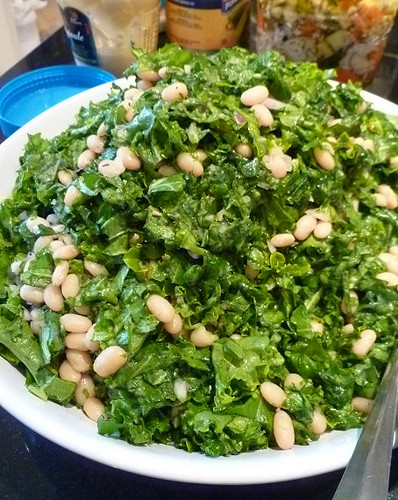
TUSCAN KALE SALAD WITH CANNELLINI
Curly-leaf kale with scratch-cooked cannellini beans in a simple lemon juice and olive oil vinaigrette.
TJ Tip:
Add a little dressed Kale Salad to your sandwich for tang & texture!
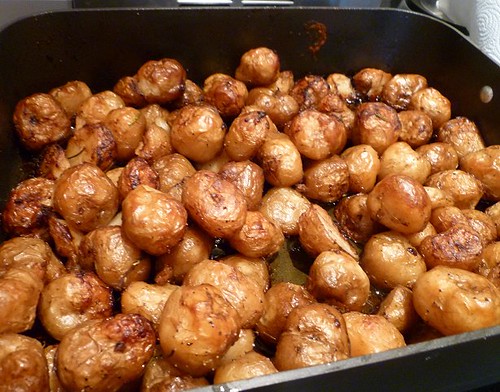
Not just Roast Potatoes,
CHICKEN-ROAST POTATOES
What makes roast potatoes better?
Roasting them in roast chicken juices! A little pork fat also joined the party. Woohoo.
Condiments
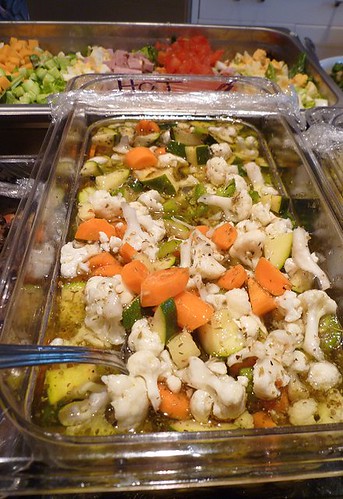
GIARDINIERA
Pickled cauliflowers, carrots, zucchinis and celery. Its tang is a great addition to your sandwich! We made hot and mild versions.
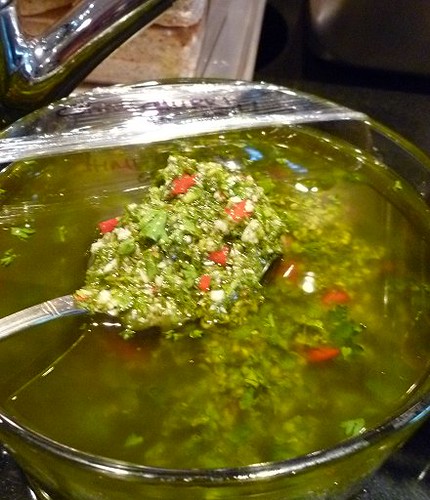
CHIMICHURRI
Garlic, bird’s eye chilis, parsley, lemon juice and olive oil. More than the sum of its parts.
Oh man, what a SUPER APPETITE-STOKER!
See it in action here with flank steak and here on a burger.
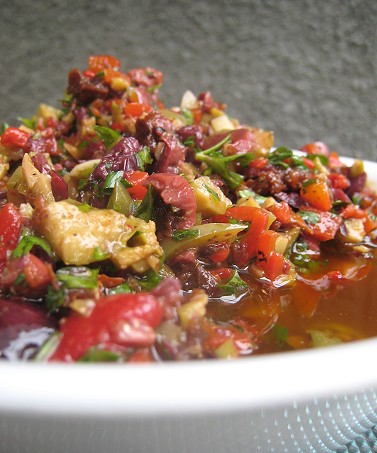
OLIVE SALAD
Think you don’t like olives? Just add this to your sandwich and it will change your mind. Used in our muffuletta and "muffuletta-inspired" stuffed flank.
TJ Tip:
Mix the Giardiniera and Olive Salad together to make a SUPER CONDIMENT for your sandwich. Hell, throw in the Chiimichurri as well!
Holy, I just drooled a little. Those 3 condiments!!
BEEF JUS
(Not pictured.)
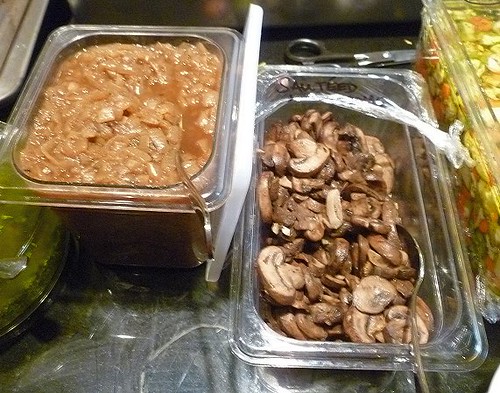
CARAMELIZED ONIONS
SAUTÉED MUSHROOMS
PROVOLONE CHEESE
MONTEREY CHEESE
FETA CHEESE
(Pictured in photo of entire buffet, after a few scrolls down.)
Of course, also available were
Mayo, Mustard, Pepperoncini, Hot Sauce…
Dessert
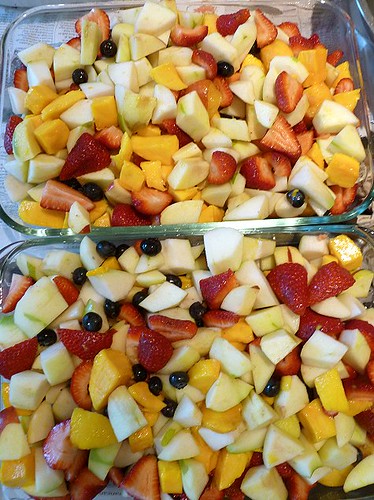
FRUIT CRISP
Pears, apples, mangos, peaches, blueberries and strawberries baked with a sweet crumbly topping. Great with gelato! (Pictured above before they donned their topping and got baked.)
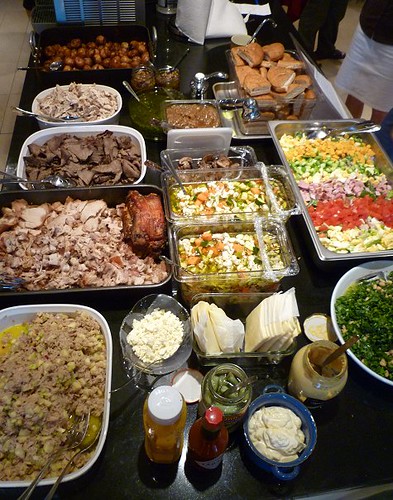
The entire "sandwich bar" in all its glory.
TS:
Of course, it was a bit of a struggle getting everyone to actually build sandwiches. Everybody just went straight for the meat (and the salads, too, actually). I guess that's just how we roll.
Of course, it was a bit of a struggle getting everyone to actually build sandwiches. Everybody just went straight for the meat (and the salads, too, actually). I guess that's just how we roll.
And now, more about the PORCHETTA!
Porchetta
JS:
TS is pressuring me to write my bit for the porchetta.
You have to remember that this party was almost three years ago! How can I remember what I did to a piece of pork three years ago?!?
Deliciousness of the porchetta not withstanding, everything seems like a dream now, and in two more years, it would not be far-fetched to imagine this porchetta dropping from the sky, like manna.
Maybe we'll just have to wait a couple of years. . .then this post would be FIVE years old.
Wow.
JS:
With a hunk of meat like this, I had to get it special from a butcher. An expensive butcher. I believe the whole thing cost about $300. . . three years ago.JS:
TS is pressuring me to write my bit for the porchetta.
You have to remember that this party was almost three years ago! How can I remember what I did to a piece of pork three years ago?!?
Deliciousness of the porchetta not withstanding, everything seems like a dream now, and in two more years, it would not be far-fetched to imagine this porchetta dropping from the sky, like manna.
Maybe we'll just have to wait a couple of years. . .then this post would be FIVE years old.
Wow.
JS:
I had asked for a loin and I had asked for belly.
I was concerned that it would take too much muscle (although these butchers were big guys) to try to wrap the belly around the loin, so I suggested to them that draping the belly over the loin would be good enough. They were going to tie the whole thing up with string anyways.
I had the butcher score the skin, as we only had dull knives at home. We still do.
Getting the pork was probably the hardest thing here.
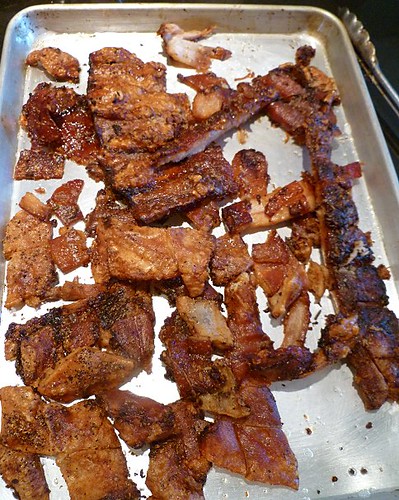
The skin!
JS:
From there, it was a matter of seasoning the outside of the log.
Salt and pepper it was! And, I believe, some garlic powder and dried herbs as well (oregano, thyme).
Turned out that was all was needed because the pork was delicious as it was.
TS:
Perhaps, technically, this wasn't a "porchetta" because we didn't get to stuff the rolled up piece of meat. But no matter, we're still calling it porchetta.
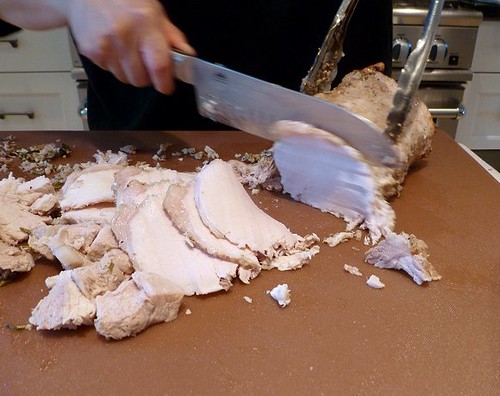
The loin.
JS:
Look at it, so white and so tender and so juicy.
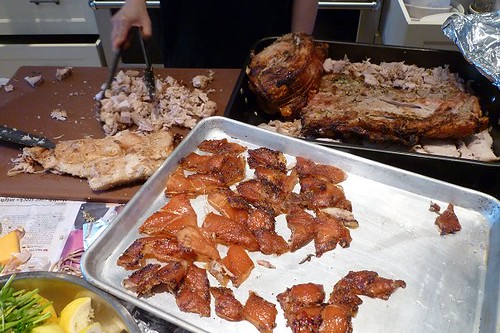
TS:
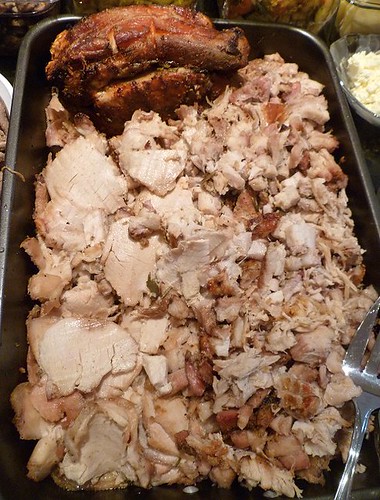
Since we were making this for sandwich filling, we decided to disassemble the porchetta after roasting. We sliced the loin and chopped the belly. We also separated the skin from the meat and chopped that up.
I believe for our subsequent porchettas, we mostly went with just pork belly. Who needs all that lean loin meat anyway?
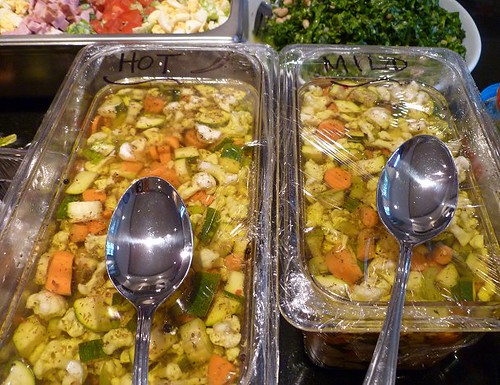
JS:
If I may, I just want to say that the gardiniera was my favourite! Piled on top of the porchetta, it was simply fabulous. I loved the tang, the crunch, and the heat.
Want to try your hand at porchetta? Why not look to The Food Lab at Serious Eats?
The Food Lab: How to Make All-Belly Porchetta, the Ultimate Holiday Roast
Subscribe to:
Posts (Atom)


