Showing posts with label legume. Show all posts

Tuesday, December 14, 2010

Sichuan Ma Po Tofu (麻婆豆腐)


JS:
Ma po tofu is one of the most popular Chinese dishes around -- and I've eaten my fair share of ma po tofu over the years.

I hope I won't be losing my street cred here, but I must admit to liking ma po tofu in any guise. Around Vancouver, I've eaten and enjoyed ma po tofu in Cantonese restaurants and I've also ordered and enjoyed ma po tofu in Taiwanese restaurants.


JS:
Of course, these dishes bear only a passing resemblance to the Sichuanese, the supposed original. Surprisingly -- and how's this for a twist -- I haven't really enjoyed ma po tofu in any Sichuanese restaurants I've visited. Weird, wouldn't you say?

Wikipedia: Mapo doufu

So one day, I decided to try my hand at a home-cooked Sichuanese version of ma po tofu. I consulted Fuschia Dunlop's cookbook to start.

I was quite surprised that the recipe called for ground beef instead of ground pork. All my years eating ma po tofu, I've never had it with beef.

But, forged ahead I did.

"Specialty" Ingredients


TS:
First, some "specialty" ingredients are needed for this dish. One of these is Sichuan chili pepper flakes (四川辣椒).


四川辣椒 ("Sichuan chile pepper")TS:
I do not actually know what specific kind of chili pepper, except that it is usually labeled "Sichuan/Szechuan chili pepper". Best thing to do is go by the Chinese, as opposed to the English, description. These peppers do have quite a different aroma from regular chili flakes in regular supermarkets.
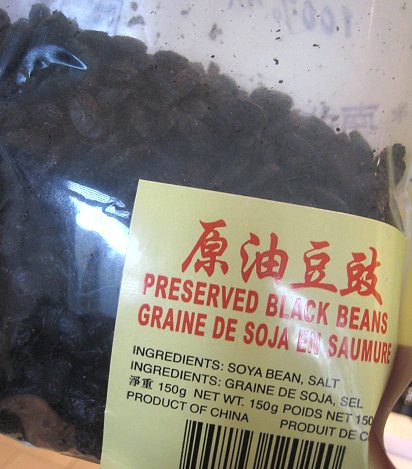

豆豉 (fermented black beans)

TS:
Another ingredient, probably not as unusual, is fermented black beans (豆豉).

These are the black beans in anything labeled "black bean sauce" on Chinese menus -- in Stir-fried Pork with Black Bean Sauce, for example. Or, the classic clams with black bean sauce. We have also used these before to quickly add flavor and seasoning to dishes, like in our Steamed Fish and Tofu with Chinese Black Beans.

About.com: Chinese Food - Fermented Black Beans
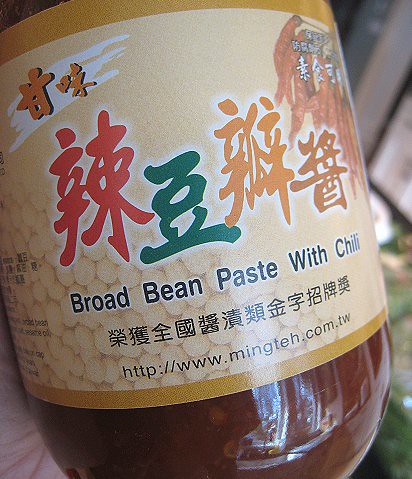

辣豆瓣醬 ("Broad Bean Paste with Chili")

TS:
My complaint about Fuchsia's book is that she does not include the Chinese names of the ingredients in her recipes. As some of you may have already experienced, describing something as "bean paste" is not very helpful at all!

Wikipedia: Doubanjiang

In the "Sichuanese Pantry" section of her book, she describes "chili bean paste" and includes the Chinese, 豆瓣醬 (dou ban jiang). She also includes a few sentences about a "Pixian bean paste" (no Chinese term included). However, in the actual recipe, she refers only to a "Sichuanese chili bean paste".

So, we used la doubanjiang (辣豆瓣醬), which is bean paste with chili.
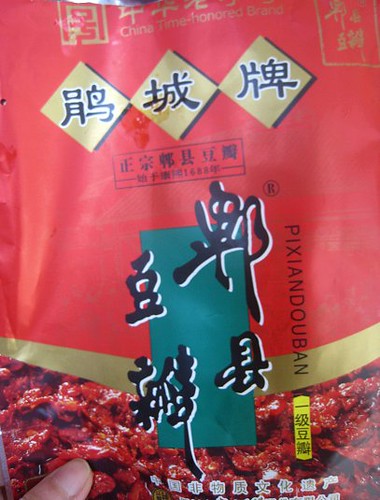

郫县豆瓣酱 (Pixian bean paste)

JS:
It turns out, or I'm assuming, that I actually needed Pixian bean paste (郫县豆瓣酱), which is a tad different from the normal dou ban jiang (豆瓣醬) we use for other dishes. Pixian bean paste is a fermented broad bean paste, and boy is it potent!
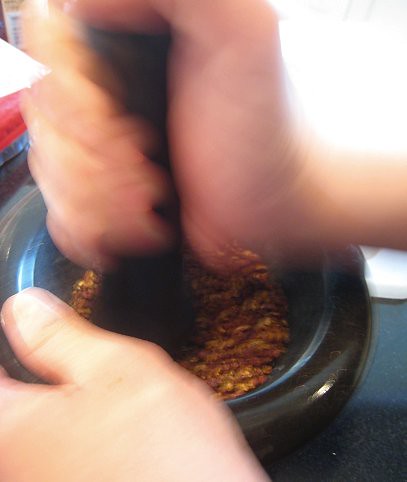

花椒 (Sichuan peppercorns)

TS:
Of course, one must not forget Sichuan peppercorns (花椒)! They taste citrus-y, with an unmistakable numbing sensation.

JS roasted the Sichuan peppercorns first, then ground them in a mortar and pestle.

Wikipedia: Szechuan peppercorn


TS:
Fuchsia did not specify the type of tofu/bean curd needed for the dish! [sigh... Fuchsia.]

JS:
The recipe called for blanching the tofu, I think to get rid of the excess water. Well, given that I tend to be rough in handling tofu, I figure if I blanched them first, I would be left with curds. So, I simply cut them into large cubes.


TS:
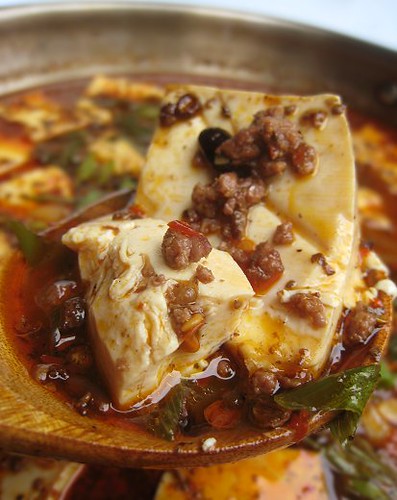
JS went ahead and used ground pork. This was sautéed first, then the chili bean paste was added. We used both the doubanjiang with chili (辣豆瓣醬) and the Pixian bean paste (郫县豆瓣酱). The fermented black beans (豆豉) and the chili flakes (四川辣椒) went in next.

At this point, the oil should be a nice red color from the bean paste(s) and the chili flakes.

The recipe calls for adding stock, then the tofu. The whole lot is seasoned with sugar, soy sauce and salt, then simmered for a few minutes.

To get a nice luxurious consistency to the sauce, a cornstarch slurry (cornstarch dissolved in cold water) is used. Then, sliced baby leeks, or green onions in our case, and the ground roasted Sichuan peppercorn (花椒) are the finishing touches to the dish.


JS:
This version of ma po tofu turned out to be more watery than I wanted. One reason may be because I skipped the tofu-blanching in the beginning. But I also think that there was too much chicken stock in the recipe. I suppose I could have let the dish reduce further but impatience got the better of me. I turned off the stove and served my slightly watery ma po tofu.

I was also quite disappointed with the heat level in the dish, or the lack thereof. Fuchsia warned us that adding the ground Sichuanese chiles was "only for chile fiends", but this dish was not hot at all! Well, it all ended well, I suppose, as the kiddies also ate this up.

Our first Sichuan Mapo Tofu was still delicious, despite its shortcomings. But I know what to do, or what not to do, next time.

TS:
P.S. I've included the Chinese terms in the recipe below for ease in looking for ingredients.


eatingclub Sichuan/Sichuan-inspired (Szechuan)
Red Chile Oil (紅油)
Sichuan Peppercorn Chili Oil
Spicy Sweet Sichuan Popcorn
Gong Bao ("Kung Pao") Chicken (宮保雞丁)
Eggplant Dandan Mian (擔擔麵)
Sichuan "Crossed Hands" Wonton Dumplings 抄手, Two Ways (in Broth and with Chili Oil Sauce)
Sichuan Ma Po Tofu (麻婆豆腐)
Water Boil Fish (水煮魚) or Water Boil Beef (水煮牛肉)

Enjoyed this post? Why not subscribe to our blog? Subscribe via reader or subscribe via email. Thank you!

Recipe
Pock-marked Mother Chen's Bean Curd
from Fuchsia Dunlop's Land of Plenty: A Treasury of Authentic Sichuan Cookingour notes/comments in green

Serves 2-3 as a main course with one vegetable dish and rice, 4 with three other dishes

1 block bean curd (about 1 pound)
we used soft tofu

4 baby leeks or 2 leeks
we used green onions
1/2 cup peanut oil
6 ounces ground beef
we used ground pork
2-1/2 tablespoons Sichuanese chili bean paste
we used both chili bean paste (la doubanjiang, 辣豆瓣醬) and the Pixian bean paste (郫县豆瓣酱)
1 tablespoon fermented black beans (豆豉)
2 teaspoons ground Sichuanese chiles (only for chile fiends) (四川辣椒)
1 cup "everyday stock" or chicken stock
we would use less liquid next time
1 teaspoon white sugar
2 teaspoons light soy sauce
salt to taste
4 tablespoons cornstarch mixed with 6 tablespoons cold water
1/2 teaspoon ground roasted Sichuan pepper (花椒)

1 Cut the bean curd into 1-inch cubes and leave to steep in very hot or gently simmering water that you have lightly salted. Slice the leeks at a steep angle into thin "horse ear" slices 1-1/2 inches long.

2 Season the wok, then add the peanut oil and heat over a high flame until smoking. Add the minced beef and stir-fry until it is crispy and a little brown, but not yet dry.

3 Turn the heat down to medium, add the chili bean paste and stir-fry for about 30 seconds, until the oil is a rich red color. Add the fermented black beans and ground chiles and stir-fry for another 20-30 seconds until they are both fragrant and the chiles have added their color to the oil.

4 Pour in the stock, stir well, and add the drained bean curd. Mix it in gently by pushing the back of your ladle or wok scoop gently from the edges to the center of the wok -- do not stir or the bean curd may break up. Season with the sugar, a couple of teaspoons of soy sauce, and salt to taste. Simmer for about 5 minutes, until the bean curd has absorbed the flavors of the sauce.

5 Add the leeks or scallions and gently stir in. When they are just cooked, add the cornstarch mixture in two or three stages, mixing well, until the sauce has thickened enough to cling glossily to the meat and bean curd. Don't add more than you need. Finally, pour everything into a deep bowl, scatter with ground Sichuan pepper, and serve.

Sunday, June 20, 2010

Gong Bao ("Kung Pao") Chicken (宮保雞丁)


JS:
It's chicken breast time again.

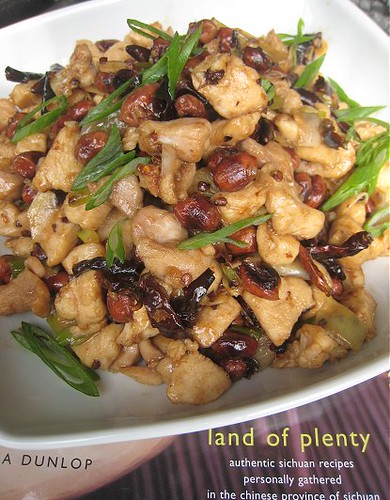
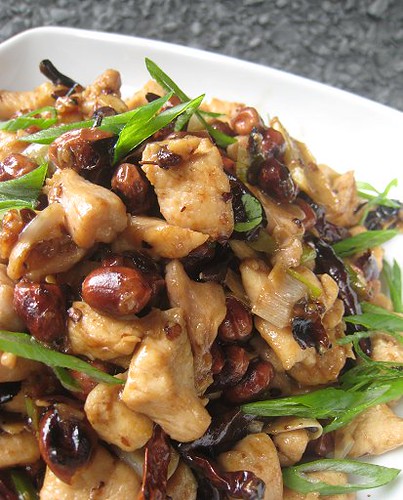
This time, due to the fortuitous event of having peanuts around, we decided to turn to Fuschia Dunlop and go with her version of Gong Bao chicken from Land of Plenty: A Treasury of Authentic Sichuan Cooking.

I started with cutting up the chicken breast pieces.


JS:
When TS saw what I had done, she tsk-ed tsk-ed me and decided to re-do my pieces. She said my pieces were too big! Okay, well, I was just trying to do it as quickly as I could.

I told her to take over then. :)

I'm sure everybody knows about this tactic by now: if you want to get out of doing things, just act incompetent -- and this is the key thing -- admit to the incompetence! Someone will take over for you.

TS:
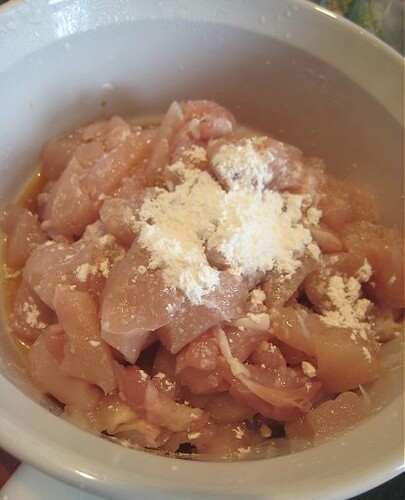
As per the recipe, I marinated the chicken cubes in a mixture of light soy sauce, Shaoxing wine, cornstarch and a touch of water. You know, the usual suspects.


TS:
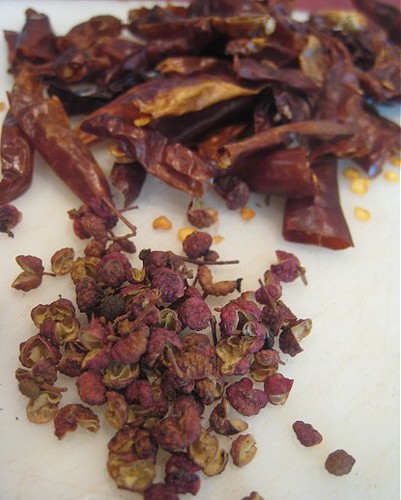
Sichuan peppercorns (foreground) and dried chiles (background).


TS:
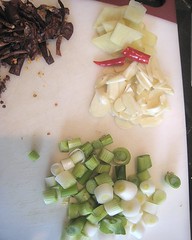
Just a quick prep of the ingredients: ginger, garlic and green onions. I even had to make my green onion pieces the same size as my chicken cubes!

I also mixed the sauce ingredients together: light and dark soy sauces, Chinkiang vinegar, sugar, sesame oil, cornstarch and just a touch of water.

Oh, we pan-roasted some peanuts as well. Mustn't forget the peanuts. Without them, what would the point! ;)

The dish came together very quickly after the initial prep.


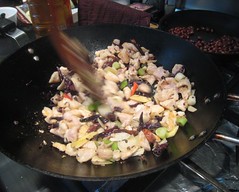
Cook the Sichuan pepper and chiles in hot oil, then add marinaded chicken.


Add the ginger, garlic and green onions. Toss, toss, toss.


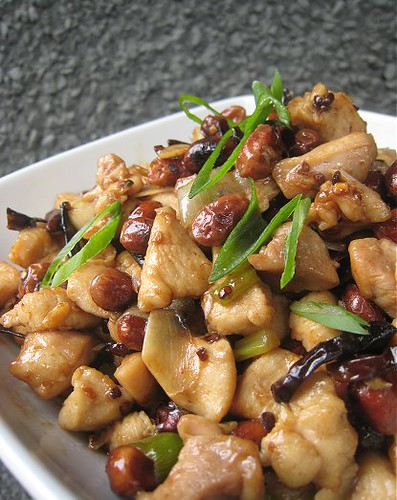
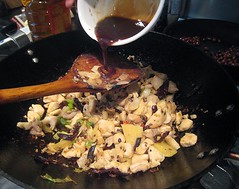
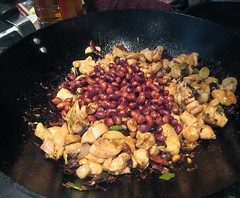
Add the sauce and roast peanuts, and it's done.


JS:
I think I like my Gong Bao chicken to be a tad more spicy but this has a nice balance of hot, salty, sour. Of course I loved the fried peanuts in this, although I concede that cashews might perhaps add a touch more sweetness to the flavour balance.

TS:
(No to cashews! Peanut-love all the way!)


eatingclub Sichuan/Sichuan-inspired (Szechuan)
Red Chile Oil (紅油)
Sichuan Peppercorn Chili Oil
Spicy Sweet Sichuan Popcorn
Gong Bao ("Kung Pao") Chicken (宮保雞丁)
Eggplant Dandan Mian (擔擔麵)
Sichuan "Crossed Hands" Wonton Dumplings 抄手, Two Ways (in Broth and with Chili Oil Sauce)
Sichuan Ma Po Tofu (麻婆豆腐)
Water Boil Fish (水煮魚) or Water Boil Beef (水煮牛肉)

Enjoyed this post? Why not subscribe to our blog? Subscribe via reader or subscribe via email. Thank you!

Recipe
Gong Bao (Kung Pao) Chicken with Peanuts (宮保雞丁)
from Fuchsia Dunlop's Land of Plenty: A Treasury of Authentic Sichuan Cooking

Serves 2 as a main dish with a simple stir-fried vegetable and rice, 4 as part of a Chinese meal with three other dishes

2 boneless chicken breasts, with or without skin (about 2/3 pound total)
3 cloves of garlic and an equivalent amount of ginger
5 scallions, white parts only
2 tablespoons peanut oil
a generous handful of dried red chiles (at least 20), preferably Sichuanese
1 teaspoon whole Sichuan pepper
2/3 cup roasted unsalted peanuts

For the marinade
1/2 teaspoon salt
2 teaspoons light soy sauce
1 teaspoon Shaoxing wine or medium-dry sherry
1 1/2 teaspoons potato flour or 2 1/4 teaspoons cornstarch
1 tablespoon water

For the sauce
3 teaspoons sugar
3/4 teaspoon potato flour or 1 1/8 teaspoons cornstarch
1 teaspoon light soy sauce
1 teaspoon dark soy sauce
3 teaspoons Chinkiang vinegar or black Chinese vinegar
1 teaspoon sesame oil
1 tablespoon chicken stock or water

1. Cut the chicken as evenly as possible into 1/2-inch strips and then cut those into small cubes. Place in a small bowl and mix in the marinade ingredients.

2. Peel and thinly slice the garlic and ginger, and chop the scallions into chunks as long as their diameter (to match the chicken cubes). Snip the chiles in half or into 2-inch sections. Wearing rubber gloves, discard as many seeds as possible.

3. Combine the sauce ingredients in a small bowl -- if you dip your finger in, you can taste the sweet-sour base of the gong bao flavor.

4. Season the wok, then add 2 tablespoons of oil and heat over a high flame. When the oil is hot but not yet smoking, add the chiles and Sichuan pepper and stir-fry briefly until they are crisp and the oil is spicy and fragrant. Take care not to burn the spices (you can remove the wok from the heat if necessary to prevent overheating).

5. Quickly add the chicken and fry over a high flame, stirring constantly. As soon as the chicken cubes have separated, add the ginger, garlic, and scallions and continue to stir-fry for a few minutes until they are fragrant and the meat is cooked through (test one of the larger pieces to make sure).

6. Give the sauce a stir and add it to the wok, continuing to stir and toss. As soon as the sauce has become thick and shiny, add the peanuts, stir them in, and serve.

Sunday, May 16, 2010

Nasi Lemak (Malaysian Coconut Rice Meal with Sambal)


JS:
A while back, we had a spectacular Alaskan King Crab dinner with Ben and Suanne of Chowtimes and ET and Christina of Doesn't Tazte Like Chicken.

Being the generous and gracious people that they are, both Ben and Suanne and ET and Christina gave us some food items to take home.

Thanks, guys!


peanuts and anchovies

JS:
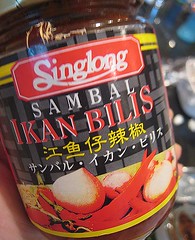
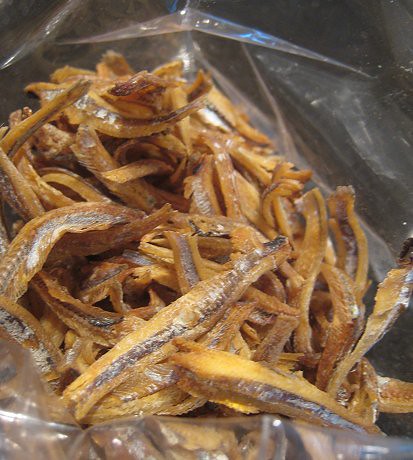
Suanne and Ben gave us a jar of their homemade sambal belacan, a jar of sambal ikan bilis, as well as a packet of peanuts and ikan bilis (dried anchovies) straight from Malaysia.


left: homemade sambal belacan; right: sambal ikan bilis

Wikipedia: Malaysian Sambal

Naturally, we thought to use these products to make nasi lemak.


TS:
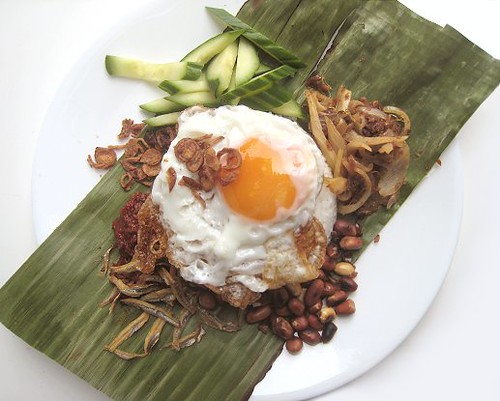
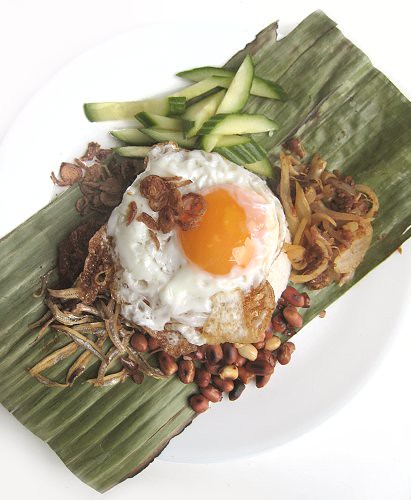
Nasi Lemak means "rice in cream". In this case, the cream is coconut cream (or milk). Besides the coconut rice, nasi lemak usually comes with cucumber slices, dried anchovies, roasted peanuts, egg, and sambal.

Let's get to work.

Coconut Rice


TS:
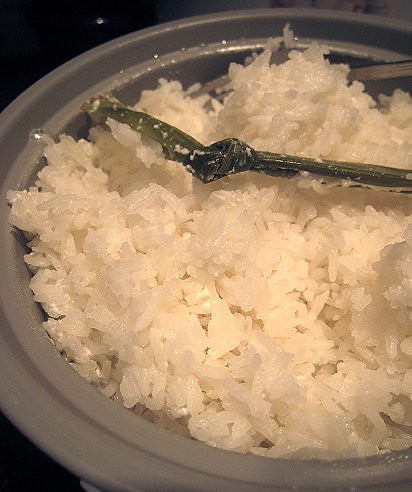
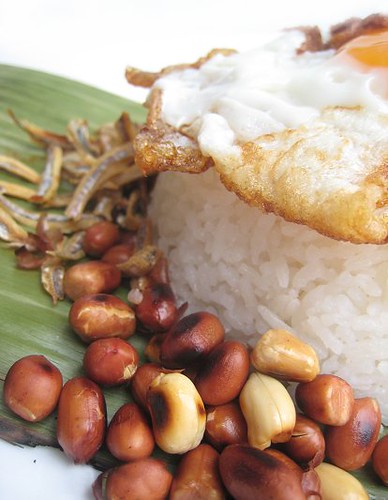
Of course, I simply used the rice cooker. For this attempt of mine, since I didn't exactly know how coconut-ty we wanted the rice, I used half coconut milk and half water for my liquid. I added a knot of pandan (screwpine) leaf to the rice while cooking.

The rice was extremely fragrant. Mmm.

Roasted Peanuts


TS:
I toasted the peanuts on the stovetop.

Sambal, Ikan Bilis, and Onions


TS:
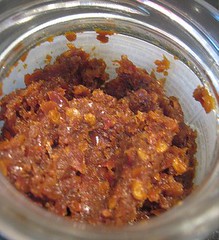
Actually, instead of frying up the sambal with the dried anchovies (for sambal ikan bilis), I followed Suanne's suggestion of simply caramelizing some onions and adding the sambal, without adding the anchovies.


TS:
That way, the dried anchovies will remain crispy and give us some nice textural contrast. Besides, we have that jar of prepared sambal ikan bilis anyway.


TS:
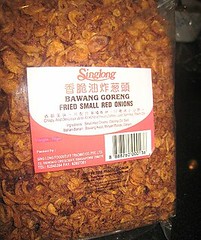
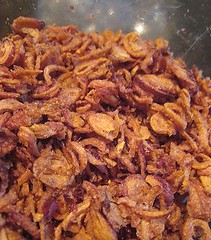
We also happened to have recently purchased a bag of fried shallots (or actually, small red onions that I haven't seen in Vancouver). Why not have contrasting onions as well?

Fried Egg
TS:
Instead of hard-boiled eggs, I fried mine up. I can't resist egg yolk ooze, after all. It's so much better than hard-boiled eggs!

Nasi Lemak


TS:
So, there's our nasi lemak plate! Here's what we have on there.


Sautéed Onions with Suanne's Homemade Sambal Belacan.
Sliced Cucumbers (in the background).


Sambal Ikan Bilis and Ikan Bilis (dried anchovies).


Pan-roasted Peanuts and Fried Egg.
Fried Shallots/Small Red Onions (see below).


TS:
What's great about this is that one doesn't even really need a recipe. It's assembly work! Yet, the result is fantastic. The whole meal is so savory and hearty, and that fragrant rice is quite something else.

Of course, our version is a bare-bones version. All sorts of accompaniments (or ulam, as we would call it) can be added: fried fish, beef rendang, chicken dishes, seafood... I think a trip to Malaysia is in order to sample all the possible different combinations or nasi lemak plates!

Wikipedia: Nasi Lemak

other Nasi Lemak recipes/how-to
Chowtimes.com
Rasa Malaysia
MalaysianFood.net

Enjoyed this post? Why not subscribe to our blog? Subscribe via reader or subscribe via email. Thank you!

eatingclub vancouver Malaysian
Sambal Mini Eggplants with Campari Tomatoes
Nasi Lemak (Malaysian Coconut Rice Meal with Sambal)

Some eggy eatingclub dishes
Tarragon-Carrot Deviled Eggs
Golden Egg Torta
Hunanese Stir-fried Eggs with Green Peppers
Tortilla de Patatas (Spanish "Omelette")
Piedmont Marinated Eggs
Asparagus and Crab Egg Crêpes
Stir-fried Egg and Tomato
Oyster Torta
Torta with Pork and Kecap Manis
Curried (Easter) Egg Salad
Taiwanese Stewed Eggs (滷蛋) with Stewed Minced Pork (魯肉 or 肉燥)
Longsilog (Longganisa + Sinangag + Itlog)
Torta (Mexican Sandwich)
Mr. Zheng's Soupy Tomatoes and Eggs with Tofu
Nasi Lemak (Malaysian Coconut Rice Meal with Sambal)
Home-style Chinese Steamed Egg with Pork
Golden Shrimp Torta (Philippine Shrimp Omelette)

Monday, May 10, 2010

Jade Tower ( 翡翠塔), or Tofu with Aster Indicus (香乾馬蘭頭)


JS:
This is one of our favourite appetizer dishes when we go to Shanghainese restaurants. I first discovered this dish of tofu and spinach while dining at Top Shanghai, in Richmond, quite some time ago. It doesn't seem like much, but this is a combination that works.

One day, I was browsing through Pei Mei's cookbooks and chanced across something called Jade Tower 翡翠塔. Reading through the recipe and looking at the picture, it seems that this is the dish we had. I kept this information for future reference.

about Fu Pei Mei
http://www.flavorandfortune.com/dataaccess/article.php?ID=379
http://tofuwatch.com/2009/07/decades-later-fu-pei-meis-chinese-recipes-particularly-tofu-still-inspire-who-was-she/

Pei Mei cookbooks

TS:
Fast forward to a couple of weeks ago, we were dining at Suhang restaurant and wanted to order "Jade Tower." We peered long and hard at Suhang's menu, looking carefully through the English names and muddling through the Chinese, but we could not find this dish.

urbanspoon: Suhang Restaurant

JS:
Thankfully, our mother is a regular at Suhang and our server knows that she always orders this dish. Our server thus pointed us to the right item on the menu. The name of this dish on Suhang's menu is totally different from "Jade Tower."

For future reference, Pei Mei's "Jade Tower" is called 香乾馬蘭頭, translated as "Marinated Tofu with Special Vegetables", in Suhang's menu.

(Just a note, 香乾 (xiang gan) literally means "fragrant dry". It's the term used for marinated firm tofu.)


TS:
How can a dish have two completely different, unrelated names?

JS:
I told TS in a confident tone of voice that it could be that "Jade Tower" is simply the poetic name of the dish.

It sounds plausible enough, doesn't it? Given that I saw the dish in the banquet section of Pei Mei's book, I convinced myself that I was of course right.

TS:
It turns out that 馬蘭頭 (malantou) is indeed a "special vegetable."

Googling madly to find the origin of the name -- because I suspected that JS was simply making up answers like she sometimes does -- it turns out that malantou is a plant/vegetable called "Aster indicus," which grows wild in certain parts of China.

Further googling couldn't help me find out more about "Aster indicus." I merely discovered that it's also called boltonia or Kalimeris indicus. The plot thickens.

I still don't know the exact relationship between "jade tower" and "tofu with Aster indicus", but I have to accept that.

In any case, getting to the bottom of the names of this dish took up a lot more time than actually making this dish!


TS:
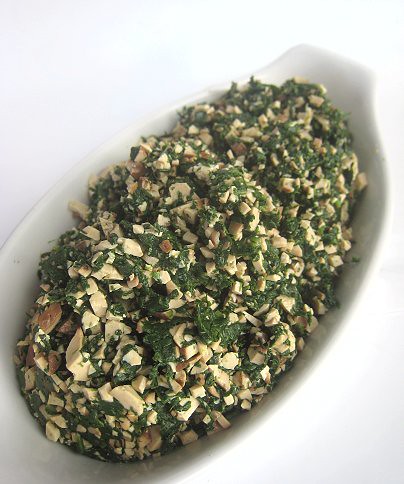
It's simply a matter of mixing together finely chopped cooked greens and finely chopped firm tofu. A little salt (perhaps sugar) and sesame oil, and that's it.

If this looks familiar, why yes, we did something similar with celery before (Fragrant Celery and Tofu Salad).

Obviously, they don't taste quite the same, one being made from celery while this one with spinach. Also, the recipe called for also simmering the firm tofu for about a minute or so. This resulted in the tofu having a "spongier" texture.

If anyone can find this elusive Aster indicus plant, then by all means, use it. Then you can say your dish is tofu with Aster indicus 香乾馬蘭頭, as opposed to simply being a generic "jade tower."


I have copied the recipe for Jade Tower from Pei Mei's book below. There are also links to others' versions of this tofu and Kalimeris Indica/Boltonia dish.

eatingclub JiangZhe dishes
Jade Tower ( 翡翠塔), or Tofu with Aster Indicus (香乾馬蘭頭)
Wuxi Pork Spareribs (無錫排骨)
"Little Cubby Heads", Lion's Head Meatballs (小獅子頭)
Supreme Lion's Head Meatballs with Crabmeat (清燉蟹粉獅子頭)
Suzhou Deep-fried Fish, or Suzhou Smoked Fish (蘇州燻魚)

Recipe
Jade Tower (翡翠塔)
from Pei Mei's Chinese Cook Book Volume III

Ingredients
400g spinach (or other kind of green vegetable)
150g dried tofu

Seasonings
1/3 teaspoon salt
1/6 teaspoon sugar
1 teaspoon sesame oil

Trim spinach, blanch and drain quickly. Rinse with cold water, squeeze dry, and chop finely.

Boil dried tofu over low heat for 1 minute. Drain and chop finely once cool to the touch.

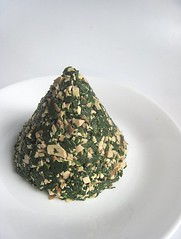
Place spinach and dried tofu in a bowl; mix with seasonings. You may use a mold to shape the mixture into a tower; it'll look prettier.


Life is Beautiful!: Kalimeris Indica and Tofu Salad
FoodNo.1: Tossed Dried Beancurd With Boltonia


Enjoyed this post? Why not subscribe to our blog? Subscribe via reader or subscribe via email. Thank you!

LinkWithin Related Stories Widget for Blogs