


Happy Chinese New Year!
To celebrate, our family will be dining at Fisherman's Terrace tonight. However, we also had a party at home last night (New Year's Eve), inviting friends and family/relatives.
Our Chinese New Year Menu
(This will be one of those "ugly pictures, good food" kind of moments.)
Dumplings

TS:
Dumplings are supposed to resemble gold ingots, and hence, are good to serve during New Year dinners. We did two types: a plain one with a soy sauce-based dipping sauce, and another with Sichuan chile oil sauce.
Recipe:


Sichuan "Crossed Hands" Wonton Dumplings, Two Ways
Red-Braised Pork


TS:
I don't know what this dish is supposed to represent. It just happens to be delicious and popular. =)
Recipe:
Mao's Hunan Red-Braised Pork (毛氏紅燒肉)
Noodles: Pancit Canton

TS:
Of course, the Chinese New Year table has to have noodles to symbolize long life.

This is one of CSC's absolute favoritest dishes. Just the mention of "pancit canton" lights up her face and sets her eyes a-twinkling.
We have previously mentioned that we always make a humongo batch of pancit canton. Well, for this party, it was even more humongo than usual!

TS:
Yup, we used this whopping 18QT pot. And, there were barely any leftovers!
Recipe: Pancit Canton (Philippine Braised Egg Noodles)
Whole Chicken

TS:
Hmm, it seems impossible to make this dish look good in photographs.
This is simply whole chickens poached with leeks and shiitake mushrooms, served in its own broth. Oh, for interest, I made the standard Chinese ginger and green onion sauce to serve alongside.

TS:
When serving chicken for New Year's dinner, one has to serve the chicken whole to symbolize togetherness. There's the proof above: the chicken feet are still attached to the chicken bodies!
Mussels: Baked Tahong

TS:
Clams and mussels are supposed to resemble coins (money, in other words). Of course we would want them on the table!
We decided to make the Filipino/Philippine classic, Baked Tahong. Mussels are topped with garlic butter and cheese, then baked. The aroma when they came out of the oven was swoonworthy!
Recipe:


Baked Tahong (Mussels)
Vegetable: Braised Napa Cabbage with Abalone

TS:
This is one of those dishes with a "subtle, yet profound" taste profile.
A Chinese meal won't be complete without vegetables. We were also going to cook a broccoli dish, but did not have time. We had to pump this out quick!
We braised some napa cabbage in stock until soft, then simply used canned sliced abalone. The stock was then thickened slightly with cornstarch slurry.
That's it!
Shrimp: Shrimp and Walnut with Honey Mayonnaise

TS:
In Cantonese, at least, the word for "shrimp" sounds like "ha". Hence, it is quite nice to have a lot of "ha ha ha" when celebrating the coming new year. =D
This is our ghetto take on the restaurant dish of honey walnuts and shrimp with mayonnaise sauce.
In my much simpler version, I toasted the walnuts first. Then, I cooked the shrimp (seasoning them as I did) and set them aside. I made sure the pan I used was dry before proceeding. I heated some oil, added the walnuts and honey, stirring them round. Next, the mayonnaise went in. When they were well-mixed, I turned off the heat and added the shrimp back. I stirred until everything was well-coated.
This dish is so popular that even my poor-man's version went fast!
Whole Fish

TS:
Last, but certainly not the least, whole fish!
For me, there is nothing like Cantonese-style steamed whole fish. And so that's what we made. In this case, we used tilapia because that was the only fish available live at the Chinese supermarket.
Needless to say, one has to serve the fish whole!
Why serve fish, you may ask? Let me show you this sign at the Chinese supermarket which offers the explanation:

"The pronunciation of FISH in Chinese is as surplus which implies surplus of wealth."
TS:
To make this, we lay the fish on a little julienned ginger and sprinkled them with a little bit of coarse salt. I topped them with more julienned ginger, then some yellow chives. A little splash of Shaoxing wine, and the dish was covered with plastic wrap and microwaved for about 8 to 10 minutes.
Yes, you read right! This was simply microwaved. Easy.
In the meantime, I heated a small pot with a little bit of peanut oil and in a small bowl, added sugar, Shaoxing wine and sesame oil to soy sauce.
Instead of the usual green onions and cilantro, we opted to use yellow chives. So, when the fish finished steaming, I topped them with the tender portion of the yellow chives, then poured the hot oil over them. Sizzle! The soy sauce mixture was poured in next.
And that's our Chinese New Year menu!
Once again, Happy New Year to all!
We are off to Fisherman's Terrace to have professionals cook for us! What to have? Peking duck? Whole steamed fish? Crab or lobster?
Showing posts with label pasta/noodle. Show all posts
Showing posts with label pasta/noodle. Show all posts
Thursday, February 03, 2011
Chinese New Year Menu (2011)


Friday, October 22, 2010
Chayote and Bean Thread Vermicelli with Mussel Coconut "Bisque" Sauce
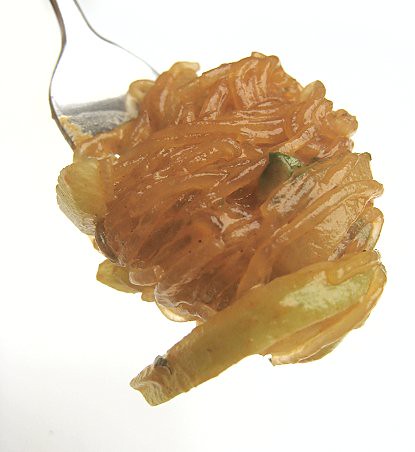
TS:
A while, while, while back, we had a party. Besides numerous other dishes (of course), we also cooked off 8 pounds of mussels à la Congolaise.
I don't exactly know how these flavors are Congolese. We had seen this descriptor on a local restaurant's menu for a dish cooked with tomatoes, coconut milk/cream, "smoky chili" and citrus.
Congolese? Really?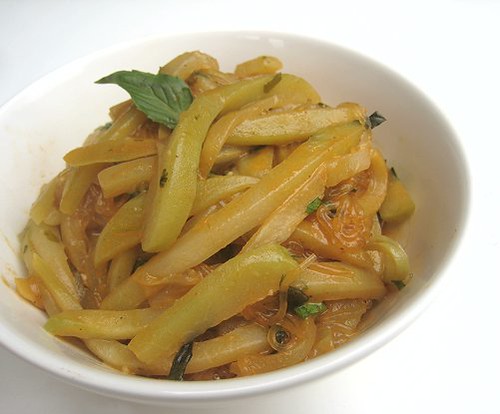
TS:
Congolese or not, the flavors work.
So, I sautéed some onions and garlic along with tomato paste until the tomato paste was nicely cooked.
I may or may not have added a little bit of smoked paprika as well.
Then, I poured in some white wine and after a little bit, coconut milk.
The 8 pounds of mussels jumped into the creamy pool.
When they were cooked, I finished the whole thing with just a little squeeze of lime juice, and a generous amount of cilantro.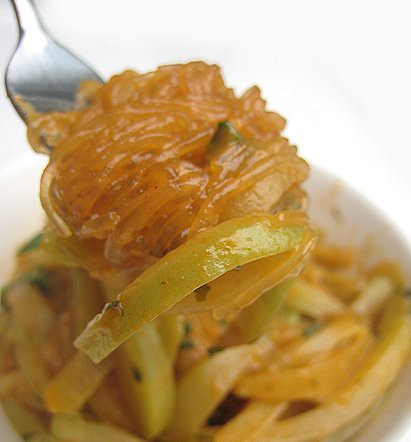
TS:
Why am I going on and on about mussels when this dish doesn't seem to have a mussel in sight?
After the guests had left, I noticed the serving bowl was devoid of mussels, but filled with the "Congolaise" sauce. As you may have already imagined, cooking 8 pounds of mussels will yield you quite a lot of exquisite mussel liqueur.
I couldn't waste that!
This was pure shellfish-y gold. It was so rich and flavorful that I had to christen it a "bisque".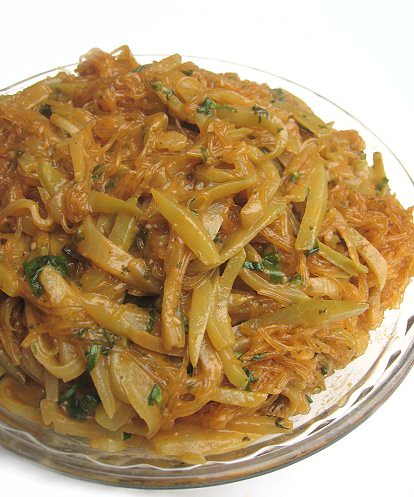
TS:
What to do? What to do?
Wanting to do something different with some chayote on our counter besides our usual, I got to thinking and set to work.
TS:
I brought the mussel-infused coconut-tomato "bisque" to a boil then a simmer, reducing it somewhat, then dumped in my peeled chayote batons.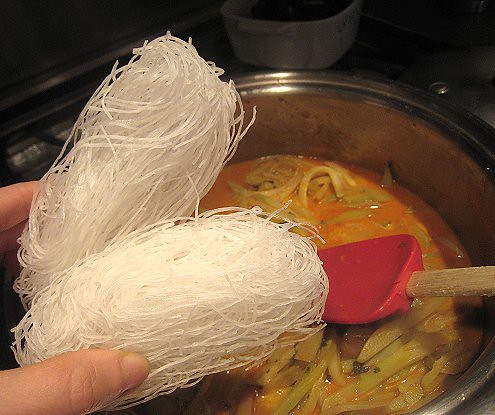
TS:
It seemed to me, though, that I still was not taking full advantage of the broth-y goodness in the pot.
Noodles! That's what this needs. Taking the path of least resistance, I opted for bean thread vermicelli. No pre-cooking required. I just placed them in the pot until they were cooked. A few minutes, tops.
TS:
With the bean thread vermicelli, this dish seemed to have taken a decidedly Asian turn.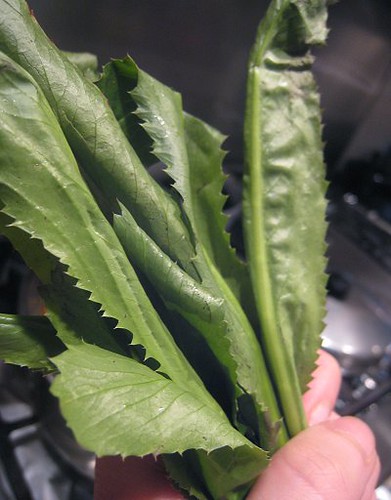
TS:
So, why not use up the rest of the culantro, aka saw-tooth herb, aka ngo gai, aka Mexican cilantro, that I still had leftover from making Pho Ga (Vietnamese Chicken Noodle Soup)?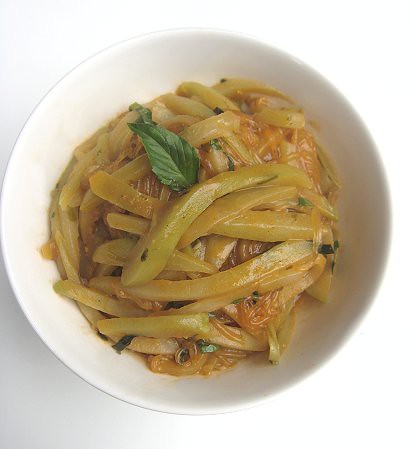
TS:
For a dish of dubious origins and muddled pedigree, this was absolutely mind-blowing!
The "bisque" was so rich and satisfying -- I do not know how that amount of liquid could have packed that much wallop of mussel-tomato-coconut flavor.
I love chayote and having it in this new, unusual way was a delight. The bean thread noodles absorbed all that bisque-y goodness and the culantro gave the dish a bright, verdant flavor.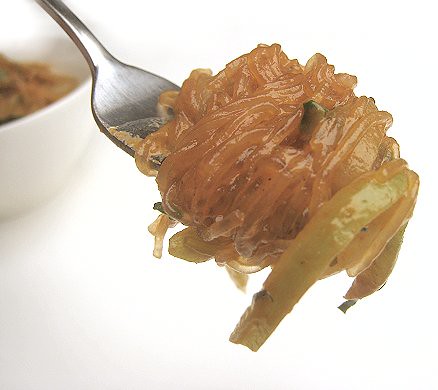
TS:
The moral of the story: next time you have mussel liqueur from 8 pounds of mussels, you know what to do. ;)
Enjoyed this post? Why not subscribe to our blog? Subscribe via reader or subscribe via email. Thank you! |
Friday, October 08, 2010
Sichuan "Crossed Hands" Wonton Dumplings 抄手, Two Ways (in Broth and with Chili Oil Sauce)

"Crossed Hands" Wonton Dumplings in Broth
JS:
I had some leftover wonton wrappers from our Smoked Salmon Rangoon escapades, so I decided to make use of them in another dumpling application.
Of course, I immediately had to top up my wonton wrappers and had to buy two extra packets, given that I was making dumplings for our family. Yes, we are a family of big eaters and I have a tendency to make too much food.
I've experimented with the Scarcity Principle a few years back for a couple of gatherings. We still implement it judiciously, on key occasions, but it seems like I can't quite use it when it comes to dumplings.
For this dumpling excursion, I bought 6 pounds of ground pork.
"Crossed Hands" Wonton Dumplings with Chili Oil Sauce
JS:
I also bought a couple of stewing chickens (called "old chicken" in Chinese) as I wanted to make a version of these "crossed hands/arms" dumplings in broth. Of course, I also had to make my personal favourite, dumplings swimming in Sichuan chili oil, topped with an explosion of ground roasted Sichuan peppercorns.
I looked at Fuschia Dunlop's "crossed hands" filling recipe and it is a straightforward one, just pork with seasonings (the usual suspects, soy sauce, Shaoxing wine, pepper).
All the better, since TS is not a big fan of the pork + cabbage combination (as seen in our post about CSC's Shanghai Potstickers and Faux Siu Mai) when it comes to meat fillings.
JS:
One concession I made to Fuchsia's recipe was making this "ginger water". I crushed some ginger and let it steep in cold water.
Then, it was a matter of mixing the meat with seasonings and pouring the ginger water slowly into the mixture to incorporate.
JS:
We filled these dumplings like tortellini: drop meat filling onto wrapper, fold into triangle, let two tips meet.
I assume the "crossed hands/arms" name comes from the way the wrapper tips come together in the middle like so.
Cooking the Dumplings
JS:
We boiled the dumplings in a pot of water and set them aside.
TS:
They look so brainy! Adorably brainy.
In Broth
JS:
I used the "old chicken" to make a broth, then simply ladled heated chicken broth over the dumplings.
Kinda plain Jane, isn't it?
To jazz it up, I'm thinking one can add some mushrooms (wood ear mushrooms would be nice for textural contrast, while shiitakes would add a deeper, woodsy flavour to everything), but we decided to eat them as is.
I suppose we could have also added some chopped green onions on top for extra flavour and color, but I was in a hurry to get to the chili oil version.
With Chili Oil Sauce
JS:
For my personal favourite, I roasted some Sichuan peppercorns in a dry pan until fragrant. Then, I ground them up, quite coarsely as you will see, but you can ground them up finer if you wish.
JS:
To make the chili oil sauce, I took some Red Chile Oil 紅油 (how to make red chile oil), added some chicken broth to thin it, added soy sauce or salt (or a combination of both), and some sugar to taste.
JS:
I also added some minced garlic into the mix. I used only red chile oil here, but one could mix in some Sichuan Peppercorn Chili Oil as well. One could even add some sesame paste here, which I'm going to do next time. (I forgot to do it here.)
JS:
Sprinkle some of the ground roasted Sichuan peppercorns and everything's all right with the world.
eatingclub Sichuan/Sichuan-inspired (Szechuan)
Red Chile Oil (紅油)
Sichuan Peppercorn Chili Oil
Spicy Sweet Sichuan Popcorn
Gong Bao ("Kung Pao") Chicken (宮保雞丁)
Eggplant Dandan Mian (擔擔麵)
Sichuan "Crossed Hands" Wonton Dumplings 抄手, Two Ways (in Broth and with Chili Oil Sauce)
Sichuan Ma Po Tofu (麻婆豆腐)
Water Boil Fish (水煮魚) or Water Boil Beef (水煮牛肉)
What a handsome pair of dumplings they make!
Enjoyed this post? Why not subscribe to our blog? Subscribe via reader or subscribe via email. Thank you! |
Recipe
"Crossed Hands" Wonton Dumplings (抄手)
filling & chili oil sauce recipes adapted from Fuchsia Dunlop's Land of Plenty: A Treasury of Authentic Sichuan Cooking

Serves 4 to 6
approximately 80 wonton wrappers
filling
4-inch piece ginger, unpeeled
1 pound finely ground pork
1 egg, beaten
2 teaspoons Shaoxing wine
2 teaspoons sesame oil
salt
white or black pepper
1/2 cup chicken stock
Make Filling
Crush the ginger with the flat side of a cleaver or heavy object and leave to soak for a few minutes in 1/2 cup cold water.
Place ground pork in a bowl and add the beaten egg, Shaoxing wine, ginger-soaking water (pieces discarded), sesame oil, salt and pepper. Mix well, using your hand to stir the stuffing in one direction, then add the stock in several stages, making sure each batch has been fully absorbed by the meat before you continue.
Fill and Shape wontons
For each wonton wrapper, drop a teaspoon or so of meat filling and fold the wrapper diagonally to form a triangle. You may need to moisten the edges to seal the wrapper. Then, take the right and left tips of the triangle and seal them together.
Lay the wrapped wontons out, separately, on a lightly-floured tray.
To Cook Wontons
Bring a generous pot of water to boil. In batches, drop in some dumplings into the boiling water and boil/simmer until dumplings are cooked through. Scoop out and drain. You may want to lightly toss cooked dumplings in oil to prevent sticking.
To serve in broth:
chicken or pork stock
sliced cooked mushrooms (optional)
chopped green onions (optional)
Heat chicken or pork stock. Add sliced mushrooms (if using) and cook until done. Keep broth hot. Place desired number of cooked dumplings in large serving bowl or in individual bowls and ladle hot stock (and mushrooms) over. Garnish with chopped green onions, if desired.
To serve in chili oil sauce:
1 part red chile oil
1 part light soy sauce
1 part white sugar
1 part stock
crushed garlic (optional)
Sichuan peppercorn chili oil (optional)
Sichuan peppercorns
In a dry pan, toast Sichuan peppercorns until fragrant. Grind coarsely.
In a bowl, mix together red chile oil, light soy sauce, sugar and stock. Add crushed garlic and Sichuan peppercorn chili oil to taste, if using.
Spoon sauce over cooked dumplings and top with ground Sichuan peppercorns.
Enjoy!
Subscribe to:
Posts (Atom)


