Showing posts with label Korean. Show all posts

Thursday, October 28, 2010

Korean Oxtail Soup (Gom Tang)


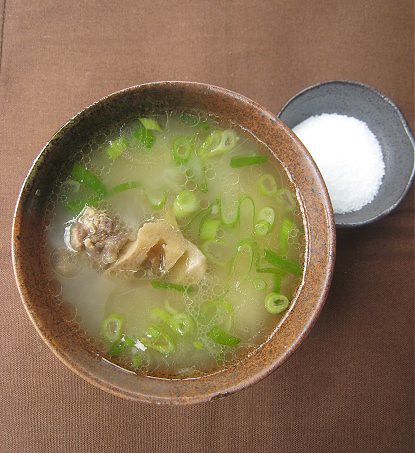
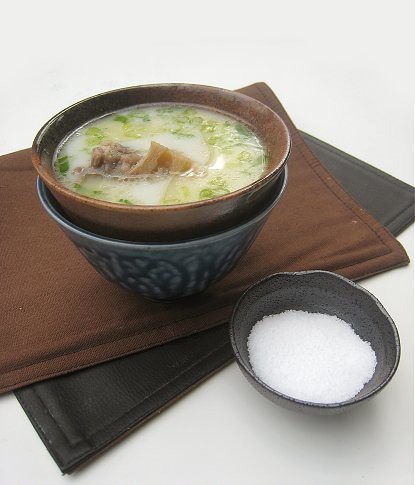
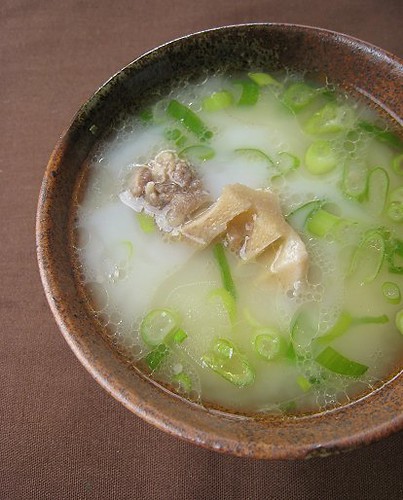
Korean Oxtail Soup, served with coarse salt.

TS:
We bought some oxtails one day. Now what?

We have used oxtail in applications that nod to Jamaica (Jamaican Oxtail Stew) and to Mexico (Shredded Beef and Tripe Tacos), but more often than not, we fall back to making our favorites, like a simple Clear Oxtail Soup, or Kare-Kare (Philippine Oxtail Peanut Stew) -- OMGTHEDELICIOUSNESS!!!

JS:
With oxtails, it is always the "Mendy's question".**

See, we're so enamoured with kare-kare and bulalo that we think them the apotheoses of oxtail, oxtail the best that it can be.

TS:
But, perhaps, this time we should made something totally new.

** Seinfeld reference


JS:
Okay then.

TS:
Well, we didn't venture too far when we made this Korean Oxtail Soup. I used the instructions from My Korean Cuisine as my guide.


TS:
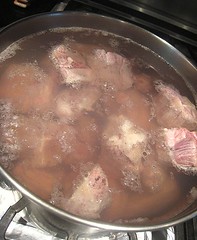
First, I placed the meat in cold water and brought the water to a boil. Once the exterior of the meat has changed color, I drained the pot.

After draining, the meat is rinsed to get rid of any residual coagulated blood.


TS:
I put the meat back into the pot (which I also rinsed out), covered with cold water, and brought the mixture to a boil. The pot is kept at a light boil.

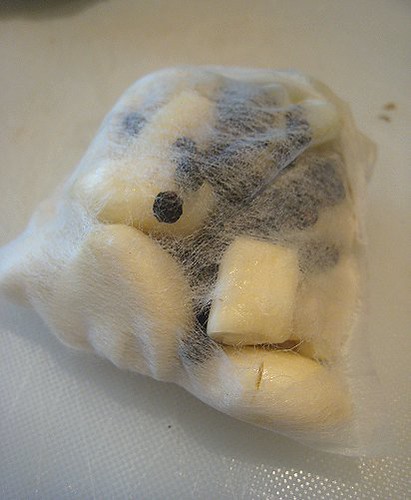
Oh, that pouch in there?


TS:
That pouch contained garlic, ginger, and black peppercorns.


TS:
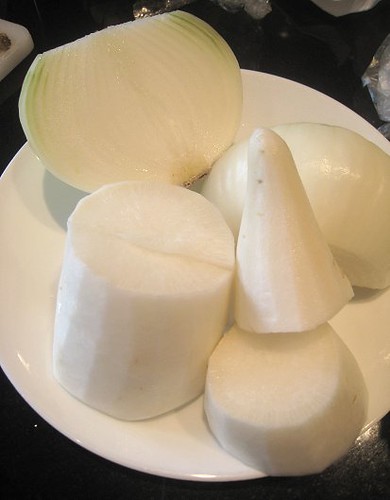
Some more components: onions and daikon radish.


TS:
After about 2 hours of boiling, I added the onions and daikon. Oh yeah, look at all that fat on top. Try to skim that off every so often.

I boiled the pot for a couple of hours more.

At this point, one can make the broth ultra-milky. My Korean Cuisine recommends removing all the solids from the soup, separating the meat from the bone, rinsing the bones clean and adding only the bones back into the pot, then boiling for more than 14 hours!

Well, I had already invested about 5 hours into this soup, and being lazy as I am, I wasn't in the mood for picking meat from bone, so my Korean Oxtail Soup stopped here.


TS:
This soup is usually served unseasoned, with the diner adding salt at the table. I simply added some green onions for some freshness and crunch.

JS:
I must say I cannot help comparing this soup to our standard bulalo (Philippine Beef Bone Soup) or clear soup. I found this oxtail soup quite rich -- and I'm afraid that is not exactly a compliment. That is, it seemed to me slightly too bovine-y, as if the oxtails haven't transcended their nature and reached their apotheosis as food. The soup sits heavily in the mouth and on the tongue, and I felt that I needed to rinse the soup out after I finished eating.

Maybe I needed to eat it with some kimchi, which alas, we didn't have at that time.

TS:
Perhaps I'll reserve judgment until after I taste a "professionally"-made soup. But, in this instance, this soup was nice enough, but I'm afraid my heart still belongs to our favorites.


For a guide to making Korean Oxtail Soup:
My Korean Cuisine: Korean Oxtail Soup

eatingclub vancouver Korean
Korean Sprouts & Spicy Cold Cucumber Salad
Kimchi Fried Rice, an addiction
Korean Soybean Sprouts Pancake (Kongnamul Jeon)
Korean Pork Bulgogi (with Muu Namul, Kong Namul)
Korean Roast Salmon
Korean Fried Chicken
Korean Sweet Potatoes with Yangnyeom Sauce
Japchae / Jap Chae (Korean Glass Noodles with Vegetables)
Brown Rice Bibimbap (Korean Rice Bowl)
Korean Oxtail Soup (Gom Tang)

Enjoyed this post? Why not subscribe to our blog? Subscribe via reader or subscribe via email. Thank you!

Tuesday, June 15, 2010

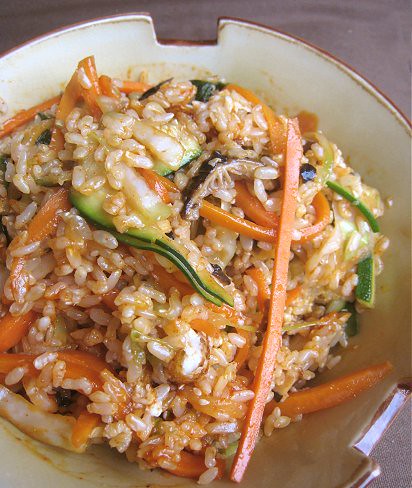
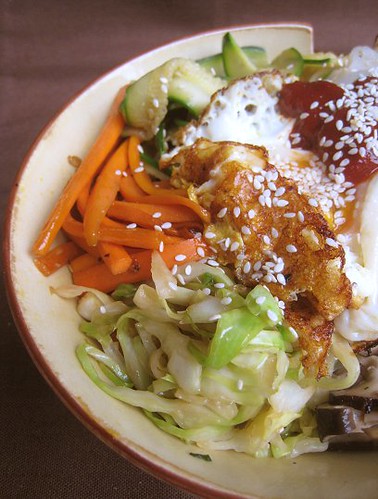
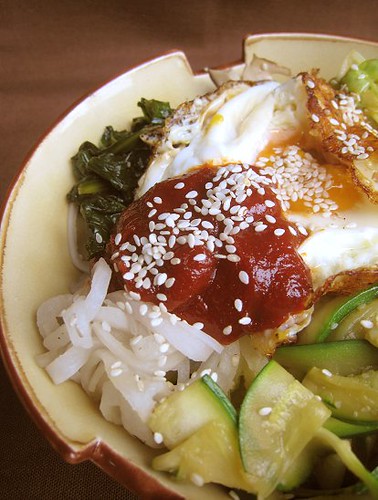
Brown Rice Bibimbap (Korean Rice Bowl)


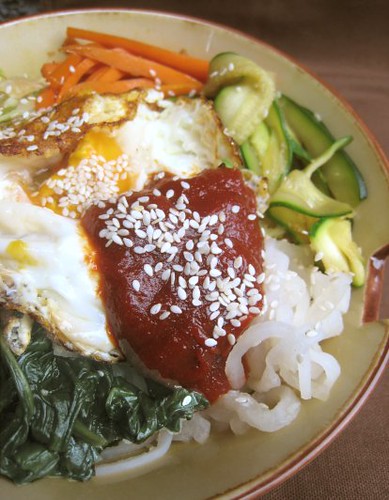
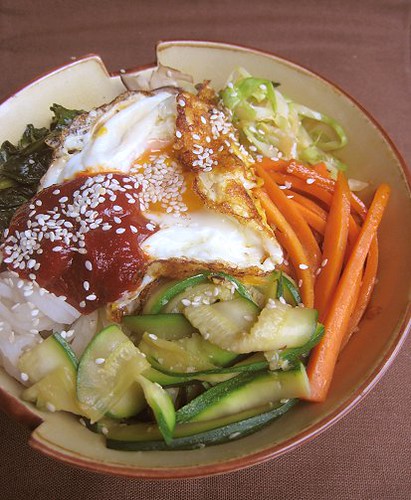
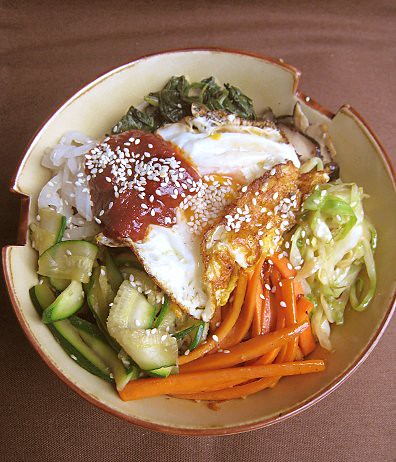
clockwise from top: daikon, spinach, mushrooms, cabbage, carrots, zucchini
center: fried egg, gochujang and sesame seeds
not visible: brown rice

JS:
About three or so months ago, TS and I decided to embark on a fitness journey, resolving to exercise more and eat healthier.

While we have no problems following the exercise regimen -- well, okay, okay, mumbles and grumbles are an everyday occurence at a certain time of the day, but it is doable -- eating the food prescribed by these fitness plans is another matter.

TS:
We did try, making things such as souvlaki with lean pork and chicken, or a quinoa lentil apple salad.

JS:
Less than a week into the prescribed eating plans, we were already bucking under the pressure, defying the meal plans with potato chip binges, can't-fit-into-your-mouth Mexican Torta Sandwiches, as well as several pork belly dishes (here and here), including a deliciously decadent
Gua Bao 刮包 ("Taiwanese Burger", or Pork Belly Buns) of our own.

TS:
Don't forget the Korean Fried Chicken and chili hotdogs! =D


JS:
We try (or is it "tried") to eat healthier, cooking up a batch of brown rice sometimes instead of white.

But really, come on, I don't understand how one fitness maven can tell me that whole wheat pasta tastes no different than white. "Don't even tell your family it's whole wheat pasta in your spaghetti: they won't know!"

Well. Seems to me that it's wishful thinking to think that there's no difference, or that people can't taste the difference, especially between white rice and brown rice.

TS:
I actually like brown rice! But, it's not a substitute for white.

JS:
Simply put, a lot of food tastes better on white rice than brown. There's no denying it.

Sometimes, one can fudge it, as is the case with this brown rice bibimbap.


TS:
Unfortunately, we don't own any of those Korean stone bowls, so ours is just regular bibimbap as opposed to dolsot bibimbap.

http://en.wikipedia.org/wiki/Bibimbap

We were too lazy to cook up beef or some such thing, so we used all vegetables in our version.

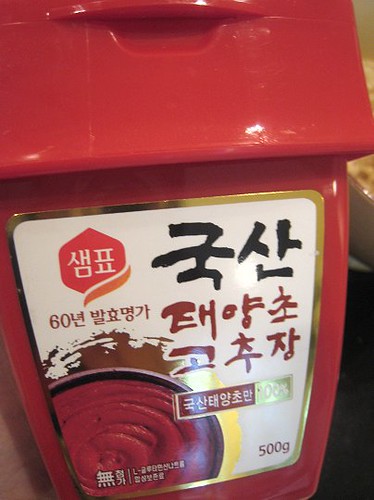
But first, the gochujang (Korean red pepper paste).


TS:
There it is. Just buy one from the supermarket and you're good to go.

http://en.wikipedia.org/wiki/Gochujang

Making the dish is simply a matter of cooking your different components/vegetables separately on the stove, seasoning with garlic, salt and sesame oil, and sometimes a touch of soy sauce.

I used various combinations of the above seasonings when cooking my vegetables.


TS:
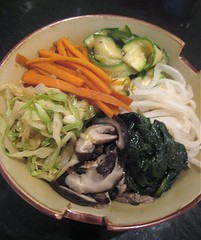
I have there tons of zucchini, carrots and daikon, some cabbage, and leftover spinach and mushrooms.


TS:
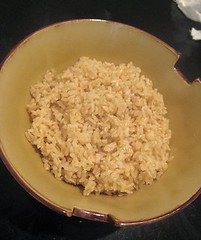
Brown rice in the bottom (cooked using a rice cooker), then the vegetables in neat little piles.

I was too lazy too fiddle around with eggshells (separating the egg yolk from the white), so I simply fried a whole egg and placed that on top.


TS:
Of course, one mustn't forget the gochujang paste. I sprinkled a bit of sesame seeds on top as well.

To eat, mix, mix mix!


JS:
It seems like we've found an application for brown rice where it's allowed to shine as itself, not as a substitute for its whiter sibling.

That's the key it seems to incorporating brown rice into our diet. Don't tell me there's no difference between brown and white because there is -- tell me to embrace the difference, as in "Vive le difference!"


JS:
In this bibimbap, the slightly grassy, very nutty flavours of brown rice complement the seasoned vegetables perfectly. The gochujang paste ties everything together.

I loved the toothy brown rice, the slightly tender, still-crunchy vegetables, and the soft ooze of the egg yolk in every bite. I'm getting hungry.

TS:
Love. Love. Love.


JS:
Now, if I eat the more than two servings of this bibimbap, does that still qualify as healthy? ;)


For a more detailed guide to making bibimbap:
Tasty Meals at Home: Tasty Dol Sot Bi Bim Bap

eatingclub vancouver Korean
Korean Sprouts & Spicy Cold Cucumber Salad
Kimchi Fried Rice, an addiction
Korean Soybean Sprouts Pancake (Kongnamul Jeon)
Korean Pork Bulgogi (with Muu Namul, Kong Namul)
Korean Roast Salmon
Korean Fried Chicken
Korean Sweet Potatoes with Yangnyeom Sauce
Japchae / Jap Chae (Korean Glass Noodles with Vegetables)
Brown Rice Bibimbap (Korean Rice Bowl)
Korean Oxtail Soup (Gom Tang)

Enjoyed this post? Why not subscribe to our blog? Subscribe via reader or subscribe via email. Thank you!

Sunday, April 25, 2010

Japchae / Jap Chae (Korean Glass Noodles with Vegetables)


JS:
I'm not a big fan of jap chae (also known as chop chae, job chae), but I always order it when we go to Korean restaurants, probably out of a sense of obligation. I feel like I should like jap chae, but in any case, even if I don't, I know my family members love this noodle dish enough to finish it without my help.

One fine day here in eatingclubvancouverland, my sense of obligation lined up with my desire to get a good deal. When I saw some sweet potato noodles (dangmyun/dangmyeon) on sale, marketed as "Korean traditional food," I thought I'd get them and try to make jap chae at home.

TS:
Well, unlike JS, I love jap chae! I was excited to cook some at home.


TS:
Jap chae can take on various ingredients. In our case, I had onions, carrots, mushrooms, spinach, bell peppers, mushrooms, green onions and garlic. We also had beef, so I added that as well.

To prepare the sweet potato starch noodles, I cooked them in boiling water until tender, then added soy sauce and sesame oil to taste. I also cut them with scissors at this point for ease of eating.

I followed the more "traditional" method of making jap chae by cooking each ingredient separately, seasoning each with a bit of soy sauce and sesame oil, then tossing everything together with the boiled glass noodles.

I added a bit of sugar (or use honey), made a quick adjustment of the seasonings (soy sauce and sesame oil) and the dish was good to go.

Since I am pretty lazy, next time I am going to cook the non-noodle ingredients all at once, adding them to one pan in the order of longest to shortest cooking time.


JS:
Still not a fan -- that is, I probably wouldn't choose to eat jap chae if there are other dishes to have -- but I can see the appeal of it. I'm thinking food preferences must be one of those things, eh? Either you like it or you don't: no harm, no foul, no judgments.

TS:
Let me be the one to "flame" JS, then. FLAME! FLAME! FLAME!

I love jap chae. =)


Scroll down for recipes.

Enjoyed this post? Why not subscribe to our blog? Subscribe via reader or subscribe via email. Thank you!

Recipes
Maangchi: Japchae (stirfried noodle with vegetables)
Tasty Meals at Home: Tasty Jap Chae
Kits Chow: Stir-fried noodles with vegetables, Chap Jae
Steamy Kitchen: Korean Glass Noodles -- Jap Chae / Chap Chae
Dr. Ben Kim: How to Make Jap Chae

eatingclub vancouver Korean
Korean Sprouts & Spicy Cold Cucumber Salad
Kimchi Fried Rice, an addiction
Korean Soybean Sprouts Pancake (Kongnamul Jeon)
Korean Pork Bulgogi (with Muu Namul, Kong Namul)
Korean Roast Salmon
Korean Fried Chicken
Korean Sweet Potatoes with Yangnyeom Sauce
Japchae / Jap Chae (Korean Glass Noodles with Vegetables)
Brown Rice Bibimbap (Korean Rice Bowl)
Korean Oxtail Soup (Gom Tang)

Friday, April 16, 2010

Korean Sweet Potatoes with Yangnyeom Sauce


[ts]
We still had some Yangnyeom Sauce leftover from our Korean Fried Chicken, so we thought to glaze some sweet potatoes.

Simply cook some peeled and cut sweet potatoes -- we steamed ours, but one can easily roast or boil them -- and then toss in Yangnyeom Sauce.


[ts]
This was finger-lickin' good -- that is, if you were like me and just grabbed a piece with your fingers every time you passed by the bowl.

In fact, JS liked the sauce better on the sweet potatoes than on the fried chicken! We definitely didn't make enough, having cooked only five sweet potatoes.


For Yangnyeom Sauce recipe, visit the ZenKimchi: Korean Food Journal post:
The Great Korean Fried Chicken Recipe (Experiment)


Enjoyed this post? Why not subscribe to our blog? Subscribe via reader or subscribe via email. Thank you!

eatingclub vancouver Korean
Korean Sprouts & Spicy Cold Cucumber Salad
Kimchi Fried Rice, an addiction
Korean Soybean Sprouts Pancake (Kongnamul Jeon)
Korean Pork Bulgogi (with Muu Namul, Kong Namul)
Korean Roast Salmon
Korean Fried Chicken
Korean Sweet Potatoes with Yangnyeom Sauce
Japchae / Jap Chae (Korean Glass Noodles with Vegetables)
Brown Rice Bibimbap (Korean Rice Bowl)
Korean Oxtail Soup (Gom Tang)

Thursday, April 15, 2010

Korean Fried Chicken


[js]
Some people in our household, me included, are fried chicken fiends. Give us a bucket of fried chicken and we're all happy campers.

We don't fry chicken that often in our house and it seems that the choices for good fried chicken in this town are becoming more and more limited. Of course, this fact that fried chicken are rare birds that alight our tables probably explains the gusto with which we dig into them.

Recently, our favourite has been Thai Fried Chicken. The scent of the oyster sauce, fish sauce, garlic and cilantro while the chicken pieces are frying is enough to bring a horde to the kitchen fingers itching to grab the next piece.

When I brought home some drumsticks the other day, though, I toyed with the idea of being unfaithful to our current love. Maybe it was time to bring another fried chicken dish into our lives. . .

It is spring, after all, and in the spring this young woman's fancy (okay, not so young!) lightly turns to thoughts of love.

I've been hearing and reading so much about Korean fried chicken for the past couple of years, that maybe, maybe, maybe it is time to fall in love with Korean fried chicken.


[js]
When we went to New Year last summer, I had written down a list of Korean fried chicken places to try. Unfortunately, we didn't have enough time (4 days) and stomach space (see our previous posts) to partake of the other "KFC".

When we went to LA last fall -- well, you already know what happened on that trip: we had to shorten our entire trip because of the eye injury, hence the disappointment.

But, just to show you how dedicated we are, we did manage to snag a sample of Korean fried chicken at Kyochon on that Thursday night, the night before the day we had to fly back to Vancouver.

I don't recall myself going ga-ga over the Kyochon fried chicken. Perhaps it was the circumstances of the meal, perhaps it was an off-day for them, but I thought, while the coating was spicy and flavourful enough, the chicken itself had no taste at all.

I don't know if TS concurs with my opinion or if she even saw the fried chicken that she ate that night!


[js]
Because of the non-flavourful chicken, I decided to marinate my chicken overnight before the actual cooking. I combined some soy sauce, sesame oil, green onions, garlic, cider vinegar, brown sugar and grated apple (didn't have pears). Into this marinade went the chicken drumsticks.

[ts]
We coated the chicken with cornstarch before frying. Afterwards, I tossed them in that startlingly red Yangnyeom Sauce, the sauce that seems to define Korean fried chicken in North America. It's made with gochujang, corn syrup, garlic, sesame oil, and a touch of soy sauce and vinegar.


[js]
Am I in love?

No, not really. As with Kyochon, I'm not ga-ga over this version of Korean fried chicken. All I seem to taste in this fried chicken is the sweet-ish heaviness of the gochujang paste. While good, especially when paired with the crispy, crunchy skin, I found I needed more dimensions to keep my palate interested.

Please note that the above is a personal opinion. Please do not write or flame me about my personal opinion. On Korean fried chicken -- at least, Kyochon and this version -- we just have to agree to disagree.

[ts]
I made the Yangnyeom sauce using the recipe from the fantastic Korean Fried Chicken post at ZenKimchi. The post concentrates on the different seasoning and coatings for the fried chicken, so perhaps it is those two aspects of Korean fried chicken that we should concentrate on.

The Yangnyeom sauce should be a supporting player instead of the star.

Speaking of which, I liked the Yangnyeom-glazed fried chicken more than JS. I do love my gochujang, after all. Add some sweetness, some garlic (which you know I love), some sesame oil, and I'm a happy camper.

[js]
Fair enough.

As I said, please do not flame me about my current indifference to Korean fried chicken. My two dalliances with it have not touched my heart. However, I am very open to the possibility. Maybe I just need to keep trying more versions of Korean fried chicken or keep tweaking with this recipe to find The One. ;)

We're pencilling Korean Fried Chicken again for another run. Stay tuned.

In the meeantime, this is what else we used Yangnyeom sauce for.


Get the recipes from ZenKimchi: Korean Food Journal
The Great Korean Fried Chicken Recipe (Experiment)

Enjoyed this post? Why not subscribe to our blog? Subscribe via reader or subscribe via email. Thank you!

eatingclub vancouver Korean
Korean Sprouts & Spicy Cold Cucumber Salad
Kimchi Fried Rice, an addiction
Korean Soybean Sprouts Pancake (Kongnamul Jeon)
Korean Pork Bulgogi (with Muu Namul, Kong Namul)
Korean Roast Salmon
Korean Fried Chicken
Korean Sweet Potatoes with Yangnyeom Sauce
Japchae / Jap Chae (Korean Glass Noodles with Vegetables)
Brown Rice Bibimbap (Korean Rice Bowl)
Korean Oxtail Soup (Gom Tang)

Monday, August 31, 2009

Korean Roast Salmon


[js]
I had bookmarked a page describing a recipe for Korean roasted fish and had wanted to try making it for the longest time.

The recipe calls for a small-ish white-fleshed fish, something like a bass, but everytime I try to make it, the pickings at my usual Asian grocery seemed pretty thin for a white-fleshed fish. I did not want to do this recipe with tilapia, which had going for it its size, which seemed to me the proper size for this recipe.


[js]
One day, I saw a whole sockeye salmon shopping at Costco and decided to get it. I have a weakness for sockeye salmon: it is my favourite type. Seeing it whole (albeit without the head, unfortunately) always gets my heart a-pitter-patter.

Reading over the recipe again, I felt that the boldness of the sauce would go extremely well with the boldness of the sockeye salmon.


[js]
I started by chopping up green onions and mincing garlic and ginger. I added double the garlic in the recipe as I happen to love garlic.

We had some Korean red pepper paste (gochujang) in the fridge and I used that instead of the sambal oelek in the recipe. To compensate, I added a couple teaspoons of white vinegar as the Korean red pepper paste has a thicker, more viscous, deeper flavour than sambal oelek.

Everything else goes into the bowl to be mixed together: Korean coarse red pepper flakes, soy sauce, brown sugar, lemon juice and sesame oil.

One final taste of the sauce to check -- taste! as this is going to be the flavour of the sauce when cooked -- and I started slathering on the sauce on the fish.


pre-oven & post-oven

[js]
I put the fish on a rack as I didn't want it to swim in the sauce. I roasted the fish in an oven for about 40 minutes until slightly underdone as it had about 5-8 minutes to go under the broiler.


We served this with rice, green lettuce leaves, and kimchi.


[js]
This was delicious!

I loved the sweet, mildly spicy, savoury combo of the sauce and it was indeed an exceptional pairing with the flavour of the sockeye salmon. I would have preferred the sauce to be even spicier, and next time I make it, I would probably add a couple of jalapeño peppers for that sprightly spicy greenness.

A perfect bite would have the sauce, with some charring from the broiler, the skin, preferably crispy, and the juicy, moist flesh of the fish.


eatingclub vancouver Korean
Korean Sprouts & Spicy Cold Cucumber Salad
Kimchi Fried Rice, an addiction
Korean Soybean Sprouts Pancake (Kongnamul Jeon)
Korean Pork Bulgogi (with Muu Namul, Kong Namul)
Korean Roast Salmon
Korean Fried Chicken
Korean Sweet Potatoes with Yangnyeom Sauce
Japchae / Jap Chae (Korean Glass Noodles with Vegetables)
Brown Rice Bibimbap (Korean Rice Bowl)
Korean Oxtail Soup (Gom Tang)

Enjoyed this post? Why not subscribe to our blog? Subscribe via reader or subscribe via email. Thank you!


Recipe
Korean Roast Sockeye Salmon
adapted from
http://www.npr.org/templates/story/story.php?storyId=101987037

4 tbsp Korean coarse red pepper flakses
2 tbsp Gochujang (Korean red pepper paste)
4 tbsp minced garlic
2 tsp minced fresh ginger
2 tbsp soy sauce
2 tbsp light brown sugar
2 tsp lemon juice
4 tsp white vinegar
6 stalks green onions, chopped
2 tbsp sesame oil

6 to 8 lbs whole salmon
(or, use fillets or steaks)

Combine all ingredients into a bowl and mix together.

Pat the fish dry. If desired, cut 3 slits into the flesh of the fish across the length of the fish. Place the fish on a rack and slather on the sauce on both sides of the fish. Reserve some for glazing at the end.

Roast in the oven for 35 minutes at 375 degrees until slightly underdone. Glaze the fish with the half of the remaining sauce. Turn on broiler and broil for 5 to 8 minutes until slightly charred on the edges. Flip the fish over and glaze with the remainder of the sauce. Broil for 5 to 8 minutes on this side.

Serve with rice, lettuce, and kimchi.

Monday, June 15, 2009

Korean Spicy Pork Bulgogi (with Muu Namul and Kong Namul)


[js]
On the day I went home with a pork loin roast, I had no idea what to do with it. Normally I wouldn't pick up such a big hunk of pig, and I wasn't drunk or anything like that, but sometimes, its nice pink roundness can be enticing.


the roast cut in half, to fit on the cutting board

[js]
I had done straight pork roasts before, but it always seemed like we end up with more meat than when we started. It didn't matter what kind of flavours I bathe the roast in and baste on it -- it really was all over except for the leftovers.

Maybe there is something to the Confucian dictum that all food must be served to the table already bite-sized. Supposedly, eating smaller pieces of food promotes geniality and civility among people, them not needing to brandish knives and other sharp implements to cut up food.

Sliced Pork


[js]
I asked TS to slice the roast into thin slices and seeing the meat fanned out beautifully like that made me think of spicy pork bulgogi.

At first, I only had half of the roast cut into slices. But they looked so pretty that I asked TS to slice up the rest of it.

[ts]
Funny story. Mama came around while I was slicing the pork and said something to the effect of, "Oh, they're so pretty. I like!"

I guess we are the type of people who find things like this attractive. JS was correct about the pork's enticing "nice pink roundness"!

We ended up with seven pounds of sliced pork.

The Marinade


[js]
I proceeded to cut up some green onions, onions, garlic, apple for my marinade. These will go with soy sauce, sesame oil, brown sugar, some apple cider vinegar, and Korean red pepper paste.
Seeing the blender already out, I made a mistake of grabbing it instead of the food processor so my marinade was smoother than I had hoped. I added Korean red pepper flakes, as well as carrots and more green onions and onions to the pork after adding it my marinade.

The pork slices were marinated overnight in the fridge.

Grilling

bulgogi on top; gatecrashing Philippine pork "BBQ" on the bottom

[js]
On the day we were supposed to have our spicy pork bulgogi Korean barbecue, as you can see, some Philippine pork barbecue skewers gatecrashed the party!


The Gatecrashers

Somebody in our family threw a semi-hissy fit because of a request for Philippine pork barbecue skewers being unheeded for more than a week now.

To remedy the situation, we had to buy more meat, buy an electric slicer(!), then fast-tracked the whole thing to make the Philippine pork barbecue skewers in time for dinner.
Grilled Version


[js]
It was just as well, because I needed to finetune my spicy pork bulgogi a tad. I mean, the whole thing was okay but not as spicy as I would have liked. Also, the pork loin was a bit too lean for my taste. Pork shoulder would have been my preferred cut of meat for this one. I lacked the proper tools and implements to grill my spicy pork bulgogi: some of the pieces kept falling through the grates.

Our grilled version seemed less "saucy" than other bulgogi I've seen.

Pan-fried Version


[js]
And of course, everybody just kept going for the Philippine pork barbecue skewers!

I couldn't focus on the bulgogi because people were demanding more and more skewers. I finally decided to just char some of the pieces on the grill and have TS pan-fry the rest of the bulgogi so I can concentrate on the skewers.

The pan-fried version seemed "saucier", perhaps since the juices collected in the pan instead of falling through the grates of the grill.

So please consider the recipe below Spicy Pork Bulgogi Version 1, which is not bad at all (it was quite good), and it will be perfected sometime in the near future.

Muu Namul


[ts]
We couldn't very well have Korean food without at least a couple of banchan. Since we had daikon in the fridge, we decided to make use of it.

I actually wanted thin julienne of daikon radish, but I was too lazy to slice it up by hand, so I decided to use the grater attachment in the food processor.

Mistake!

As you can see, these really did look like grated radish, not at all like nice thin strips.

A lesson for the kiddies: always use the right tool for the job, even if the right tool is a knife and your own hard work!

I simply cooked the julienned grated radish with some garlic (see the big hunk of grated garlic), sesame oil, salt & pepper, a touch of sugar (for balance), and a generous sprinkling of sesame seeds. I garnished with some Korean red pepper flakes.

Kong Namul


[ts]
This dish has turned out to be a family favorite and we've made it numerous times. (Previous blog post about kongnamul here.)

The Meal


[ts]
We ate our pork bulgogi with a bit of plain rice, wrapped with a piece of romaine lettuce. It was accompanied by muu namul and kong namul.

[js]
I think it would be more correct to say that we ate our pork bulgogi with a few skewers of Philippine pork barbecue on the side. ;)


[js]
The recipe below reflects my desire to have the pork bulgogi more juicy and more spicy. I've also scaled down the recipe to reflect a smaller portion of pork.

eatingclub vancouver Korean
Korean Sprouts & Spicy Cold Cucumber Salad
Kimchi Fried Rice, an addiction
Korean Soybean Sprouts Pancake (Kongnamul Jeon)
Korean Pork Bulgogi (with Muu Namul, Kong Namul)
Korean Roast Salmon
Korean Fried Chicken
Korean Sweet Potatoes with Yangnyeom Sauce
Japchae / Jap Chae (Korean Glass Noodles with Vegetables)
Brown Rice Bibimbap (Korean Rice Bowl)
Korean Oxtail Soup (Gom Tang)

Enjoyed this post? Why not subscribe to our blog? Subscribe via reader or subscribe via email. Thank you!

Blazing Hot WokWe're submitting this to Regional Recipes, a blogging event created by Blazing Hot Wok that celebrates food from all over the world.

The region for this edition is Korea. The round-up will be hosted by Wandering Chopsticks and will be posted around June 20.

Regional Recipes information

Our Regional Recipes posts:
Greek Meatball Soup (Giouvarlakia)
Simmered Saba Mackerel with Daikon Radish (Saba Oroshi-ni)
Thai Fried Chicken
Roast Pork Belly with Puy Lentils
Beef "Ribbon" Kebab (Pasanda Kabab) with Cilantro Chutney
Canadian Onion Soup with Oka Cheese
Muffuletta
Börek with Beef Filling
Korean Pork Bulgogi (with Muu Namul, Kong Namul)
Lobster Congee from a Lobster Feast
Pork Jowl (Pork Cheeks) with Brown Sugar Rub
Beef Salpicao
Cuban Arroz con Salchichas (Yellow Rice with Vienna Sausages)
Cuban Pastelitos de Guayaba y Queso (Guava and Cheese Pastries)
Vietnamese Spring Roll (Cha Gio)
Grilled Fish Fillet on Oregano
Pastéli (Greek Sesame Snaps)

Recipes
Spicy Pork Bulgogi, v. 1
Serves 8 t0 10

2-3 pounds pork shoulder, sliced thinly

Marinade
6 stalks green onion, minced
6 cloves garlic, minced
1 apple (or Asian pear), grated
1/4 cup soy sauce
1/4 cup brown sugar or honey
4 tbsp apple cider vinegar
2 tbsp sesame oil
1 tsp black pepper
3 tbsp Korean red pepper paste
3 tbsp Korean pepper flakes (or more, depending on how spicy you like)

optional
1 medium onion
3 stalks green onions
1 carrot

Mix marinade ingredients together and pour over slices of pork. Let sit in fridge for 4 hours or overnight.

Optional ingredients:
If desired, cut up one onion into slices, 3 stalks of green onions, one carrot into strips to mix in with the pork. You can cook these with the pork on the grill for extra flavour and fragrance.

Grill or pan-fry pork slices until done. Serve with plain white rice and lettuce leaves.


Muu Namul (Korean Radish)
Serves 8 to 10, as a side dish

1 medium-large daikon radish
1-2 tablespoons sesame oil
1-2 tablespoons sesame seeds
4 garlic cloves, grated/minced
1/2 teaspoon sugar, or to taste
salt and pepper

Cut daikon into thin slices, or into matchstick-sized sticks.

Heat sesame oil in pan. Stir-fru radish pieces over medium heat until softened slightly. Add in the rest of the ingredients and cook for another minute. Serve at room temperature as a side dish in a Korean meal.

LinkWithin Related Stories Widget for Blogs