Showing posts with label Spanish. Show all posts

Tuesday, April 06, 2010

Slow-Roast Pork Shoulder, Two Ways


[ts]
Sometime ago, JS and I chanced upon a couple of pork shoulder sales. Of course, the easiest way to whip something up is to slow-roast them.

Version 1: Spanish


[ts]
The first sale was early in the new year, so we took the opportunity to use up our leftover ingredients from our New Year's Eve Spanish menu. I combined leftover sofrito from our fideuá (Spanish Seafood Noodle "Paella") and leftover gremolata from our cocido (Spanish Pork Stew).

We scored the pork skin before rubbing in the marinade. So, from the sofrito, there's cooked-down bell peppers, onions, garlic and tomatoes, flavored with smoked paprika and bay leaves. From the gremolata, we have parsley, cilantro, capers, garlic and zest from oranges and lemons. We also lay some orange slices at the bottom of the pork.


[ts]
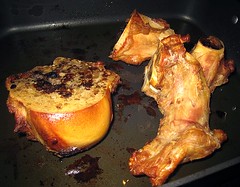
There's our Spanish Pork Shoulder, out of the oven.


Version 2: Cuban


[ts]
The other time we bought pork shoulder, we decided to go Cuban.


[ts]
I melted some guava paste (last seen when we made our Cuban Guava and Cheese Pastries), and mixed that into a marinade of citrus juices (orange, lemon and lime), chopped garlic, cumin, dry oregano, bay leaves, and a tiny splash of vinegar.


[ts]
As with the previous dish, we scored the pork skin before bathing the shoulders in the marinade.


[ts]
Cuban Pork Shoulder, oven-ready.


[ts]
These are just two ways with pork shoulder. I'm sure that you can slather anything onto pork shoulders, slow-roast them, and the result will always be fabulous, succulent meat.

In fact, our Cuban pork shoulders were accidentally placed in a hot oven (as opposed to one with low heat), and the result was still good. Not ideal, but edible. So, we devised the perfect way to use up this less-than-ideal pork. Stay tuned.

[update]
Our roast pork shoulder is put to good use in a Torta (Mexican Sandwich)!


[eatingclub] Cuban
Cuban Pastelitos de Guayaba y Queso (Guava and Cheese Pastries)
Grilled Cuban Chicken
Cuban Arroz con Salchichas (Yellow Rice with Vienna Sausages)
Slow-Roast Pork Shoulder, Two Ways

[eatingclub] Spanish
Tortilla de Patatas (Spanish "Omelette")
Roast Duck and Orange Crêpes with Orange-White Wine Sauce
Sardinas na Bangus (Milkfish in the style of Sardines)
Red Wine-braised Squid with Potatoes and Chorizo
Philippine Beef Salpicao (and a Spanish variation)
Stewed Tripe, Spanish-style
Lengua Estofada (Beef Tongue Braised in Red Wine and Veal Stock)
Bacalao con Patatas (Baked Salt Cod and Potatoes)
Salsa Romesco ("Queen of the Catalan Sauces!")
Grilled Calçots (Green Onions) with Salsa Romesco
Empanada de Pavo
(Galician-style Meat Pie with Turkey Filling), plus Turkey Cracklings!

Fideuá (Spanish Seafood Noodle "Paella")... and Paella
Cocido (Spanish Stew with Various Pork Cuts)
Slow-Roast Pork Shoulder, Two Ways

Enjoyed this post? Why not subscribe to our blog? Subscribe via reader or subscribe via email. Thank you!

Recipe
Cuban Pork Shoulder

1 pork shoulder, approx 4-5 pounds

marinade
1 head garlic, cloves chopped
1 orange, zested and juiced

2 limes, zested and juiced

1 lemon, zested and juiced
1 tablespoon dry oregano
1 bay leaf
1 tablespoon ground cumin
1/2 cup olive oil

2 tablespoons vinegar
1/2 cup guava paste, softened/melted in the microwave
1 tablespoon coarse salt
1 tablespoon black pepper

Score skin of pork shoulder. Combine all marinade ingredients and pour over/rub into pork shoulder. Marinate overnight to 2 days.


Preheat oven to 250F. Roast pork shoulder in marinade for about 3-4 hours. Enjoy!

Sunday, March 14, 2010

Cocido (Spanish Stew with Various Pork Cuts)

Warning:
Gratuitous use of various PORK PRODUCTS in this post. Reader discretion is advised.


Huge pot o' pork

[js]
We wanted another meat dish for our New Year's Eve party to complement the lengua estofada, but we wanted something that was relatively hassle-free to prepare.

And we wanted a dish with pig's feet.


browned pig's foot

[js]
For some reason, we've decided to go offal-intensive with our Spanish-inspired menu, probably because we've been consulting the Culinaria Spain book and they do have a lot of offal dishes in there.

I wasn't sure how our offal dishes were going to be received by our guests.

It was a gamble with something so undisguisable as pig's feet -- but I figure the cocido (stew) we envisioned would have other meats beside the feet to make it more palatable to our other guests.

[ts]
Here's our version of cocido:
A hearty stew with pork shoulder & shank, pig's feet, smoked ham hock, chorizo, morcilla sausage, cabbage and garbanzo beans. Served with a "gremolata" of parsley, capers, garlic, and orange & lemon zests.

Veal & Turkey Stocks


[js]
The day before cooking, I roasted off a turkey carcass and some veal bones, then made stock.


[ts]
Our turkey stock and veal stock were ready for next day's action.

Garbanzo Beans (Chickpeas), Soaking


[js]
Also on the same day, I started to soak some dried chickpeas in some water.

Day of Cooking

pots simmering away

[js]
To make the cocido, I first fried off some pieces of bacon.


blurry bacon browning

[js]
I then used some of the fat rendered from the bacon to brown off my pork shoulder and shank pieces...


pork shoulder & shank

[js]
...and pig's feet.


pig's feet pieces

[js]
I must say, while I was browning off the pigs feet, I was hit with such an intoxicating fragrance that I wanted to gobble them up then and there!


[js]
I had dusted some salt and smoked paprika on the pigs feet, and when they hit the oil...

WOWZO!

I managed to hold it together to continue on making the dish. I set the browned pork shoulder and pig's feet pieces aside, putting them into a pot for now.


huge pot with browned pork pieces


[ts]
After browning, the onions went into the pot with the good bits of crusted-on pig at the bottom. Garlic went in next.


[js]
I deglazed with a cup of white wine, and then added some turkey and/or veal stock. The browned off pig pieces went back into the pot.


brimming

[ts]
Or, more accurately, we poured the deglazed onions and liquid into the big pot o' pork.

Smoked Ham Hock

smoked ham hock

[ts]
We also threw in a smoked ham hock into our cocido, by the way, for smoky porky goodness.

BACON + PORK SHOULDER + PIG'S FEET + SMOKED HAM HOCK.

Can it get any porkier?


Two big pots o' pork.

[ts]
At first I thought we could get by with cooking the big pot o' pork as is -- ambitious, I know -- but a little boil-over told me that we had to separate the lot into two pots.

Chorizo and Morcilla Sausages


chorizo

[ts]
While the two big pots o' pork were simmering away, we prepared the other ingredients for the cocido. We fried up some chorizo...


left: chorizo; right: morcilla

[ts]
...and some morcilla (blood) sausages.

We had to look for these sausages as they were a little hard to find. We finally found some at Universal Bakery, a Portuguese establishment, where we also bought a Pudim Flan.

http://en.wikipedia.org/wiki/Morcilla
http://foodosophy.wordpress.com/2009/11/16/universal-bakery-vancouver-bc/

We sliced up the morcilla as well and pan-fried them, but they were very soft. Do people usually just eat them whole?

BACON + PORK SHOULDER + PIG'S FEET + SMOKED HAM HOCK + CHORIZO SAUSAGE.

Porkier!

Garbanzo Beans (Chickpeas) and Cabbage


[ts]
We stole some of the braising/stewing liquid from the cocido and cooked the chickpeas in there.


[ts]
We did the same for the cabbage, cooking them in the braising/stewing liquid as well. We layered the cabbage and chickpeas in our serving trays. (Yes, plural!)

"Gremolata"
[ts]
As our cocido was quite rich and hearty, we decided to add a high, bright note to the dish with a "gremolata".

We mixed together parsley, capers, garlic, and orange & lemon zests and served that with the cocido.

Finished Product

Our Spanish New Year's Eve Buffet

[ts]
For each serving tray, we layered the cabbage and chickpeas, then grouped together the pork shoulder & shank pieces, then the pig's feet.

We also placed the pan-fried chorizo and morcilla sausages in individual piles. We poured the broth over, then sprinkled everything with the gremolata.

Unfortunately, it was too dark to take photographs of the dish when it was finished. We cooked this the night before.

On the day of the party, I was too busy to take a picture of the trays during the daytime. By the time the party started, it was once again too dark for decent photographs!

So, if one looks at the photo, our cocido is the dish at the bottom left corner.

Here's that photo above, with labels.


[js]
I need not have worried about the pig's feet -- the pig's feet were the first to go!

In fact, we could have done it with all pig's feet and no pork shoulder, as the pig's feet were really spectacular in this dish.

I don't eat and cook pig's feet at all but I did try this dish and I was blown away by the pig's feet. They really are great!

There's meat, there's the gelatinous skin, there's good sucking on the little bony cartilage bits: eating pig's feet is quite similar to eating chicken feet.

[ts]
The broth was rich and quite heavenly. It was great slurping it down with tender pieces of cabbage, which lent their sweetness to the whole dish while at the same time were flavored with all the porky goodness. The chickpeas were also very flavorful, having bathed in that porky goodness.

The cocido was fantastic!

See the rest of our Spanish-themed New Year's Eve Menu here.

[eatingclub] Spanish
Tortilla de Patatas (Spanish "Omelette")
Roast Duck and Orange Crêpes with Orange-White Wine Sauce
Sardinas na Bangus (Milkfish in the style of Sardines)
Red Wine-braised Squid with Potatoes and Chorizo
Philippine Beef Salpicao (and a Spanish variation)
Stewed Tripe, Spanish-style
Lengua Estofada (Beef Tongue Braised in Red Wine and Veal Stock)
Bacalao con Patatas (Baked Salt Cod and Potatoes)
Salsa Romesco ("Queen of the Catalan Sauces!")
Grilled Calçots (Green Onions) with Salsa Romesco
Empanada de Pavo
(Galician-style Meat Pie with Turkey Filling), plus Turkey Cracklings!

Fideuá (Spanish Seafood Noodle "Paella")... and Paella
Cocido (Spanish Stew with Various Pork Cuts)
Slow-Roast Pork Shoulder, Two Ways

Enjoyed this post? Why not subscribe to our blog? Subscribe via reader or subscribe via email. Thank you!

Recipe
Cocido (Spanish Stew with Various Pork Cuts)
(scaled down version)

4 pieces bacon, sliced
2 lbs pig's feet
2 lbs pork shoulder/shank, cut into cubes

1 onion, diced
4 cloves garlic, chopped
Spanish smoked paprika (sweet and/or hot)
black peppercorns

1 cup white wine
stock (chicken, beef, turkey, pork)

1 smoked ham hock, approximately 1.5 pounds
2 chorizo sausages
2 morcilla sausages

1 head of cabbage, sliced
3 cups cooked garbanzo beans/chickpeas

gremolata (optional)
parsley
cilantro
capers
garlic
orange and/or lemon zest

If making the gremolata, chop parsley, cilantro, capers, and garlic. Mix with orange and/or lemon zest. Set aside until ready to use.

In a pot, sauté bacon pieces until browned. Remove from pot and set aside.

Season pork shoulder and/or shank pieces, and the pig's feet, with salt and paprika.

In the same pot, brown pork shoulder and/or shank cubes. You may need to add more oil as necessary and brown in batches. Set aside.

In the same pot, brown the pig's feet. You may need to add more oil as necessary and brown in batches. Set aside.

In the same pot, cook onions and garlic until soft. Season with salt and smoked paprika, and add your desired amount of black peppercorns. Pour in white wine to deglaze the pot: scrape off softened browned bits on the bottom of the pot.

Add the browned pork shoulder/shank cubes and browned pig's feet back into the pot. Cover with stock (or until stock is almost covering all the pork). Bring the pot to a boil, then lower the heat and simmer. Cooking time will take approximately 1-1/2 hours to 2 hours.

While the pot is simmering, slice chorizo sausages. Pan-fry slices in olive oil. Morcilla sausages can be kept whole. Pan-fry the morcilla in olive oil as well.

About 30 minutes before the end of cooking, add the cooked chickpeas and sliced cabbage into the simmering pot. Stir in and cook until cabbage is desired tenderness.

Alternatively, one can cook the cabbage in a separate pot with some of the braising liquid, until desired tenderness.

The stew is done when the pork shoulder/shank pieces and the pig's feet are tender.

To serve, place stew in serving vessel and add the chorizo slices and pan-fried morcilla sausages, as well as the fried bacon. Serve with the "gremolata", if desired.

Sunday, February 14, 2010

Fideuá (Spanish Seafood Noodle "Paella")... and Paella


paella (not fideuá)

[js]
We couldn't well have a Spanish-inspired menu without having a paella, could we?

I have made paella several times before; unfortunately, I cannot say I have perfected the technique as yet. My previous paellas, although delicious, have always turned out too wet for my liking.

This fear of too-wet paella was hanging over my head for days before the party. Of course, the logical thing to alleviate the fear of failure would have been to do a test run before the big day to iron out the kinks in my paella technique -- but, of course, not being a logical, industrious sort, I did not.

We came up with another solution to the problem and please tell me if it isn't the most brilliant solution ever.

Why not do a fideuá instead, a paella only with noodles instead of rice? ;)

Unfortunately, our brilliant solution was too brilliant and had me doubly worried. I had never made fideuá before.

Actually, I have never even seen nor eaten fideuá before.

This was jumping ahead into the total unknown.

http://en.wikipedia.org/wiki/Fideuá


messy-looking fideuá

[js]
So now, instead of the intermittent scenarios of failure in my head throughout the day, I started to have constant playback, resulting in quite a sleepless night before the big day. I tossed and turned until 2:30am, watched some TV until 5:30am hoping to fall asleep. I finally gave up and ate breakfast at 6:30 calling it the start of my day.

What can I do but soldier on? ;)

[ts]
I, on the other hand, slept well that night. Teehee.

Short Noodles, Toasted


[ts]
We didn't really have a recipe to work off of. JS simply did what she would've done to make paella. But first, the noodles.

Interestingly enough, Gourmet Today had a recipe for "Fideos with Mussels" and from that recipe, we gleaned some tips. Like, substituting spaghetti for the fideos.

JS and I decided to use spaghettini as spaghetti seemed too thick. The day before the party, I proceeded to break the spaghettini up into little pieces.

[js]
TS and I had some discussion on how long the pieces should be. I was under the impression that it should be around the size of a rice grain or just slightly bigger, so I settled on 1 inch as the ideal length.

[ts]
I thought that was a little insane, as how am I supposed to break noodles into 1-inch pieces?! 2 inches seemed a more feasible size.

[js]
We consulted the Gourmet Today recipe for fideos, and it said to break it up into 2 inches. I thought 2 inches might still be a tad long, but being outvoted by TS and Gourmet, I went along.


[ts]
The easiest way to break the noodles was by hand.

[js]
The broken noodle pieces went into the oven to toast. We played it safe and toasted the noodle pieces at 250F. After half an hour, I went to check on the noodles but most of them were not even halfway done.

I tossed the noodle pieces around and was tempted to crank up the oven temperature. TS warned against this brash move, cautioning that things can turn pretty ugly pretty quickly in the oven. One minute everything is beautiful and golden brown, the next black and burnt.


huge baking sheet of toasted noodles; spatula for scale

[js]
It took more than an hour, closer to 90 minutes, to get the noodle pieces all nice and toasted.

[ts]
Look at our huge baking sheet! We used 4 pounds of spaghettini!


[js]
We set the noodles aside for the next day and called it a night. We were cooked out as I had been working on our cocido all this time while TS had been battling some beef tongues (for lengua estofada).

Prep
[js]
On the day of the party, I set about prepping the rest of my fideuá ingredients.


[ts]
I roasted off some sweet peppers, while JS browned/fried some chorizo coins.


Sofrito

sofrito, cooked for a while

[js]
I was ready to make sofrito. I didn't know how much of the sofrito I would need for 4 pounds of noodles, so I erred on the side of caution and made a very big batch.


[js]
I processed about 6 bell peppers, 3 onions, and used three (3) 28-oz canned whole tomatoes.


sofrito, before and after

[js]
I used the rendered chorizo fat as my oil, and started to cook the processed bell peppers, onions and tomatoes. I seasoned the mixture with smoked paprika, salt, pepper, and some bay leaves.

Given the quantity, it took quite some time (around 3 hours, I would hazard) for it to cook down to the sofrito-like consistency.

Seafood Saffron Stock


[js]
While the sofrito was cooking down, I proceeded to make the seafood saffron stock.

We had a bagful of shrimp peels saved over quite some time, and finally, I'll be able to get rid of them!

I cooked the shrimp peels with an onion, a couple sticks of celery, and a couple of bay leaves. To boost volume and flavour of my stock, I also added a couple of bottles of clam juice into the mix. After straining the stock, I added a generous pinch of saffron.

(Later on, I'll add the steaming/poaching liquid from the seafood.)

Seafood Galore

my little pretties! (aka, mussels & clams)

[js]
It was time to get to the part that was giving me most grief, the seafood portion of the paella, erm, fideuá.

Given that I knew I was going to be cooking at least 2 batches of fideuá for the party, and given that I don't know how long the noodles take to cook, I was at a total loss as to the timing of the dish. I thought that the best way to minimize my risk of failure was to cook the seafood beforehand and just put the seafood on top towards the end of the cooking time.


squid and shrimp

[js]
I steamed the mussels with a splash of white wine, and did the same for the clams. I used the resulting to poach the squid and the shrimp.

I then put all the liquid from this batch of cooking back with my shrimp-clam stock to be the seafood stock for my fideuá.

[ts]
Wow, frugal and smart! ;)

The Cooking!

Yes, once again, that above is paella-in-the-making, not fideuá.

[js]
Then it was showtime, the time I've been fearing and dreading for several days. The actual cooking of the fideuá. I took a big breath and forged ahead.


[ts]
There's the set-up that JS had for her fideuá cookery. There was the container of mussels and clams, shrimp, roasted and peeled red peppers, fried chorizo, and peas.

Of course, the seafood saffron stock and the toasted short noodles were also standing by.


[js]
In went some oil, then the sofrito. A splash of white wine, and then a couple of ladles of my quick seafood stock. Then, I added the broken noodles and added more stock -- more than enough to cover them -- to cook the noodles.


[ts]
Just pretend those are short noodles there, not rice. I was too busy with finishing our other dishes that I didn't get to take pictures of the whole process.

[js]
After the noodles have cooked for several minutes and are 95% done, I started to layer in the other ingredients, starting with the roasted peppers, then the chorizo, and then the seafood components: mussels, clams, squid, shrimp.

For a festive touch, I added some peas. I put a couple of ladles of seafood stock to wet the ingredients on top and then put the pan into the oven for about 5 minutes to let the final infusion of liquid get soaked into the fideua.


[js]
The fideua indeed tasted just like a seafood paella! ;)

I found it a little bit messy-looking though, the broken noodle pieces going every which way, being all unruly.

The flavour was intensely seafood-y, even when eating just the noodles without the juicy, plump pieces of mussels, clams, squid, and shrimp. The roasted peppers and peas added some sweetness to counterbalance the richness.


[js]
All in all, I liked the fideua, although as I was eating it, I couldn't help imagine how good it would be if I had made rice paella instead! ;)

[ts]
In fact, our brother complained about the "paella" being made with noodles!


[js]
Couldn't help it so the next day, I made paella with the leftover ingredients. We had so much leftover seafood that I was able to make, not one, but two batches of paella.

My New Year's meal was a very satisfying combination of seafood paella and Spanish-style Stewed Tripe. I'd say my year started off right!

See the rest of our Spanish-themed New Year's Eve Menu here.


[eatingclub] Spanish
Tortilla de Patatas (Spanish "Omelette")
Roast Duck and Orange Crêpes with Orange-White Wine Sauce
Sardinas na Bangus (Milkfish in the style of Sardines)
Red Wine-braised Squid with Potatoes and Chorizo
Philippine Beef Salpicao (and a Spanish variation)
Stewed Tripe, Spanish-style
Lengua Estofada (Beef Tongue Braised in Red Wine and Veal Stock)
Bacalao con Patatas (Baked Salt Cod and Potatoes)
Salsa Romesco ("Queen of the Catalan Sauces!")
Grilled Calçots (Green Onions) with Salsa Romesco
Empanada de Pavo
(Galician-style Meat Pie with Turkey Filling), plus Turkey Cracklings!

Fideuá (Spanish Seafood Noodle "Paella")... and Paella
Cocido (Spanish Stew with Various Pork Cuts)
Slow-Roast Pork Shoulder, Two Ways

Enjoyed this post? Why not subscribe to our blog? Subscribe via reader or subscribe via email. Thank you!


Recipe
Fideuá (Spanish Seafood Noodle "Paella"), or Seafood Paella
Makes 10 to 12 servings

Sofrito
2 bell peppers,
1 onion, medium
1 canned tomatoes, liquid drained
4 cloves garlic

1 tablespoon smoked paprika
2 bay leaves

2 chorizo, sliced
4 cups rice or 1 lb spaghetti/spaghettini noodles
1/2 cup white wine
8-10 cups seafood stock
For seafood stock, make it from shrimp peels, or fish bones, or any combination of seafood.

pinch saffron
1/2 cup peas (frozen)
1/2 cup roasted red peppers
1/2 pound mussels
1/2 pound clams
1/2 pound shrimp
1/2 pound squid, whole or sliced

If using noodles, break them into 2-inch pieces. Then, roast in the oven at 350F until golden brown. Alternatively, one can also pan-fry them in a little olive oil on the stovetop. Set aside.

Purée the sofrito ingredients in the food processor. Set aside.

Heat olive oil in a paella pan or a large pan/pot over medium heat. Add chorizo and cook until golden. Take out chorizo pieces and set aside.

In the same pan with rendered chorizo fat and olive oil, add puréed sofrito ingredients. Add smoked paprika and bay leaves. Cook until almost all of the moisture has evaporated.

Add white wine into the pan and let alcohol cook out. Add the toasted/fried noodles or rice into the pan and stir until coated. Add seafood stock and saffron. Reduce heat to low.

When the noodles or rice are almost cooked (90-95% cooked), add the roasted peppers, peas, and the seafood: mussels, clams, shrimp and squid, arranging them as you wish onto the noodles/rice.

Cook until the seafood is cooked through. (One can cover the pan with foil to accelerate the process.) Serve and enjoy!

LinkWithin Related Stories Widget for Blogs