


[js]
Bibingka.
Just the word alone used to send me into a happy tizzy, of excitement and anticipation of the coming deliciousness.
Even in Manila, bibingka was only an occasional treat for us. I was told that it was a staple during midnight mass, the twelve -- or ten? or seven? -- midnights before Christmas, but never having gone to midnight mass then, I would not know.
Bibingka was not readily available and there were only a handful of places we went to that would serve it, but they also didn't serve it all of the time.
And of course, not all bibingka are created equal -- and there are some unacceptable ones that we didn't want to have even, or when, they were available.
What is bibingka anyways?
The bibingka that holds a dear, dear place in my heart was a kind of cake. It was usually lined with banana leaves, brushed with a lot of butter (or margarine, as that was the fashion those days), cooked in a claypot over wood charcoal, and served hot, freshly baked -- because there was no point in having it any other way.
Biting into that cake was pure heaven. It was usually not a very fluffy cake, so it was very easy to take into one mouthful all the things that are right with the world:
the sweet cake delicious with coconut and butter, the rich saltiness of the duck eggs and cheese interpersed with the rich sweetness of the freshly grated coconut on top, the fragrance of the banana leaves, and the aroma and flavour of the fire and smoke enveloping the rest of your senses.
It is hard to do justice to the experience. And even harder to recapture experiences of one's childhood and youth. I had been content to let bibingka stay in the back of my mind, simmering on a very low, low flame.
When coconut was chosen as the ingredient for this month's Weekend Wokking, we immediately thought of that topping of freshly grated coconut on freshly-baked bibingka. But even with that incentive, we were still on the fence whether to attempt bibingka or not. We played around with ideas for coconut in savoury applications -- but it turns out that TS does not like coconut in savoury applications at all!
[ts]
I'm just not too big a fan of savory dishes cooked in coconut milk. It's "OK", but not something I would crave or get excited about. Bibingka, on the other hand... I couldn't wait!
[js]
Okay, so bibingka it was, because that was the only thing we could agree on. We knew going in that our bibingka would not be the same as the bibingka of our childhood. We couldn't cook it over wood charcoals, for one.
We could, technically, cook it on our grill, but that would require a tad too much work at this time. We were already late in making our Weekend Wokking entry as it is. Maybe someday. We need to get one of those claypot things first.
We needed a recipe for bibingka and that's where the confusion started for me.
See, bibingka apparently is also a generic term for "cake" -- or is it cakes made from rice? I don't know. When I was looking for recipes online, I came upon lots of bibingka recipes, but some of them would be the
bibingka cassava: a kind of dessert made from grated cassava, which is totally different from the bibingka I like.
bibingka malagkit: translated, "sticky bibingka," and this seems to be some sort of sticky sheet cake made from glutinous rice. . .and I don't know if this is what we used to call "biko" when we were kids.
In recent memory, I recall ordering the kind of bibingka I like in some restaurants as "bibingka espesyal." Well, because they are special indeed.
We found a recipe that's promising (and easy) and we decided to go with this recipe for now. (See our recipe based on it below.)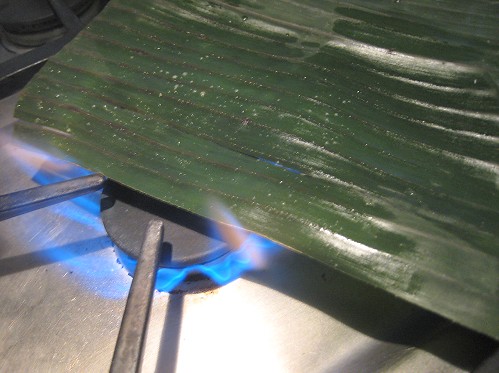
[ts]
First, preparing the banana leaves.
Since having great difficulty working with banana leaves the first time we used them (to wrap tilapia), we since learned that one had to "wilt" them first before using. That simply entails holding the leaf over the flame until the top of the leaf turns bright green and shiny. It was a little fascinating to watch.
We didn't know what size pan to use, so we guessed and used a 9-inch pie plate. We lined it with banana leaves and brushed it with butter.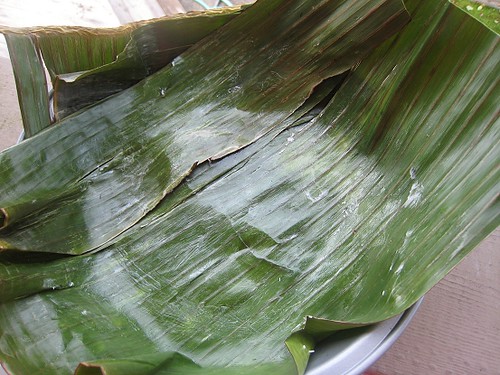
[ts]
To make the batter, we beat eggs, sugar and melted butter together. Then we combined rice flour, a little glutinous rice flour and baking powder. We added coconut milk and the egg mixture to the dry ingredients and mixed well. Into the banana leaf-lined pan it went.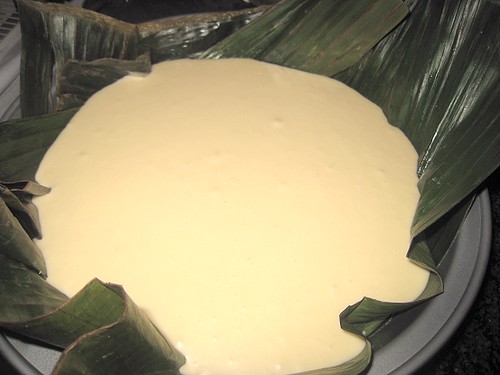
Into a 350F-degree oven for about 20 minutes. We used the toothpick test to check for doneness.
While the bibingka was baking, we prepared the toppings. Of course, first and foremost, the freshly-grated coconut.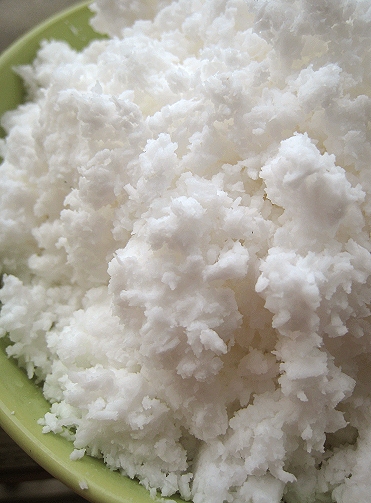
[ts]
Actually, we didn't have the energy or mental preparedness to get fresh coconuts and extract the flesh ourselves, so we just bought frozen grated coconut.
Additional sugar (we used brown sugar) is also used as a topping.
[js]
Traditionally, toppings included salted duck eggs, but when I went to get salted duck eggs, I couldn't find any. I used to see them beside the chicken eggs -- but yesterday, they were gone! I went to our two Chinese supermarkets and both of them didn't have any to sell.
[ts]
We didn't know what kind of cheese was used for the topping as well. However, to get our saltiness quotient missing from the absent salted duck eggs, we used a mixture of Parmigiano-Reggiano and Pecorino Romano.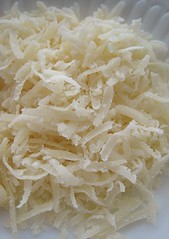

left: Parmigiano-Reggiano; right: Pecorino Romano
[ts]
As for the quantities of the toppings, it's up to you. Go hog wild!
When the bibingka finished baking, we were unsure what to do next. Were we supposed to just put the toppings on and call it a day? The recipe we were using called for adding the salted duck eggs and baking for an additional 5 minutes. But, we didn't have the duck eggs.
So, I brushed the top with melted butter then proceeded to pile up the cheeses, brown sugar and grated coconut. However, the whole thing looked anemic. We then decided to put the bibingka with toppings under the broiler.
The banana leaves caught fire! But I pressed on until the top at least had some "burn" marks. (It still could've used more scorching for that smoky aroma.)
Ta-da!
[ts]
Of course, of course, it could use even more grated coconut on top!
Ta-da redux!
See, doesn't it look better with even more coconut?
[ts]
The bibingka was very fluffy and high; I don't think they're supposed to be that high. Next time, we'll either use a bigger baking dish or do 2 9-inch pie plates. That way, there'll be more topping per cake! It's all about the toppings for me!
[js]
This bibingka was delicious! We had it on the table and I couldn't stop eating it.
The freshly grated coconut (okay, frozen freshly grated coconut) and the cheeses on top was heavenly. And having the banana leaves burned by the broiler added a little taste of fire to the bibingka which was most, most welcome.
I still missed having the salted duck eggs. Oh well. I figure this was going to be our trial run anyways and the bibingka recipe would have to undergo several revisions. The next revision, we'll have the duck eggs.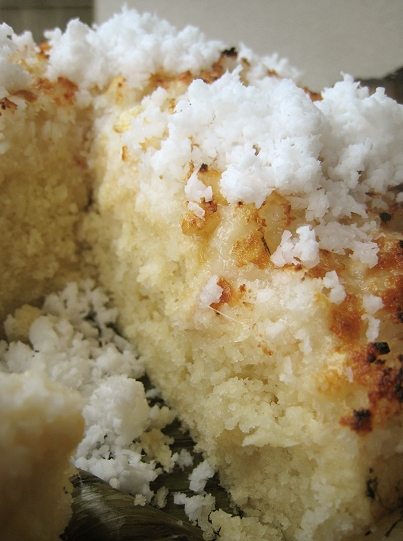
[ts]
It was so good. We deceived ourselves and pretended we weren't going to have a lot, so we never actually sliced a serving of it onto a plate. However, whenever we'd pass by the table, we'd eat a little piece. And each time, it was like having it for the first time all over again! Our eyes would widen and say -- with mouths full -- "Ang sarap!" ("It's so good!")
[js]
Was it similar to the bibingka of our past? Not quite -- but we're working on that. This was a very good attempt and so I'm happy with it. If we didn't have other bibingka to compare it with, this would an unqualified hit. But it does have all those other bibingka to contend with, not fair perhaps, but hey, that's life.
Another [eatingclub] bibingka moment:
Foodbuzz 24, 24, 24: A Starry. Starry Night in Vancouver -- Evoking the Philippine Christmas Spirit
More bibingka information
Market Manila has an approximation of a bibingka "oven."
http://www.marketmanila.com/archives/bibingkahan-pinoy-terra-cotta-oven
Here's another post about freshly-made bibingka, which I've never had the good fortune of having, by the way.
http://scentofgreenbananas.blogspot.com/2005/09/pampanga-freshly-made-bibingka.html
Pinoy Cook's post about bibingka and puto bumbong, miso de gallo (midnight mass) favorites.
http://www.pinoycook.net/bibingka-and-puto-bumbong/
Salted Duck Eggs information.
http://en.wikipedia.org/wiki/Salted_duck_egg
And of course, Wikipedia's bibingka information.
http://en.wikipedia.org/wiki/Bibingka
Recipe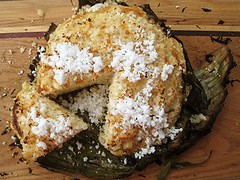 Bibingka
Based on Bibingka from Simply Anne's
Makes two (2) 9-inch bibingka
Ingredients
"wilted" banana leaves
3 eggs
½ cup sugar
¼ cup butter, melted
2 cups rice flour
¼ cup glutinous rice flour
1 tbsp baking powder
1 cup thick coconut milk
melted butter for brushing
toppings
sugar (white or brown)
grated fresh coconut
sliced salted eggs
grated cheese (Pecorino Romano, Parmiggiano-Reggiano)
Method
To "wilt" banana leaves, hold them over a flame until the "greener" side becomes shiny.
Preheat oven to 350F. Line two (2) 9-inch cake/pie pans with wilted banana leaves. Brush banana leaves with butter.
Beat eggs in a bowl until foamy. Add sugar and butter and beat until fluffy.
Mix the rice flour, glutinous rice flour and baking powder in a bowl. Add coconut milk. Blend well.
Add the egg mixture to the coconut-flour mixture, mixing until smooth.
Divide the batter in half and pour each half into lined pans. Bake for approximately 15 minutes. (Do toothpick test.)
Switch oven to BROIL.
Brush top of each cake with butter, and top with toppings of your choice: sliced salted eggs, grated cheese, sugar, grated freshg coconut. Broil until top is charred/golden.
Serve with more grated coconut and sugar, if desired.
Enjoyed this post? Why not subscribe to our blog? Subscribe via reader or subscribe via email. Thank you! |
eatingclub vancouver Weekend Wokking posts:
Ravioli "Caprese": Tomato, Basil, Bocconcini
Eggplant "Clafouti"
Bibingka
Pumpkin Congee w/ Pumpkin "Beignets" & Sesame-Roasted Pumpkin Seeds
Chicken, Broccoli and Cheese w/ Pipián Verde
Adobo Mushroom Tart
Duck and Orange Crêpes with Orange-White Wine Sauce
Almond Eggplant "Bisteeya" (Bastilla)
"Mashed Potato Beef Burger" (Red-skinned Potato Salad in Taiwanese Sacha Cheeseburger)
Korean Soybean Sprouts Pancake (Kongnamul Jeon)
Lemon Chamomile Tiramisu
Cilantro Horchata
Strawberry Cilantro Salsa, on Grilled Flank Steak
Duck Enchiladas with Chipotle Peanut Salsa
Clear Oxtail Soup with Corn, Cabbage and Potatoes
Beijing Pickled Cabbage
Salsa Romesco ("Queen of the Catalan Sauces!")
Aguadito de Pollo (Peruvian Chicken Soup)
Bangus Belly à la Bistek (Milkfish Belly with Onions, Calamansi and Soy Sauce)
White Pork with Garlic Sauce, Two Ways (蒜泥白肉)
Mr. Zheng's Soupy Tomatoes and Eggs with Tofu (蕃茄雞蛋跟豆腐)
Steamed Fish and Tofu with Chinese Black Beans
Spinach and Cheese with Puff Pastry, Three Ways

We're submitting this recipe to Weekend Wokking, a world-wide food blogging event created by Wandering Chopsticks celebrating the multiple ways we can cook one ingredient.
The host this month is Ivy of Precious Pea.
If you would like to participate or to see the secret ingredient, check who's hosting next month.
Check out all Weekend Wokking Roundups.
[eatingclub] vancouver Filipino food
Bibingka
Mama's Ampalaya (Bitter Melon)
Faux Kamote-Que
Philippine-Style Chicken "BBQ"
Fried Hasa Hasa (Mackerel)
"Savory" Chicken Wings
Sinamak (Chile-infused Vinegar)
Pan-roasted Halibut w/ Fava Beans, Potato-Onion Cakes & Bagoong Butter Sauce
Bulalo & Bangus: an even simpler Filipino meal
Baked Tahong (Mussels)
Adobo Kangkong (Adobo Water Spinach)
Oyster Torta (Oyster Omelette)
Chicken Tinola (Chicken Soup w/ Green Papaya & Pepper Leaves)
(Chinese) Roast Pork Belly / Lechon
Tilapia wrapped in Banana Leaves
Pork Belly, Two Ways
Chicken Adobo
Embutido
Salabat (Ginger Tea)
Lechon Manok (Philippine Roast Chicken) & Lechon Sauce
"Chinese Adobo" Clams and Oysters
Bistek (Citrus Beef with Caramelized Onions)
Beef Kaldereta (Beef Stew with Bell Peppers)
Atsara (Green Papaya Pickle)
Sardinas na Bangus (Milkfish in the style of Sardines) and Pressure Cooker Fear


I love the name, Bibinka too and that you're sharing an under-rated cuisine, that of the Phillipines.
ReplyDeleteIt looks great in the photo and I'd have no probs sinking into this.
Salamat!
I think Bibingka is like Malaya Ubi bingka,right?.But that a slightly different in the ingrendiets.We used grated yuka,coconut milk,palm sugar,corn flour and salt to steam.oh!! but I like your version better!! plenty of coconut flake and bake under charcoal!!
ReplyDeleteWow, I've never heard of this but it looks so good. I can imagine if I had it laying around I'd slowly eat through the whole thing...
ReplyDeleteFabulous! I'm so curious to see it with salty duck eggs. Like hard-boiled? Or is it like preserved duck eggs? Regardless, I still think it looks great without. That slightly charred coconut topping... Mmm.
ReplyDeleteWould you two like to host WW? Feb. through May slots are still open so you can take your pick. :)
This comment has been removed by the author.
ReplyDeleteAnyway, so the babingka is something I've never heard of either. Coconut and cheese...I feel inspired to throw a few things together with your babingka recipe makings. I'm excited.
ReplyDelete@beachlover
ReplyDeleteI won't be surprised if our bibingka's an adaptation of bingka ubi.
The process is very similar, and our historical connection is very close. Ingredients could be replaced with whatever is locally abundant.
Palm sugar is not part of our traditional cuisine so it got replaced with white (or brown sugar is used.
i am in total awe of this one!!! looks so rich and delicious.
ReplyDeletesalted duck eggs, huh?
It kills me that I couldn't make this the way I remember and that I couldn't find any version that comes close in Chicago.
ReplyDeleteI'll have to admit I havent tried using banana leaves. that might be the missing ingredient..
I had this couple times - best friend's mom made it and I was stuffing myself silly with it that I never even asked for recipe. :) Now that I see this here, I will attempt to make it soon. Thank you!
ReplyDeleteThis is a really interesting post. The cake looks amazing, but I'd have to pass on the duck egg bit.
ReplyDeleteI am a total stranger to this! Learnt something new today :)
ReplyDeleteThis dish obviously holds wonderful memories for you:D
ReplyDeleteWOW, this is a fascinating post. I had never hear of this, but really want to try it now.
ReplyDeleteAh! Blogger ate all my replies to your comments! Here I go again...
ReplyDeletePeter M:
Salamat to you too! (Haha, that's Taglish: Tagalog + English.)
Beachlover:
Maybe there's a version that's even closer to your Malaya Ubi Binka! There are different kinds of bibingka and we ourselves are confused about them.
kat:
said...
Wow, I've never heard of this but it looks so good. I can imagine if I had it laying around I'd slowly eat through the whole thing...
September 27, 2008 8:07 PM
Wandering Chopsticks:
I kept piling mine with more grated coconut! =)
I just wiki'd salted duck eggs and yes, they're preserved. We should've added that info to our post; I've just added the link in our post now.
Nik Snacks:
Cecil:
maybelle's mom:
The play between smoky, sweet, coconut-y, umami and salty (from the cheese and/or duck eggs) is key. Let us know how it goes! We're excited!
coco sugar:
Thanks for the info.
We Are Never Full:
Salted suck eggs are used in mooncake fillings as well.
Although, I like bibingka more; was never too big a fan of lotus paste/sweet bean fillings. =)
Jude:
My memory has almost faded, actually. But, next time we're going to try making it in palayok and over charcoal. CHARCOAL!! I can smell it already.
tigerfish:
So much good food out there, so little time to find out about them! =)
woah, how amazing! They are gorgeous. Love your features on Filipino cuisine :)
ReplyDeletewhat an interesting creation! this is completely new to me, but as an ardent coconut-lover, my interest is piqued. very cool! :)
ReplyDeletenoobcook, grace:
ReplyDeleteThanks! You should try making it. Teehee.
I truly admire the two of you for trying to recreate the food that you (we) love!
ReplyDeleteBibingka is widely available now, (not like when we were young, they were only available near Christmas time) there are many small bibingka stalls scattered around most of the malls now... so I never thought of making them myself.
The salted duck eggs truly makes a difference. I would not eat a bibingka without them! :)
ning:
ReplyDeleteWow, bibingka EVERYWHERE, you say! =D
We used to go to Via Mare... is that even still around? My memory if bibingka is not *too* clear, actually. Although, I remember that as a kid, I didn't like the egg part... But now, I know it goes so nicely with bibingka and all its other toppings.
OOo this looks very special indeed. I haven't tried it before, and wish I could!
ReplyDeleteThat is amazing! And it looks so good. I wouldn't even know where to start looking for banana leaves and freshly grated coconut around here.
ReplyDeleteThis is an incredible recipe and description, good work!!! I am salivating for some bibingka!
ReplyDeleteGreat post - I love learning about foods that other people grew up with, and childhood memories. There is a traditional Afrikaans coconut tart that looks a little like this (from above!) which I realyl adore and you have reminded me that I need to bake it again!
ReplyDeletethis is the first time i've seen a bibingki with that kind of surface texture. usually it's smoothened out by the pan of hot coals. nevertheless, it looks delicious as always. gusto ko nang mag-pasko! :)
ReplyDeletei love how rustic everything turned out. sure is a head turner in anyone´s dining table!
ReplyDeleteOMG.. this looks so yummy!!! I am salivating for some bibingka
ReplyDeleteY:
ReplyDeleteMake it, make it! Teehee, I'm telling everybody to make it. =)
Sweet Bird:
If there's an Asian supermarket/store, then both products are in the frozen section. Of course, for the coconut, you can also get a fresh coconut and crack that. But I'm too scared to do that myself. =)
Sam Sotiropoulos:
Thanks! I think we felt we had to elaborate on why those toppings were there... or, how they complemented each other.
Jeanne:
Oooh, you should make it and post about it.
Weyn Cueva:
Oh, we didn't take a picture when it was just plain, without the toppings. The top is all bumpy like that because we already put the cheese and coconut and sugar then broiled it. We have to try cooking it with coals! =D
Lianne:
Haha, we sort of didn't even really have a proper dinner... because the bibignka was just sitting there on display on the table. We ate that instead. ;D
Jin Hooi:
Make it, make it! =D
Have you tried using those round aluminum disposable pans? Maybe if you trim the top about 2 mm (cut it all around then fold the sides in half to make it a bit sturdy...that might work! I have duck eggs brining and when they are ready, I will give you a shout. I am in Vancouver, too. My mom would top it with cream cheese or ricotta and the salted duck eggs before baking. The top would be blondish and she would brush melted butter on it and sprinkle with brown sugar and broil it.
ReplyDeletebetty q:
ReplyDeleteOh wow, you're brining your own duck eggs! Where does one buy duck eggs in Vancouver?
It's been so long since we made bibingka! Yum.