JS:
Last Saturday, we had the second dinner of the Eight Great Traditions of Chinese Cuisine (8GTCC, for short) series, hosted by Ben and Suanne of Chowtimes. The featured cuisine in this second installment is Jiangsu 江蘇.
Jiangsu is a province located on the east coast of China, one of the most ancient provinces and currently one of the most populous.
Jiangsu is an extremely fertile region, abundant with gifts of the land and gifts of the sea and its numerous rivers, thus giving rise to its sometime epithet, "the land of fish and rice." Jiangsu cuisine 江蘇菜 is sophisticated, with an emphasis on bringing out the true flavours of the freshest ingredients.
links to more information
Wikipedia: Jiangsu
Wikipedia: Jiangsu cuisine
Tourism Jiangsu: Food and Dining
Chowtimes: A Discovery of Jiangsu Cuisine
My China Page: Jiangsu Food and Drink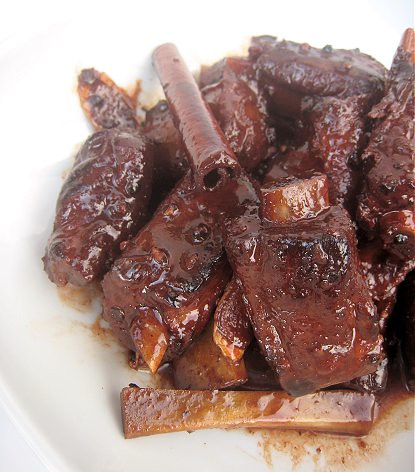
JS:
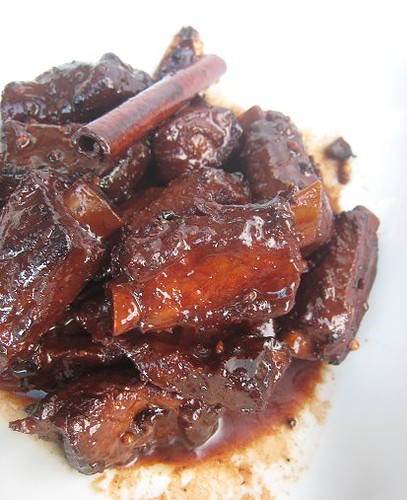
One of Jiangsu's representative dishes is Wuxi Spareribs.
Legend has it that the dish was first prepared by a peasant Lu Xiaosheng, who made it at the request of his sick wife. Supposedly, after partaking of Lu's sparerib dish, the wife made a miraculous recovery from her illness.
Whether her miraculous recovery should be attributed to the deliciousness of said dish or attributed to the fact that Lu used a cooking implement that had been blessed by a god is unclear. The moral we should take from the story is that the spareribs were fantastic.
http://en.wikipedia.org/wiki/Wuxi
Lu's spareribs were so delectable that legend also has it that he made a fortune selling them under the brand "Old Lu Gu's Gao Jian". There is a restaurant still standing with the name "Lu Gao Jian" in the region, although I'm not sure if this restaurant can claim unbroken lineage with that magic sparerib dish of long ago.
Lu Gao Jian
Address: No.8, Guanqian Street, Pingjiang District, Suzhou City
See http://www.travelchinaguide.com/cityguides/jiangsu/suzhou/when-to-go.htm for more info.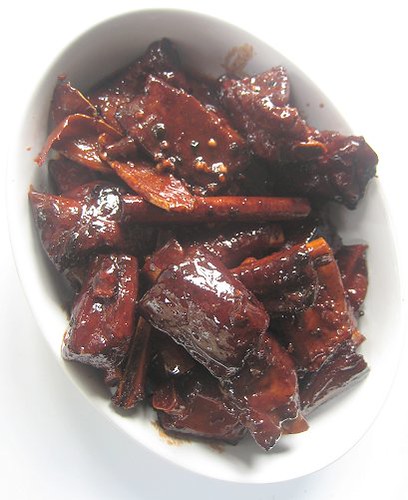
JS:
This is a long preamble to what is undeniably quite an easy dish to make at home.
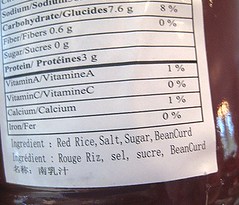
Red Yeast Rice Fermented Bean Curd Juice (紅豆腐乳/南乳)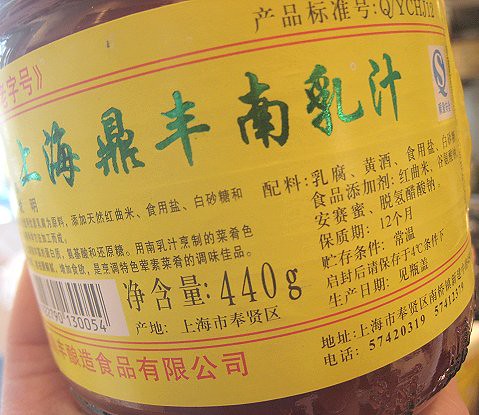
 JS:
JS:
Probably the only obstacle to making a good version of this at home is finding the red yeast rice fermented bean curd juice 紅豆腐乳/南乳, which gives the dish its red colour and unique flavour.
According to Wikipedia:
"Red fermented bean curd (紅豆腐乳/南乳) incorporates red yeast rice (cultivated with Monascus purpureus) with the brining liquor for a deep-red color, thickened flavor and a distinctive flavor and aroma."
http://en.wikipedia.org/wiki/Fermented_bean_curd
TS:
Frankly, I don't even know what the English translation is for this product. We are using a name that is the most descriptive. Say it with us now: red yeast rice fermented bean curd juice!
Easy step-by-step instructions
 TS:
TS:
Finally, without further ado, here's how to make these ribs!
The ingredients above are (clockwise from top):
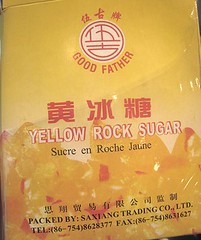
red yeast rice fermented bean curd juice, Shaoxing wine, ginger, rock sugar, salt, star anise, cloves, white peppercorns, and cinnamon.
Look to the right to see how the rock sugar we buy comes.
blanching the ribs before cooking
JS:
I had the butcher cut the spareribs horizontally for this dish. When I got home, I separated them into 1-rib sections. You can make your pieces bigger if you wish.
Like most Chinese braised meat dishes, this one begins with a boiling pot of hot water to blanch the meat. Blanching the meat gets rid of that "meat-smell" or the rankness of meat. The Chinese are very particular about eliminating this "rankness" to let the true, fragrant flavour of the meat shine -- call it the Platonic Form of Pig.

JS:
Then, it's time to make the caramel sauce that is the base of the braising liquid.
I started with 2 tablespoons of sugar and melted it in an equal amount of peanut oil. When the liquid is golden brown, slightly deeper than honey-coloured, dump -- or more elegantly, place -- the blanched spareribs in the pot.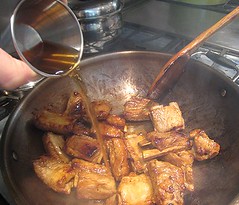
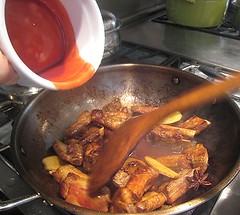
left: adding the Shaoxing wine; right: adding the red yeast rice fermented bean curd juice
JS:
Then, quickly put in the Shaoxing wine and the red yeast rice fermented bean curd juice. Coat the spareribs with the liquid.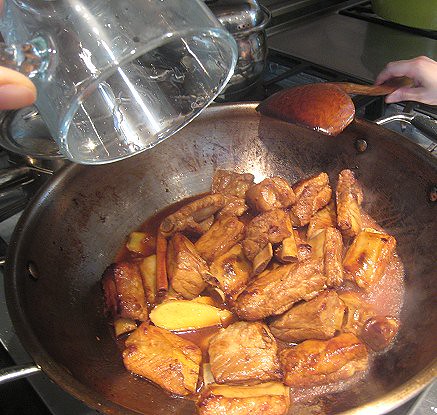
JS:
Add the rock sugar, ginger, and spices (star anise, cloves, white peppercorns, cinnamon stick) and enough water to cover the ribs.
The ribs are then braised until tender. Depending on how much water is added (this is dependent on the pot used), you might need to add some soy sauce and sugar to season. I checked the ribs towards the end added a touch of light soy sauce.
The wok and cover I was using evaporated just enough liquid that I did not have to reduce anything afterwards. I was slightly surprised to see that the braising liquid became thick and syrupy on its own, giving the pork spareribs a beautiful, shiny glaze, making the pictures taken of it somewhat overexposed (as you can see).
TS:
It's so hard to take pictures of these dark, shiny, glaze-y things! If I actually knew how to work a camera, perhaps things will be different.
JS:
Just a side note here, talking points for the "authenticity" debate.
At our 8GTCC dinner last Saturday at Shanghai Village, we were served a version of Wuxi-Style Spareribs.
urbanspoon: Shanghai Village (Vancouver, BC)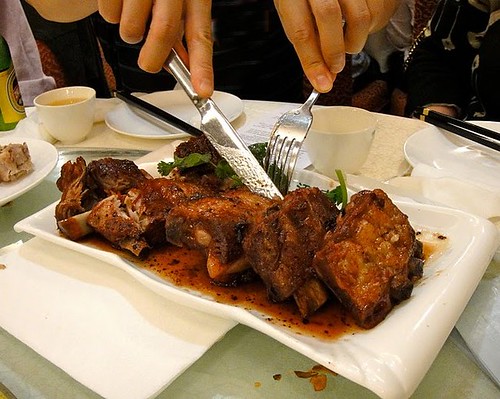
Jinling Spareribs at Shanghai Village
photo by fmed
JS:
Chef Ming's version of this dish is called "Jinling Spareribs" on his menu. His version is decidedly more clove-y than ours and his version is also not "sticky" and "syrupy" at all. Chef Ming served the ribs almost dry, with only some "sauce" (thinner and more liquid in consistency) clinging to the ribs.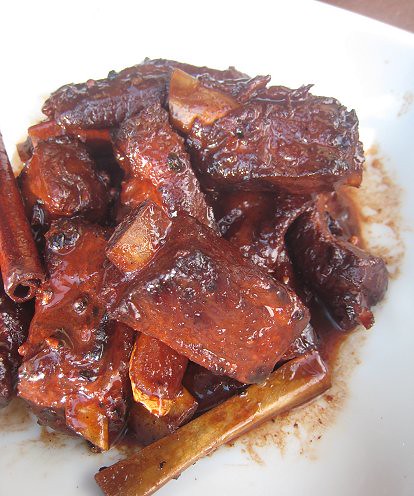
JS:
You might want to consider these factors when making your own version of Wuxi-style spareribs. Our ribs got sticky on their own from evaporation: if I used a different pot, perhaps the braising liquid would not have evaporated as much.
Interestingly enough, our family members actually like to have a thin "sauce" or "gravy" with their braised meats, instead of the more "restaurant-like-consistency" sauce shown here.
JS:
Nevertheless, this version of Wuxi-Style Spareribs was an instant hit with the family.
The ribs are slightly salty, slightly sweet, and there is the heady, fragrant notes of star anise, cinnamon, and cloves. Personally, I loved the hits of cracked black pepper that I also added: I think it gives the ribs another dimension. If black pepper's not your thing, you can surely omit it.
eatingclub JiangZhe dishes
Jade Tower ( 翡翠塔), or Tofu with Aster Indicus (香乾馬蘭頭)
Wuxi Pork Spareribs (無錫排骨)
"Little Cubby Heads", Lion's Head Meatballs (小獅子頭)
Supreme Lion's Head Meatballs with Crabmeat (清燉蟹粉獅子頭)
Suzhou Deep-fried Fish, or Suzhou Smoked Fish (蘇州燻魚)
Recipe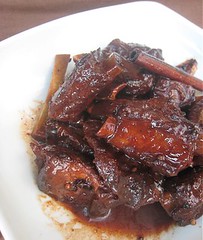 Wuxi-Style Pork Spareribs (無錫排骨)
2 pounds pork spareribs, cut into 2" pieces
2 stalks green onions
2 tbsp sugar
2 tbsp peanut oil
2 tbsp Shaoxing wine
3 tbsp red yeast rice fermented bean curd juice 紅豆腐乳/南乳
1 cinnamon stick
1 star anise
2 cloves
2" ginger, cut into slices
2 tbsp rock sugar
1 tbsp cracked black peppercorns
1 tbsp cracked white peppercorns
2 tbsp soy sauce, optional
In a pot of boiling water, blanch pork spareribs with the green onions. Drain.
Put sugar and oil together in wok to caramelize. When the colour is golden brown, add pork ribs and coat with the caramel. Add Shaoxing wine, red yeast rice fermented bean curd juice, and the rest of the ingredients. Add enough water to cover the pork ribs.
Bring to a boil and let simmer until the pork ribs are tender. Once tender, take out pork ribs and let the sauce reduce to a thick, syrupy consistency. Add soy sauce to season if necessary. The ribs should be slightly salty, slightly sweet, with notes of star anise, pepper, and cinnamon and cloves.
Enjoyed this post? Why not subscribe to our blog? Subscribe via reader or subscribe via email. Thank you! |









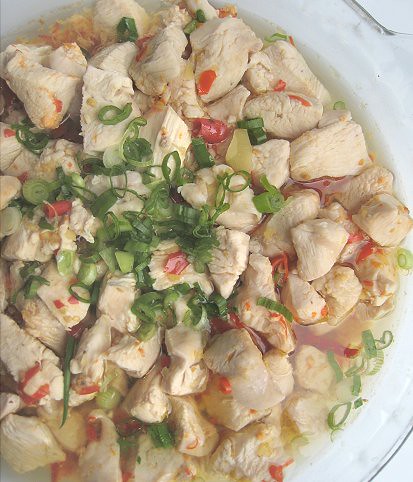

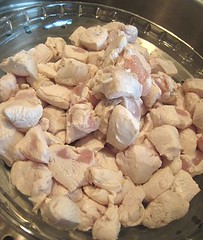
 , it still had a little "brainer", with instructions on blanching the chicken first before steaming it. But really, with breasts, there's no need for that.