


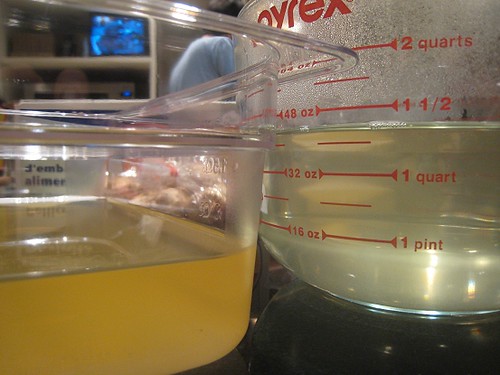
left: ichiban dashi; right: niban dashi
[ts]
Learning that this edition of Regional Recipes called for Japanese recipes, we had to brush up on Japanese food.
Well, by "brushing up", I just mean that we started flipping through Japanese Cooking: A Simple Art
But, inevitably, some information did manage to sneak its way in. So, I knew that before we could make any of our chosen dishes, we had to make dashi.
Miraculously enough, we had konbu and bonito flakes on hand!
Konbu is a type of kelp used extensively in Japanese cooking. The flavor it imparts is what inspired the creation of MSG (monosodium glutamate)!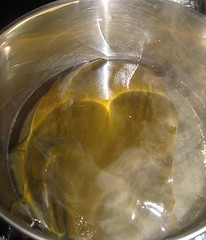
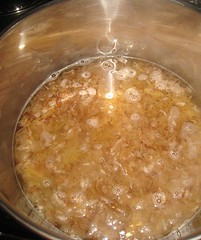
left: konbu in simmering water;
right: bonito flakes in konbu-infused liquid
[ts]
We don't usually copy out recipes here, but I felt I had to do so. I want everybody to know how specific the instructions were in all the recipes in this book. I guess the way I'll put it is... that... I've never ever encountered any other recipe that comes across as needing to be followed to the letter lest the hellmouth should open up and swallow me for failing to do so.
On to the recipe!
Primary Dashi (Ichiban Dashi)
from Japanese Cooking: A Simple Art
1 L (qt) cold water
1 oz (30 g) giant kelp (konbu)
1 oz (30 g) bonito flakes (hana-katsuo)
Fill a medium-sized soup pot with 1 qt cold water and put in the kelp. Heat, uncovered, so as to reach the boiling point in 10 minutes. IMPORTANT: Kelp emits a strong odor if it is boiled, so remove konbu just *BEFORE* water boils.
Insert your thumbnail into the fleshiest part of the kelp. If it is soft, sufficient flavor has been obtained. If tough, return to the pot for 1 to 2 minutes. Keep from boiling by adding approximately 1/4 cup cold water.
After removing the konbu, bring the stock to a full boil. Add 1/4 cup cold water to bring the temperature down quickly and immediately add the bonito flakes. No need to stir. Bring to a full boil and remove from heat at once. If bonito flakes boil for more than a few seconds, the stock becomes too strong, a bit bitter, and is not suitable for use in clear soups. If you make this mistake, all is not lost, use the stock as a base for thick soups, in simmered foods, and so on.
Allow the flakes to settle to the bottom of the pot (30 seconds to 1 minute). Remove foam, then filter through a cheesecloth-lined sieve. Reserve the bonito flakes and kelp for secondary dashi.
[ts]
Whew! What did I say?
It was so very unlike me, but I followed every exact detail exactly. Even straining the the broth through a cheesecloth-lined sieve, like below.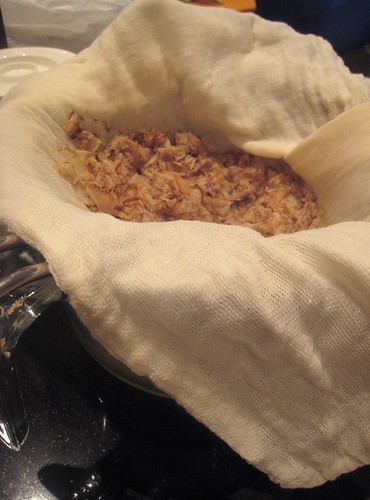
According to the book, primary dashi is used for clear soups while secondary dashi is used for thick soups, noodle broths, cooking stock, and for flavoring other dishes.
Secondary Dashi (Niban Dashi)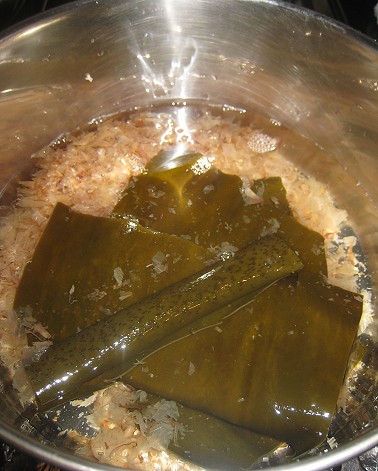
used konbu and used bonito flakes in cold water to make secondary dashi
[ts]
For the secondary dashi, one simply needs to place the used-once konbu and bonito flakes in cold water. That's heated until almost boiling then reduced to simmer until the liquid has reduced by half. Fresh/new bonito flakes are added and the pot is removed from the heat. Then it's the same procedure about letting the flakes settle before straining the stock through a cheesecloth-lined cloth. After making the secondary dashi, the now-used-twice konbu and all the bonito flakes are discarded.
left: ichiban dashi; right: niban dashi
[ts]
See the difference between the two stocks?
Then, finally, I also made Kelp Dashi (Konbu Dashi). This required no heat! Woohoo! I just had to place konbu in cold water and leave that to soak overnight. After that, I used that same piece of konbu to make another batch of konbu dashi.
Now we're ready to embark on our Japanese journey.
Well, at least "ready" in terms of dashi being available. ;)
I bet you thought this was a Regional Recipes entry. No, that comes later.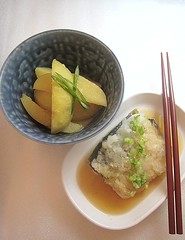
[eatingclub] Japanese
Dashi, Three Types
Potatoes Simmered in Miso (Jaga-imo Miso-ni)
Simmered Saba Mackerel with Daikon Radish (Saba Oroshi-ni)
Miso Soup
Steelhead Trout and Enoki Mushrooms with Wasabi Cream Sauce
Grilled Brats à la Japadog
Warm Wakame Cucumber Salad
Grilled Eggplant with Sweet Miso
We're submitting this post to Weekend Herb Blogging, a world-wide food blogging event (created by Kalyn's Kitchen, now maintained by Haalo of Cook (almost) Anything at Least Once) with the goal of helping each other learn about cooking with herbs and plant ingredients.
If you'd like to participate, see who's hosting next week. WHB is hosted this week by Heather of Diary of a Fanatic Foodie.
Monday, November 10, 2008
Dashi, Three Types


Subscribe to:
Post Comments (Atom)


Great tutorial!
ReplyDeleteThe first time I made dashi, I did not follow the recipe and I was very sorry. Too strong fishy flavor. But once you get the hang of it, it's so easy because it takes not time.
Looking forward to your dish!
Watching to see your applications. I have never travelled down this road.
ReplyDeleteYou forgot the fourth method... Rip open a sachet of Aji Dashi, heh heh :) Seriously, good on you for following the traditional method. You got a great book on your hands-- I hear Shizuo Tsuji's book is pretty definitive. (I've even flipped through it, but didn't buy as it's so expensive!)
ReplyDeleteWe've not played in the realm of Japanese cooking ourselves, so it's great to watch you lay out the basics. Unfishy dashi is a lovely thing!
ReplyDeleteThanks for the primer...I thought there was only dashi...how naive of me.
ReplyDeleteI'd be afraid not to follow that recipe to the letter also! I've always wanted to try dashi, I even bought the kobu and the bonito flakes.
ReplyDeletewow, that's a lot of work just to get ready to make your actual dish!
ReplyDeleteI didn't know that we can re-use the kelp and the bonito flakes to make second dashi. Thanks for the tip!
ReplyDeleteHey thanks for posting the recipe. My husband loves udon and I always make dashi as a soup base. He likes the simple taste.
ReplyDeletecw
Wow.. this is the ultimate guide to Dashi. Very helpful! I wasn't aware of the differences.
ReplyDeleteno idea about the different dashis there are! great post.
ReplyDeleteThat book is so good... You'll never really need another Japanese cookbook.
ReplyDeletedp:
ReplyDeleteThanks. The two dishes coming right up!
MrOrph:
It's going to be a short journey as we're only doing 2 dishes from the book at this time.
Manggy:
Yes, it's quite useful, the book. It's totally opposite my personality, haha... ;D
I've never seen instant dashi! I guess haven't been looking for it.
Peter M:
Zen Chef:
Jescel:
It was quite a learning experience for me too.
Pam:
It *is* actually quite easy, even with the fun I poke at the recipe and all. ;)
Ning:
That was quite useful to know... para hindi sayang yung ingredients! =)
Christina:
This is the first time we made dashi! =)
Jude:
I don't know when the next time we'll be cooking from the book, but yes, for anything Japanese, it's the go-to book.
Kudos for making your own dashi... it looks really good! I used to make my own, freeze them ... until I got lazy and switch to instant sachets, haha
ReplyDeleteGreat primer! I never knew that you could make a secondary dashi.
ReplyDeleteDashi is one of the cornerstones of Japanese cooking. I always seem to have some in my fridge or freezer. I used some in a roasted butternut squash and chard miso soup for breakfast this morning.
ReplyDeleteWow, this is serious Japanese cooking! I've only used the powdered Dashi.
ReplyDeleteI didn't know kombu flavour guided the creation of MSG. Good to know. Thanks for the idea of cold-making kombu soup. I always boil and will try this way.
ReplyDeletenoobcook:
ReplyDeleteHaha... maybe we'll get a few sachets "just in case."
Maggie:
Yeah, good to know. That book is very informative.
Kevin:
We should probably do the same... make some and have it handy.
Virginie Péan:
We had to make the cold-infused konbu stock because we ran out of bonito flakes. =D