Sunday, June 20, 2010

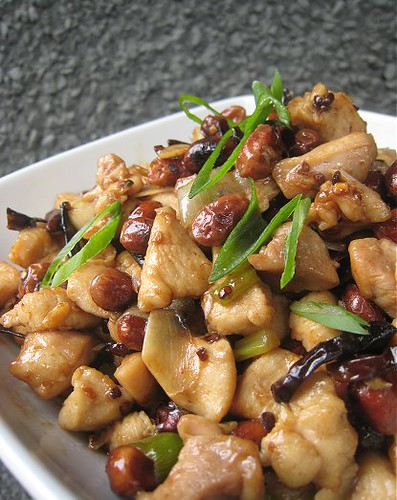
Gong Bao ("Kung Pao") Chicken (宮保雞丁)


JS:
It's chicken breast time again.

This time, due to the fortuitous event of having peanuts around, we decided to turn to Fuschia Dunlop and go with her version of Gong Bao chicken from Land of Plenty: A Treasury of Authentic Sichuan Cooking.

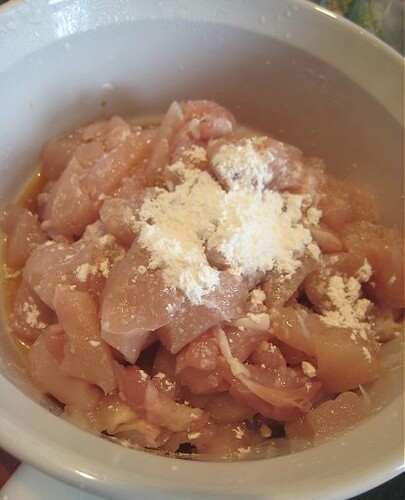
I started with cutting up the chicken breast pieces.


JS:
When TS saw what I had done, she tsk-ed tsk-ed me and decided to re-do my pieces. She said my pieces were too big! Okay, well, I was just trying to do it as quickly as I could.

I told her to take over then. :)

I'm sure everybody knows about this tactic by now: if you want to get out of doing things, just act incompetent -- and this is the key thing -- admit to the incompetence! Someone will take over for you.

TS:
As per the recipe, I marinated the chicken cubes in a mixture of light soy sauce, Shaoxing wine, cornstarch and a touch of water. You know, the usual suspects.


TS:
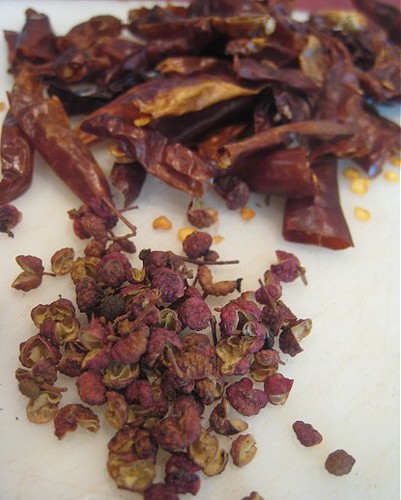
Sichuan peppercorns (foreground) and dried chiles (background).


TS:
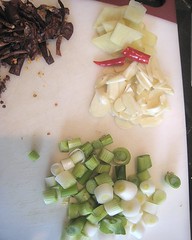
Just a quick prep of the ingredients: ginger, garlic and green onions. I even had to make my green onion pieces the same size as my chicken cubes!

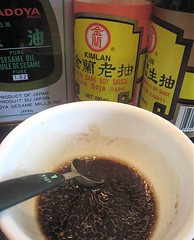
I also mixed the sauce ingredients together: light and dark soy sauces, Chinkiang vinegar, sugar, sesame oil, cornstarch and just a touch of water.

Oh, we pan-roasted some peanuts as well. Mustn't forget the peanuts. Without them, what would the point! ;)

The dish came together very quickly after the initial prep.
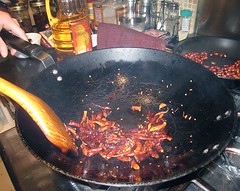
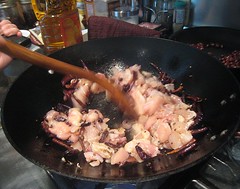

Cook the Sichuan pepper and chiles in hot oil, then add marinaded chicken.
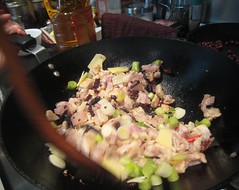
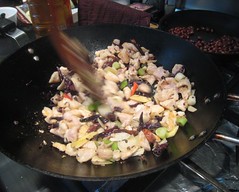

Add the ginger, garlic and green onions. Toss, toss, toss.
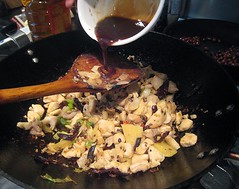
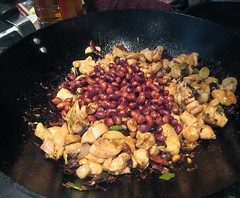

Add the sauce and roast peanuts, and it's done.
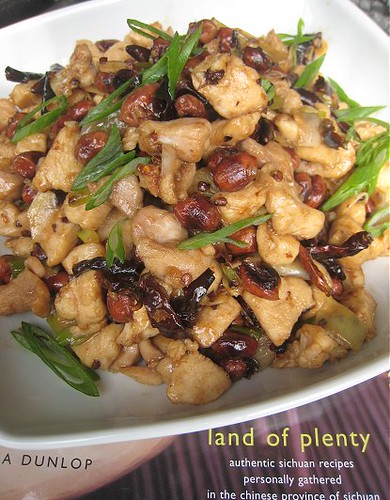


JS:
I think I like my Gong Bao chicken to be a tad more spicy but this has a nice balance of hot, salty, sour. Of course I loved the fried peanuts in this, although I concede that cashews might perhaps add a touch more sweetness to the flavour balance.

TS:
(No to cashews! Peanut-love all the way!)
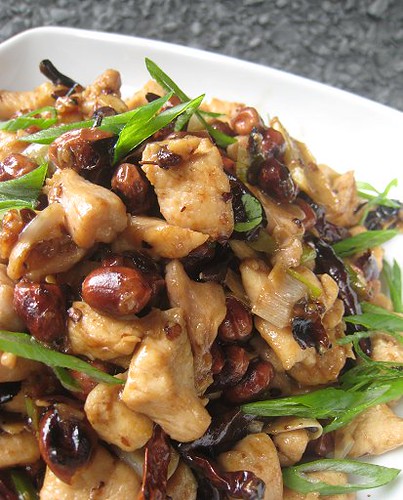


eatingclub Sichuan/Sichuan-inspired (Szechuan)
Red Chile Oil (紅油)
Sichuan Peppercorn Chili Oil
Spicy Sweet Sichuan Popcorn
Gong Bao ("Kung Pao") Chicken (宮保雞丁)
Eggplant Dandan Mian (擔擔麵)
Sichuan "Crossed Hands" Wonton Dumplings 抄手, Two Ways (in Broth and with Chili Oil Sauce)
Sichuan Ma Po Tofu (麻婆豆腐)
Water Boil Fish (水煮魚) or Water Boil Beef (水煮牛肉)

Enjoyed this post? Why not subscribe to our blog? Subscribe via reader or subscribe via email. Thank you!

Recipe
Gong Bao (Kung Pao) Chicken with Peanuts (宮保雞丁)
from Fuchsia Dunlop's Land of Plenty: A Treasury of Authentic Sichuan Cooking

Serves 2 as a main dish with a simple stir-fried vegetable and rice, 4 as part of a Chinese meal with three other dishes

2 boneless chicken breasts, with or without skin (about 2/3 pound total)
3 cloves of garlic and an equivalent amount of ginger
5 scallions, white parts only
2 tablespoons peanut oil
a generous handful of dried red chiles (at least 20), preferably Sichuanese
1 teaspoon whole Sichuan pepper
2/3 cup roasted unsalted peanuts

For the marinade
1/2 teaspoon salt
2 teaspoons light soy sauce
1 teaspoon Shaoxing wine or medium-dry sherry
1 1/2 teaspoons potato flour or 2 1/4 teaspoons cornstarch
1 tablespoon water

For the sauce
3 teaspoons sugar
3/4 teaspoon potato flour or 1 1/8 teaspoons cornstarch
1 teaspoon light soy sauce
1 teaspoon dark soy sauce
3 teaspoons Chinkiang vinegar or black Chinese vinegar
1 teaspoon sesame oil
1 tablespoon chicken stock or water

1. Cut the chicken as evenly as possible into 1/2-inch strips and then cut those into small cubes. Place in a small bowl and mix in the marinade ingredients.

2. Peel and thinly slice the garlic and ginger, and chop the scallions into chunks as long as their diameter (to match the chicken cubes). Snip the chiles in half or into 2-inch sections. Wearing rubber gloves, discard as many seeds as possible.

3. Combine the sauce ingredients in a small bowl -- if you dip your finger in, you can taste the sweet-sour base of the gong bao flavor.

4. Season the wok, then add 2 tablespoons of oil and heat over a high flame. When the oil is hot but not yet smoking, add the chiles and Sichuan pepper and stir-fry briefly until they are crisp and the oil is spicy and fragrant. Take care not to burn the spices (you can remove the wok from the heat if necessary to prevent overheating).

5. Quickly add the chicken and fry over a high flame, stirring constantly. As soon as the chicken cubes have separated, add the ginger, garlic, and scallions and continue to stir-fry for a few minutes until they are fragrant and the meat is cooked through (test one of the larger pieces to make sure).

6. Give the sauce a stir and add it to the wok, continuing to stir and toss. As soon as the sauce has become thick and shiny, add the peanuts, stir them in, and serve.

Thursday, June 17, 2010

Stewed Eggplant Penne


JS:
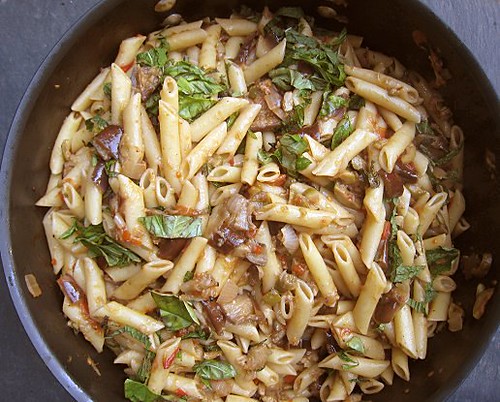
A simple pasta dish for lazy days.

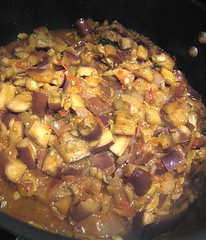
I start with some diced onions, garlic, and tomatoes, then add in chunks of eggplants, leave them to stew for a bit until the tomatoes and eggplants have broken down and form a kind of chunky sauce.
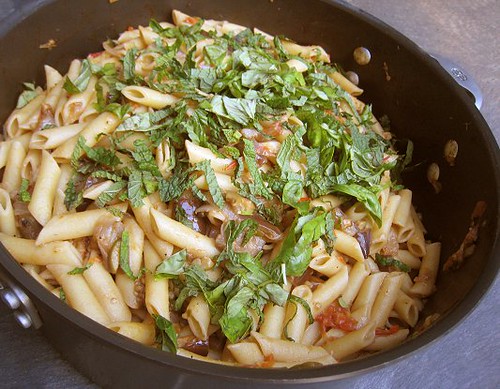
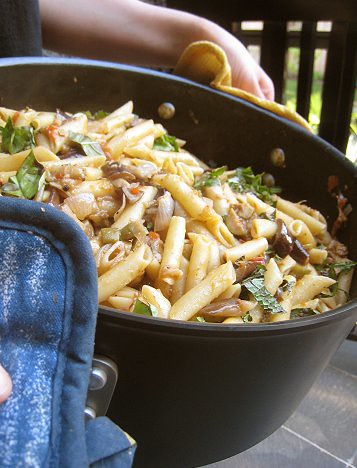
Add some cooked penne (which in this case was white penne, because, sorry, I just can't get past non-al dente whole wheat pasta), mix everything up, throw in some fresh basil and mint, grate some Parmigiano-Reggiano on top if you like -- and voilà!

As I said, a simple pasta dish for lazy days.


Recipe
Stewed Eggplant Penne

1 large onion, diced
3 cloves garlic
1 tsp red pepper flakes
4 Chinese eggplants, cut into chunks (you can use the equivalent number of large globe eggplants)
6-8 tomatoes, cut into chunks

1 lb penne
fresh basil
fresh mint

grated Parmigiano-Reggiano

Heat 4 tbsp of olive oil and red pepper flakes in a pot. Add diced onions and sweat until fragrant. Add garlic cloves.

Add tomatoes and eggplants and stew until soft. Check for seasoning.

In a separate pot, boil water for pasta. Cook pasta as per package instructions or until al dente. Drain.

Combine pasta with eggplant sauce. Add fresh basil and mint.

Grate parmiggiano reggiano on top and enjoy.


Enjoyed this post? Why not subscribe to our blog? Subscribe via reader or subscribe via email. Thank you!

Tuesday, June 15, 2010

Brown Rice Bibimbap (Korean Rice Bowl)


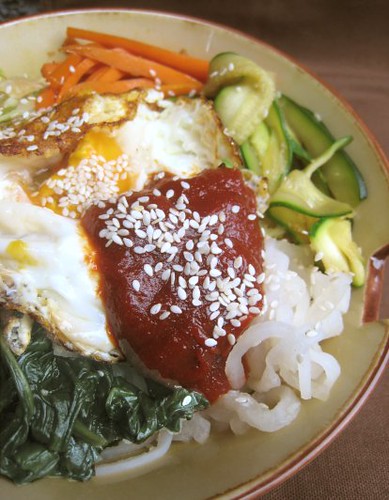
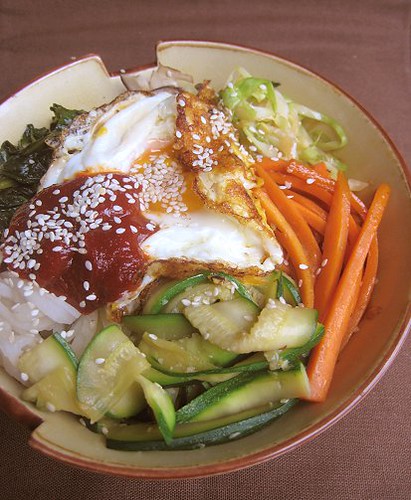
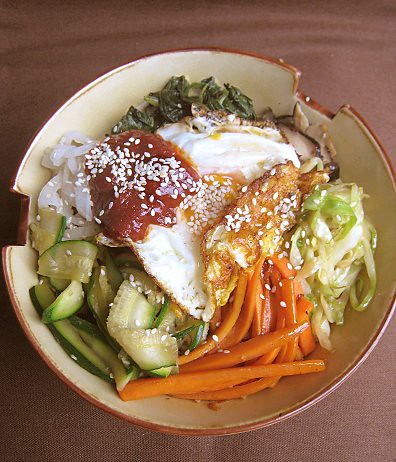
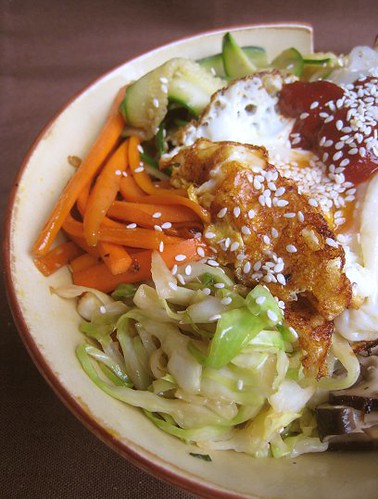
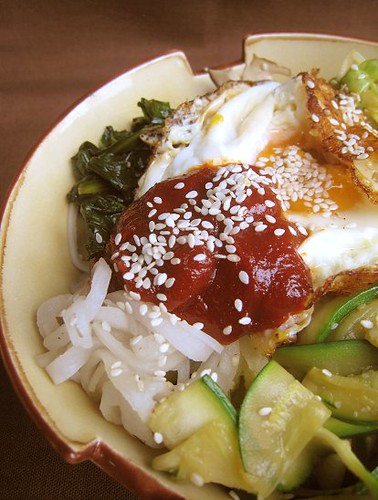
clockwise from top: daikon, spinach, mushrooms, cabbage, carrots, zucchini
center: fried egg, gochujang and sesame seeds
not visible: brown rice

JS:
About three or so months ago, TS and I decided to embark on a fitness journey, resolving to exercise more and eat healthier.

While we have no problems following the exercise regimen -- well, okay, okay, mumbles and grumbles are an everyday occurence at a certain time of the day, but it is doable -- eating the food prescribed by these fitness plans is another matter.

TS:
We did try, making things such as souvlaki with lean pork and chicken, or a quinoa lentil apple salad.

JS:
Less than a week into the prescribed eating plans, we were already bucking under the pressure, defying the meal plans with potato chip binges, can't-fit-into-your-mouth Mexican Torta Sandwiches, as well as several pork belly dishes (here and here), including a deliciously decadent
Gua Bao 刮包 ("Taiwanese Burger", or Pork Belly Buns) of our own.

TS:
Don't forget the Korean Fried Chicken and chili hotdogs! =D


JS:
We try (or is it "tried") to eat healthier, cooking up a batch of brown rice sometimes instead of white.

But really, come on, I don't understand how one fitness maven can tell me that whole wheat pasta tastes no different than white. "Don't even tell your family it's whole wheat pasta in your spaghetti: they won't know!"

Well. Seems to me that it's wishful thinking to think that there's no difference, or that people can't taste the difference, especially between white rice and brown rice.

TS:
I actually like brown rice! But, it's not a substitute for white.

JS:
Simply put, a lot of food tastes better on white rice than brown. There's no denying it.

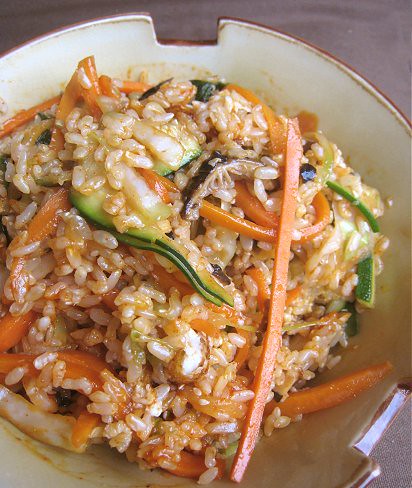
Sometimes, one can fudge it, as is the case with this brown rice bibimbap.


TS:
Unfortunately, we don't own any of those Korean stone bowls, so ours is just regular bibimbap as opposed to dolsot bibimbap.

http://en.wikipedia.org/wiki/Bibimbap

We were too lazy to cook up beef or some such thing, so we used all vegetables in our version.

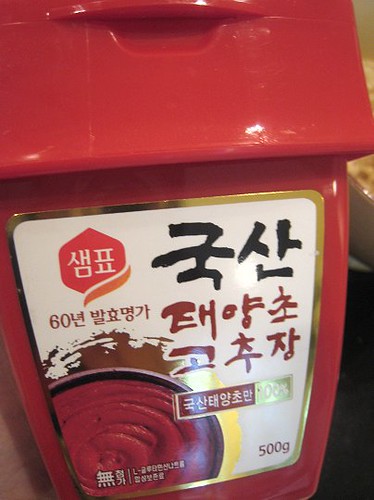
But first, the gochujang (Korean red pepper paste).


TS:
There it is. Just buy one from the supermarket and you're good to go.

http://en.wikipedia.org/wiki/Gochujang

Making the dish is simply a matter of cooking your different components/vegetables separately on the stove, seasoning with garlic, salt and sesame oil, and sometimes a touch of soy sauce.

I used various combinations of the above seasonings when cooking my vegetables.


TS:
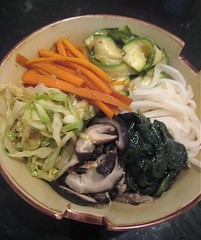
I have there tons of zucchini, carrots and daikon, some cabbage, and leftover spinach and mushrooms.


TS:
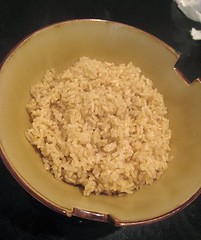
Brown rice in the bottom (cooked using a rice cooker), then the vegetables in neat little piles.

I was too lazy too fiddle around with eggshells (separating the egg yolk from the white), so I simply fried a whole egg and placed that on top.


TS:
Of course, one mustn't forget the gochujang paste. I sprinkled a bit of sesame seeds on top as well.

To eat, mix, mix mix!


JS:
It seems like we've found an application for brown rice where it's allowed to shine as itself, not as a substitute for its whiter sibling.

That's the key it seems to incorporating brown rice into our diet. Don't tell me there's no difference between brown and white because there is -- tell me to embrace the difference, as in "Vive le difference!"


JS:
In this bibimbap, the slightly grassy, very nutty flavours of brown rice complement the seasoned vegetables perfectly. The gochujang paste ties everything together.

I loved the toothy brown rice, the slightly tender, still-crunchy vegetables, and the soft ooze of the egg yolk in every bite. I'm getting hungry.

TS:
Love. Love. Love.


JS:
Now, if I eat the more than two servings of this bibimbap, does that still qualify as healthy? ;)


For a more detailed guide to making bibimbap:
Tasty Meals at Home: Tasty Dol Sot Bi Bim Bap

eatingclub vancouver Korean
Korean Sprouts & Spicy Cold Cucumber Salad
Kimchi Fried Rice, an addiction
Korean Soybean Sprouts Pancake (Kongnamul Jeon)
Korean Pork Bulgogi (with Muu Namul, Kong Namul)
Korean Roast Salmon
Korean Fried Chicken
Korean Sweet Potatoes with Yangnyeom Sauce
Japchae / Jap Chae (Korean Glass Noodles with Vegetables)
Brown Rice Bibimbap (Korean Rice Bowl)
Korean Oxtail Soup (Gom Tang)

Enjoyed this post? Why not subscribe to our blog? Subscribe via reader or subscribe via email. Thank you!

LinkWithin Related Stories Widget for Blogs