


"Hi!!!"
[js]
One of the chicken dishes I look forward to is our mother's silkie chicken stew. Basically, it's another one of our mother's one-pot, no-measure, ultra-forgiving wonders.
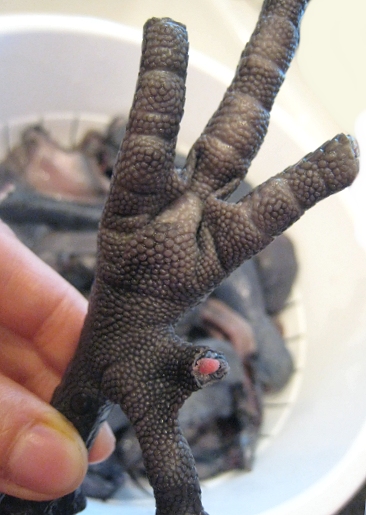
Silkie chickens are so called because their feathers are said to have a silky texture. What's interesting about them are the feathers are usually white, so you have a chicken that's white outside with black skin and meat underneath. They're quite a sight.
I've never actually seen one myself (I've only seen them in their unfeathered incarnations), but our mother, apparently, had even caught insects to feed to these chickens in her childhood and youth! One of her schoolmates had silkies they bred in the backyard for food.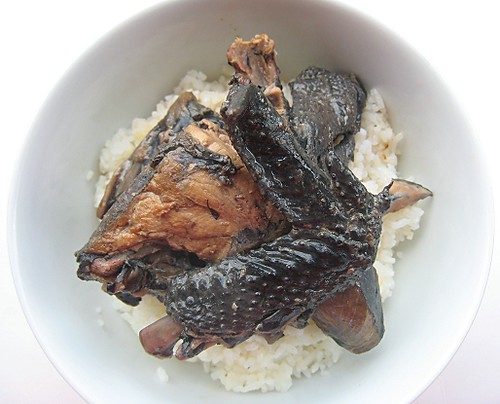
Sesame-Ginger-Soy-Braised Silkie
[js]
Sometimes we have silkie chicken in soup, but I prefer to have them in this form, braised in a mixture of soy sauce and ever-reliable water, with lots and lots of ginger. The ginger pieces are sauteed in sesame oil, which adds a profound nutty richness to the dish.
Some have noted that the meat of the silkie chicken might be a tad gamey, but I've never perceived it to be so. For me, it tastes like chicken, a tad chewier than "regular" chicken perhaps, but it tastes like a good free-range chicken does. Besides, we never have a problem with "chewy" silkies when Mama cooks them this way.
Silkie chickens are available frozen in most Asian supermarkets. In Vancouver, they are usually priced at $8.99 and above each. A bird usually weighs about a pound to a pound and a half.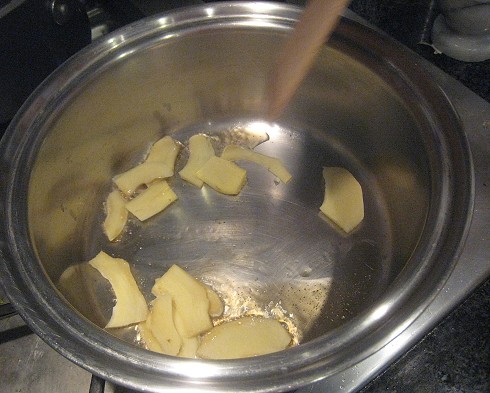
[ts]
Now being used to this "food blogging", our mother patiently goes through each step, posing each ingredient. First, sautéing ginger in sesame oil. This sesame oil and ginger combination is the base for Mama's Silkie Chicken.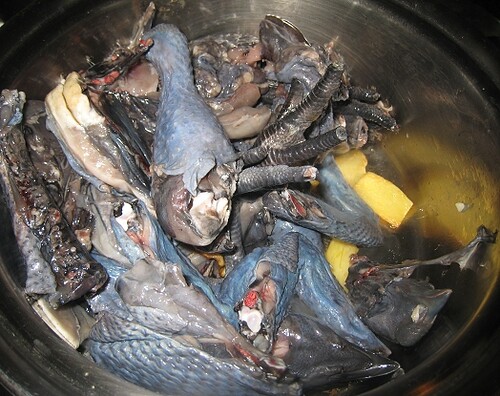
[ts]
When the ginger starts to slightly brown, the silkie is added. I love that blue!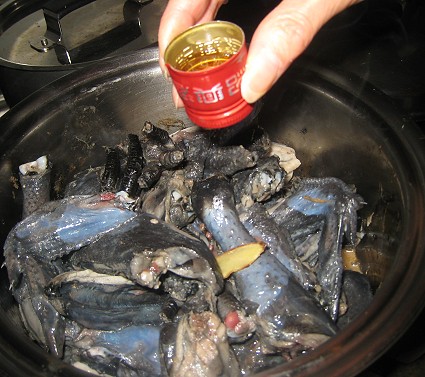
In goes about a capful of shao xing wine. Then, my mother covers the pot and lets the chicken sweat a bit with the wine. Let's say that the "sweating" takes about 10 minutes.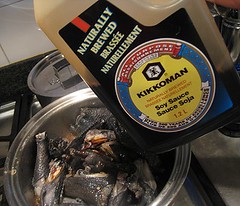
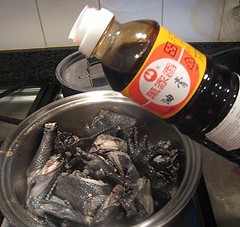
After the sweating, the braising liquids go in. So, that's soy sauce and soy paste. (Soy paste can be omitted if hard to find.)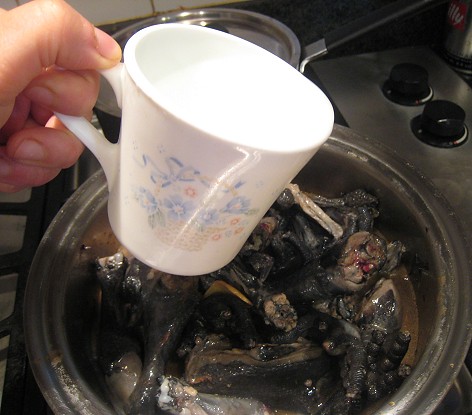
Of course, the all-important water.
The usual braising technique applies: Bring the liquid up to the boil then immediately put the pot on the lowest heat, cover and walk away.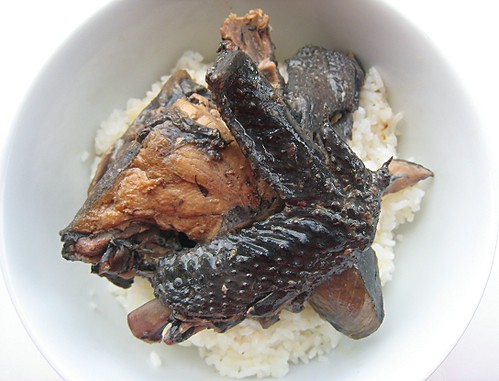
[ts]
Needless to say, sometime during the braising period you would've put some white rice to cook in a rice cooker.
Serve with said rice and lots of the braising liquid. Enjoy Mama's Dyong Kwe!
Mama Dishes
Mama's Silkie Chicken ("Dyong Kwe")
Mama's Philippine-style Fruit Salad
Mama's Cilantro Beef Shin
Mama's Black Peppercorn Shortribs
Mama's Fish Head Soup
Mama's Giniling
Mama's Giniling, v4 and v5
Mama's Ampalaya (Bitter Melon)
Ma-Kut (Pork Bone) Soup
We're submitting this to the Chinese edition of Joelen's Wine & Dine event. Find more details and the round-up at Joelen's blog: Joelen's Culinary Adventures.
Saturday, October 18, 2008
Mama's Silkie Chicken ("Dyong Kwe")


Subscribe to:
Post Comments (Atom)


Oh, moms food is always best. I am not sure that I am ready to do silky chicken because I have heard and read that it can go so very, very wrong--I think you have to have a special touch, like your mom. That said, this looks delicious and such a cool color.
ReplyDeleteI would soooooo love to try this chicken.
ReplyDeleteSilkie chicken supposed to be good for women, right? A tonic soup or something....
ReplyDeleteMy MIL makes this soup too! It is considered to be good for women.
ReplyDeleteThis chicken is delicious as soup and delicious as a braised dish! We love this chicken! However, they seem to get smaller and smaller these days (the ones sold here, that is)...
ReplyDeleteWow that's a unique looking chicken. I don't think I've ever seen one before. Where do you get them?
ReplyDeleteI wonder if it's the same black chicken that's often used here for chinese tonic soups... mum's recipe is the best ;)
ReplyDeleteBack in the Philippines, we live near the Arranque market. I always see this kind of chicken sold live in the market. Actually back then, we always buy our chickens live from the market.
ReplyDeleteI wonder if your mom has a recipe for the silkie chicken soup. Thanks....
Wow this looks so weird for me... don't take me wrong... but it's funny to see that black chicken skin!!! Amazing :D
ReplyDeleteI would love to try it!!!
I was just talking to my mom about these black skinned chickens yesterday when we saw them at the market. I was wondering what made their skin black...my mom didn't know. Do you?
ReplyDeletewow, the color of that chicken is just amazing, i think it might freak some people out
ReplyDeletemaybelle's mom:
ReplyDeleteThe silkie soup doesn't really make an appearance. We almost exclusively make this dish when we have silkies, so I don't know what other dishes to make with them. =) Perhaps if not in this form, our silkie will turn out... not well, hehe.
Cynthia:
It's very much a comfort dish. Try it! Would love to see how it turns out. =)
tigerfish:
KC:
I don't know, actually. I don't know if it's the chicken itself, or if it's because of the ginger.
Ning:
I think I don't like the soup version is because our mother puts those "Chinese medicine" type ingredients. I still haven't developed a taste for those. ;)
Marc @ NoRecipes:
We get them from our Chinese supermarket (T&T) and they're usually frozen.
noobcook:
Most likely. Not that I know chickens, but I think silkies may be the only black ones around.
Joseph:
Wow! Live chickens! We didn't really buy live chickens back then. Although, one time, Yaya brought back some live chickens from her province and we ate those.
Mama's recipe for the soup is just to add "See But" (Four "but")... I don't like it coz it tastes like medicine to me, haha.
Long time no hear! =D
Núria:
Haha, this is just "normal" for us. But, maybe you can tell people that it's the soy sauce that turned the chicken into that color. ;)
Jessica@Foodmayhem:
I don't think anything turns their skin black. They're just a specific breed of chicken; just the way they are.
kat:
Just say that the braising liquid turned it dark. ;) As for the blue, I think that was just the light/flash from the camera. I found that blue so pretty. Teehee.
Your photos are very interesting. I have never cooked with a silkie chicken before.
ReplyDeletedocchuck:
ReplyDeleteWe only cook this either this way or sometimes, a little rarely, in soup. I wonder myself how silkies would taste prepared another way.
You can get them in Vancouver, lucky you? It's not available in Switzerland, I will check out if they have it in UK next time I go there.
ReplyDeleteBeing a retired "educator" I pride myself on my unfailing honesty.
ReplyDeleteThat chicken LOOKS offputting, sorry. Someone had to say it.
My wife and I actually prefer the taste of "gamier" fowl, but it would be hard to eat something that looked like that.
Still, we both found your photos to be fascinating. Thanks.
janetching:
ReplyDeleteYeah, luckily, Vancouver is a pretty good place to look for Asian ingredients. Good luck n your search.
DocChuck:
It depends on what the familiar is to you, I guess. You can imagine it was cooked in squid ink, or some such thing. ;)
This was the first time I made this dish. I followed the directions (goumet cooking is my hobby) and it came out the way it was supposed to.... Perfect!
ReplyDeleteI added alot of ginger too!
Thank you very much!
Luke:
ReplyDeleteOoh, thanks for making it! I think people were regarding this as a "novelty" dish, whereas it's home-cooking for us. =)
I'm making this with the addition of some sweet purple yams and garlic paste! hopefully it turns out good. It looks strikingly blue with the chicken and the yams!
ReplyDeleteHi there,
ReplyDeleteThis sounds SO tasty! Could you tell us roughly how much soy sauce and soy paste you would use for one chicken? I really want to try this at home, but I'm paranoid that if I guess on the amts that the first time it'll taste way too salty or too mild...
Thanks!
Patrick:
ReplyDeleteWe love our garlic as well. Great addition. Ditto for the purple yams! We'd have to try that too.
Cory:
The soy sauce would be about 1/4 cup, I'd say. The soy paste would be 1 tablespoon (or omitted). The great thing about this is it's very forgiving. If you're afraid of it becoming too salty, put less and if it actually needs more saltiness, one can always add more soy sauce after the chicken has finished braising.
I raise Silkies in my backyard! They are wonderful, cute and sweet little things. My husband wants to make Silkie Soup, but we haven't tried it yet. I would only eat the bossy little roosters, the hens are too docile and sweet, and make fabulous mothers. They are also quite small and lay small, silky eggs that taste wonderful. Their skin and meat is naturally a dark blue-black color. Their feathers come is all sorts of colors, and are missing the barb down the center so are silky soft. They are getting smaller I think, as they are being bred to be more for pets in the United States. Also, they are slow to mature, so young hens would be barely worth eating. A year old rooster or 2 would make a fabulous Silkie soup! I have several other kinds of chickens as well, and really enjoy the Asian class. They are well bred, handsome, useful chickens. I would encourage everyone to try this soup, or try raising some Silkies of your own! They are easy to care for and a lot of fun. :)
ReplyDeleteAnon:
ReplyDeleteThanks for the info! I don't think we are up to raising chickens ourselves, but it must be nice to have those fresh eggs!
I'm still getting my brain around eating a Silkie! I have no problem processing Cornish crosses, but my Silkies are some of my favorite chickens. They make great moms, they're friendly . . .at this point for me, killing one of them would be like killing my dog for supper. Your recipe sounds very yummy, and I'll probably try it with one of my meat birds, but so far, I want to keep my Silkies alive! :)
ReplyDeleteNo problem! =) I have never actually met a silkie. But do try it with other types of chicken. =)
Deletekadaknath, the Indian black meat chicken is also there.
ReplyDeletewww.kadaknath.blogspot.com