


(Why should the pork belly have all the fun?)
Way #1: poached in "Parmesan broth", with chard and tomatoes
Way #2: roasted, with mushrooms, asparagus, bacon and eggs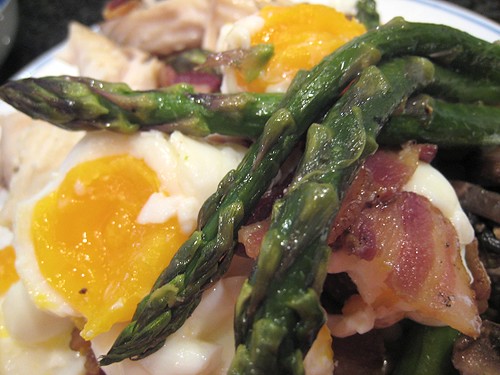
halibut, way #2
[ts]
We had 3 halibut steaks lying about in the refrigerator. I personally prefer fillets to steaks, halibut-wise, but T&T only has steaks (always!) for some reason. I guess we could go to other places that sell halibut, but it's freakingly expensive. I'd just have to let halibut stay in my "restaurant food" cateogory for now.
They were 3 sizable steaks, so I thought I'd cook them two different ways.
In the latest issue of Gourmet, there was a recipe for asparagus ravioli in Parmesan broth. I thought the "Parmesan broth" was very intriguing. After glancing at the recipe briefly, I set about my dish.
Way #1
We didn't have any stock -- well, just the tetra pack chicken stock -- so I rummaged through the refrigerator and pulled out all kinds of things, looking for ingredients I can use up in my dishes, including anything to flavor the poaching liquid I had planned for one of the dishes.
In the end, I had in there some ham, fennel trim, Parmiggiano-Reggiano rind, asparagus stalks, and orange and lemon slices. And water, of course. I simmered it for a little bit.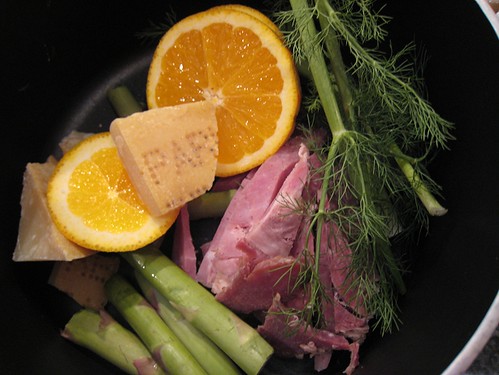
I wanted some soft-boiled eggs for my Way #2, so I plopped them into the liquid as well.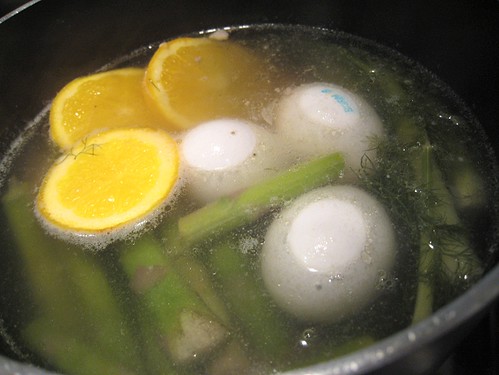
When the eggs were done, I strained the liquid (it was a little cloudy, but more on that later) and added more orange slices. In went one and a half halibut steaks. (There's also a lone mushroom in there, because it was left on the cutting board.)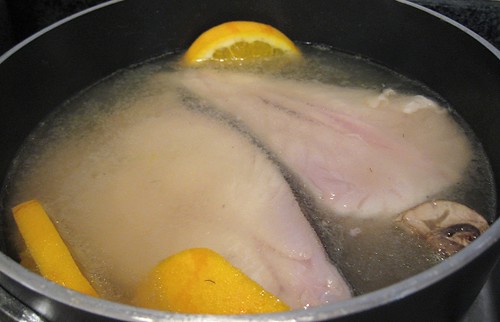
After the fish finished cooking, I removed it and added some swiss chard and diced tomatoes to the poaching liquid.
I debated whether or not to serve the fish in the poaching liquid. My uncertainty lay in the fact that while the fish was cooking, the poaching liquid was emitting an.... odor. Upon closer examination, I found that the Parmiggiano-Reggiano rind I put in there still had some cheese on it. I don't think it was the fault of the cheese, per se, but I found the smell to be -- in plainest terms -- quite revolting. In fairness to the cheesy broth, I think I was already coming down with something at this time. But, making me want to vomit doesn't bode well for any ingredient, so I opted to discard the liquid and serve the poached fish sans jus. (I think I'll hold off making that "Parmesan broth" from Gourmet as well. For now, at least.)
And here it is.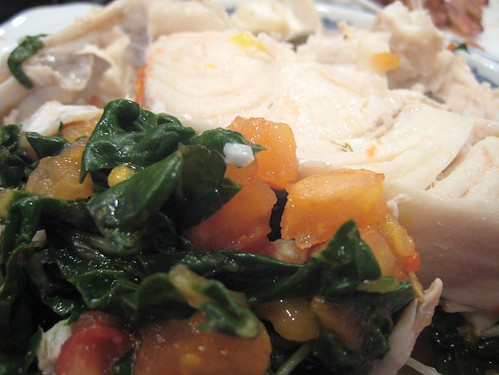
It was pretty tasty, cheesy broth odor aside. But, I must say I was partial to my Way #2.
Way #2
My scavenge hunt through the refrigerator yielded some asparagus and mushrooms. They were roasted in the oven. (I even prepped the asparagus "with love", peeling off the tough outer layer of the bottom of the stalks.)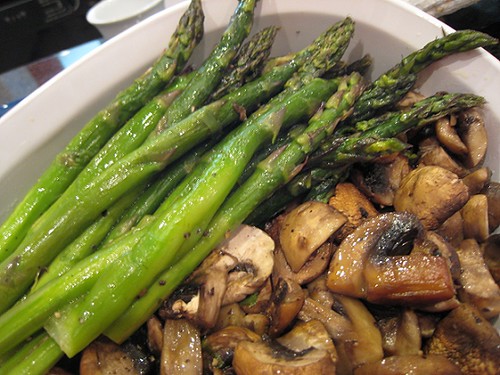
I then used the same pan to roast the remaining one and a half halibut steaks. In the meantime, I microwaved some bacon until they were crisp and peeled and halved the boiled eggs. (They were too firm to be soft-boiled, but at least they weren't hard-boiled.)
When the fish was done, everything came together.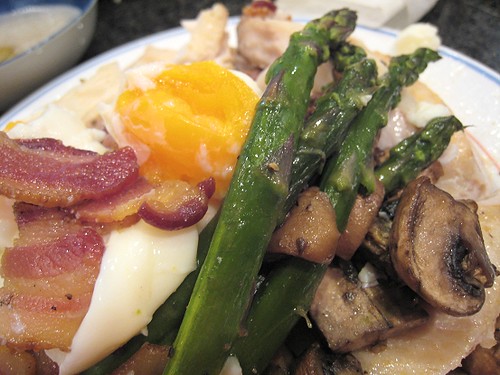
Actually, I almost didn't need the fish in this dish. ;D
It goes without saying that all those components -- mushrooms, asparagus, bacon, egg -- work well together. As for the fish, I like it better pan-fried. The steaks didn't get a nice golden crust on the outside from just being in the oven. Also, is it just me, or are those T&T halibut steaks are not white-white-white like the halibut fillets I see/eat out? Perhaps one of these days I'll spring for those expensive white-white-white halibut fillets.
Friday, April 11, 2008
Halibut, Two Ways


Wednesday, April 09, 2008
Pork Belly, Two Ways
Way #1: Philippine Adobo (reprise)
Way #2: Tamarind Series, Post #3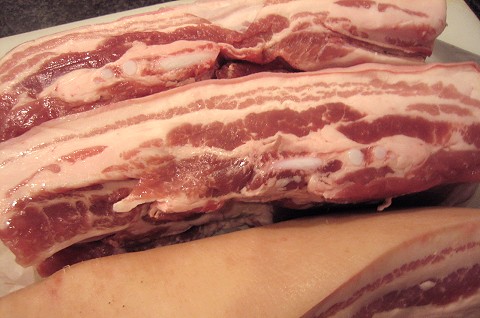
[ts]
We were trying to think of more "imaginative" ways of cooking these pieces of pork belly. Eventually, laziness got the better of me and I settled on doing "plain old" adobo. However, as per usual, once I get started doing something, I don't end up as lazy as I wish to be. So, I decided that two pieces of the belly would end up as adobo, while the 3rd would be a tamarind-based dish.
Philippine Adobo, reprise
We just did adobo with chicken (which was FANTASTIC!), but pork belly (liempo) is another traditional adobo ingredient.
So easy, yet so tasty. Dump everything into a pot!
soy sauce
vinegar
garlic
bay leaves
black pepper
Our chicken adobo post has detailed quantities.
I only added a dollop of coconut milk to this one. I didn't want the dish to taste coconut milk-ish at all.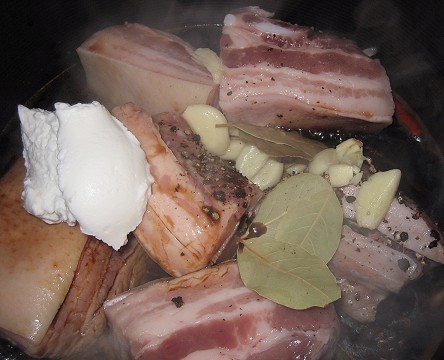
After simmering for about an hour or so, it was ready. Next, the skimming of the fat. Definitely not for the faint of heart, as those bellies render out quite the artery-clogging amount of fat. My mother loves to skim fat, so I let her get skim-happy.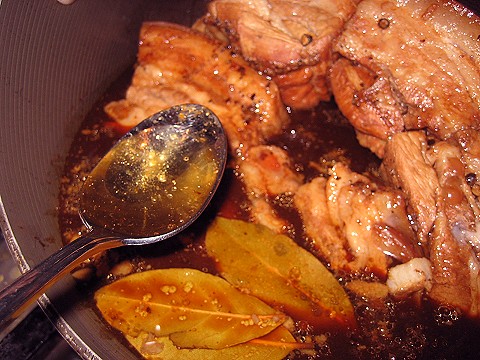
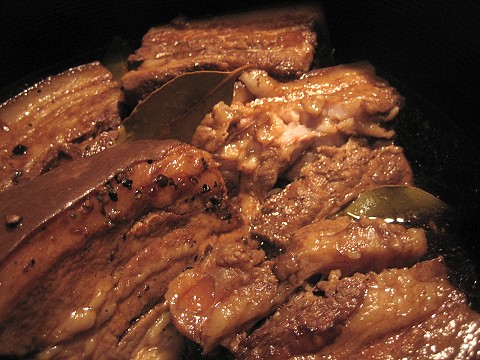
I was inspired by the braising-then-grilling action on the chicken adobo, so I thought I'd do the same thing to the pork bellies. With that in mind, I cut the pork bellies into the large pieces seen here. Otherwise, the slices would be a lot smaller. I took them jiggly bellies out of the braising liquid and loaded them onto a pan to put under the broiler. I think I needed to add a bit more water to the braising liquid to make it a nice-tasting "sauce".
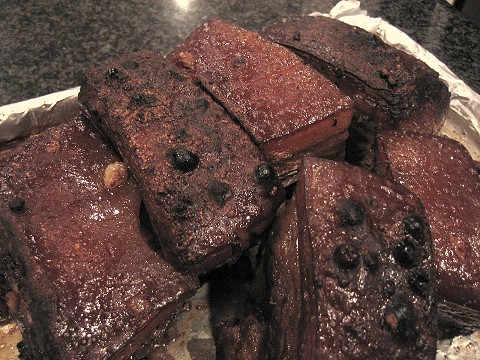
Although it looks nice and crackled, the skin didn't really get crispy. Maybe one really does need to deep-fry the bellies for that to happen? Oh well.
It was still fantabulous, nevertheless. Onto rice it went, with the sauce, of course.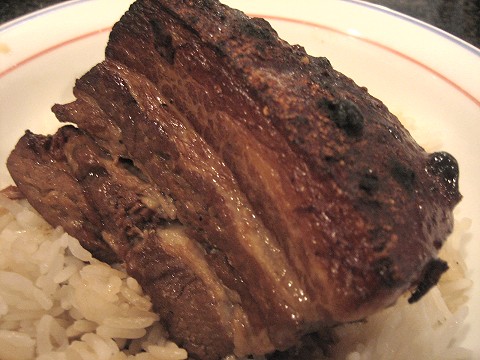

Tamarind Series, Post #3
This is also a dump-everything-into-a-pot dish. (We have quite a number of those in our repertoire.) The duo of pork bellies simmered side by side on the stove. How sweet.
tamarind pulp (pulpification seen in our pad thai post)
soy sauce
garlic
ginger
chile peppers
star anise
black pepper
cinnamon
ground coriander
(The above spices is me faking five-spice powder.)
After simmering for about the same time and the requisite fat-skimming, it was done. This dish -- which has no name -- had a thicker, more luxurious sauce because of the texture of the tamarind pulp.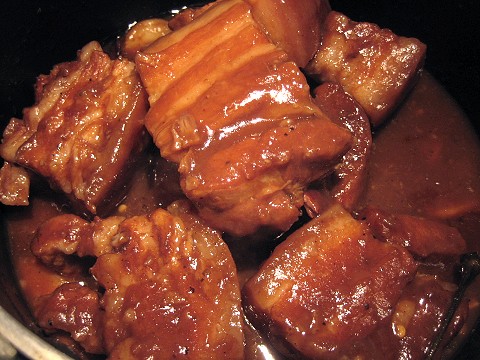
I didn't bother doing the broiling, since it failed miserably for the adobo. Again, onto rice it went.
This was also good; milder, sweeter. I was surprised that it wasn't that tart at all. It tasted more like Chinese "hong ma/hom ba" in that gelatinous pork hock way. The pull of the adobo was too strong for everybody to resist, though. Everybody ate the adobo first before even casting a glance in the direction of this second dish. I myself also liked the adobo better because of the way the acid definitely neutralizes or complements the fat from the pork. But, you say po-TAY-to, I say po-TAH-to...
Tamarind Series:
#1 Pad Thai
#2 Sinigang
#3 Pork Belly, Two Ways
eatingclub vancouver adobo posts:
Chicken Adobo
Pork Belly, Two Ways
Adobo Kangkong (Adobo Water Spinach)
Adobo Mushroom Tart
"Chinese Adobo" Clams and Oysters
Chicken Adobo in Coconut Milk (Adobo sa Gata)
Coconut Adobo Halibut Tails (Adobo sa Gata)
Roast Chicken Adobo
Brown-braised Pig's Feet
Adobong Baka (Philippine Beef Adobo)
eatingclub vancouver Filipino food
Bibingka
Mama's Ampalaya (Bitter Melon)
Faux Kamote-Que
Philippine-Style Chicken "BBQ"
Fried Hasa Hasa (Mackerel)
"Savory" Chicken Wings
Sinamak (Chile-infused Vinegar)
Pan-roasted Halibut w/ Fava Beans, Potato-Onion Cakes & Bagoong Butter Sauce
Bulalo & Bangus: an even simpler Filipino meal
Baked Tahong (Mussels)
Adobo Kangkong (Adobo Water Spinach)
Oyster Torta (Oyster Omelette)
Chicken Tinola (Chicken Soup w/ Green Papaya & Pepper Leaves)
(Chinese) Roast Pork Belly / Lechon
Tilapia wrapped in Banana Leaves
Pork Belly, Two Ways
Chicken Adobo
Embutido
Salabat (Ginger Tea)
Lechon Manok (Philippine Roast Chicken) & Lechon Sauce
"Chinese Adobo" Clams and Oysters
Bistek (Citrus Beef with Caramelized Onions)
Beef Kaldereta (Beef Stew with Bell Peppers)
Atsara (Green Papaya Pickle)
Tuesday, April 08, 2008
Ma-Kut (Pork Bone) Soup
[js]
Ma-Kut (pork-bone) soup is a favourite soup of ours. It is a frequent visitor to our dinner table.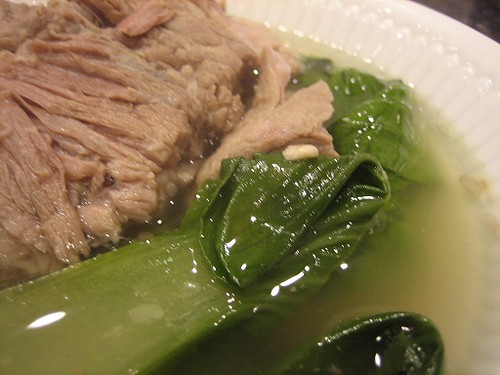
My mother makes ma-kut soup once a week. Usually she sticks with the simple combination of radish and ma-kut. This time, she added watercress instead of radish. Not knowing what to do with these Shanghai bokchoy, and deciding against sauteeing it, because of, well, you know, LAZINESS, I just dumped the bokchoy in the pot with the pork bone soup.
The result was still delicious. I also love pork bone soup in various forms, but this watercress and Shanghai bokchoy version is one of my favourites.
This is a VERY SIMPLE dish with only 3 ingredients, not counting the water and seasoning: pork bones (we usually get the neckbones), watercress, and Shanghai bokchoy.
Blanch the pork bones first by dumping them in boiling water to get rid of the impurities.
Put them in the pot with new water, boil, and simmer. It usually takes about 3 hours to extract the flavour from the pork bones.
When you add the vegetables depends on how soft and cooked you want the vegetables to be. For daikon radish, you need to add it earlier as it takes longer to cook. For green vegetables like watercress or Shanghai bokchoy, it is better to add them later as they lose their green-ness when in the soup too long.
That is all. A very, very simple dish, but very, very comforting. The children like this soup very, very much.
Mama Dishes
Mama's Silkie Chicken ("Dyong Kwe")
Mama's Philippine-style Fruit Salad
Mama's Cilantro Beef Shin
Mama's Black Peppercorn Shortribs
Mama's Fish Head Soup
Mama's Giniling
Mama's Giniling, v4 and v5
Mama's Ampalaya (Bitter Melon)
Ma-Kut (Pork Bone) Soup
Subscribe to:
Posts (Atom)


