


Way #1: Philippine Adobo (reprise)
Way #2: Tamarind Series, Post #3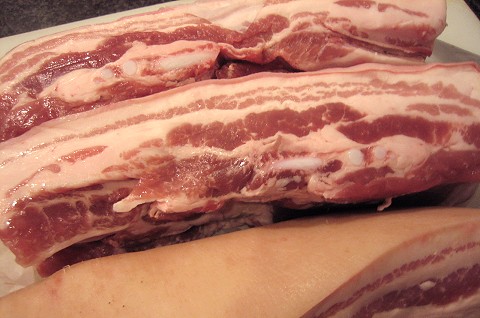
[ts]
We were trying to think of more "imaginative" ways of cooking these pieces of pork belly. Eventually, laziness got the better of me and I settled on doing "plain old" adobo. However, as per usual, once I get started doing something, I don't end up as lazy as I wish to be. So, I decided that two pieces of the belly would end up as adobo, while the 3rd would be a tamarind-based dish.
Philippine Adobo, reprise
We just did adobo with chicken (which was FANTASTIC!), but pork belly (liempo) is another traditional adobo ingredient.
So easy, yet so tasty. Dump everything into a pot!
soy sauce
vinegar
garlic
bay leaves
black pepper
Our chicken adobo post has detailed quantities.
I only added a dollop of coconut milk to this one. I didn't want the dish to taste coconut milk-ish at all.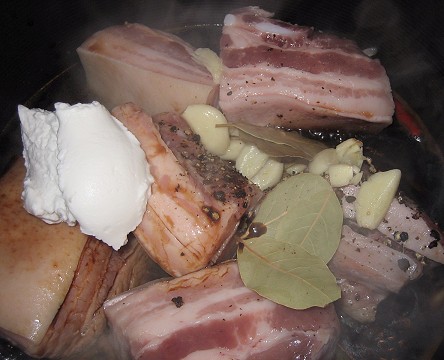
After simmering for about an hour or so, it was ready. Next, the skimming of the fat. Definitely not for the faint of heart, as those bellies render out quite the artery-clogging amount of fat. My mother loves to skim fat, so I let her get skim-happy.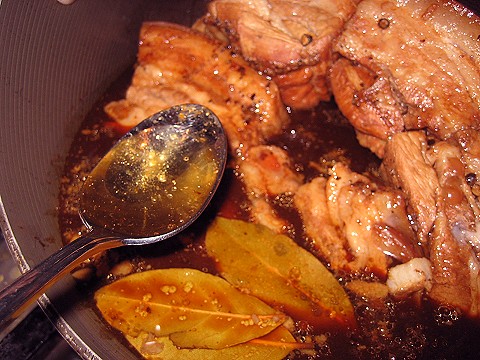
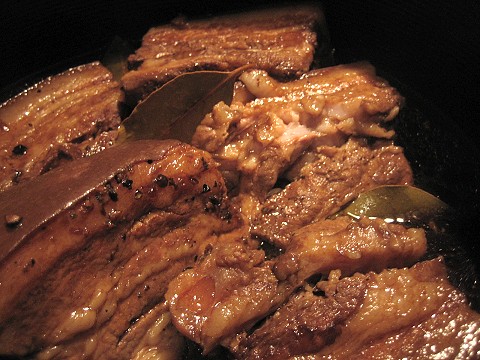
I was inspired by the braising-then-grilling action on the chicken adobo, so I thought I'd do the same thing to the pork bellies. With that in mind, I cut the pork bellies into the large pieces seen here. Otherwise, the slices would be a lot smaller. I took them jiggly bellies out of the braising liquid and loaded them onto a pan to put under the broiler. I think I needed to add a bit more water to the braising liquid to make it a nice-tasting "sauce".
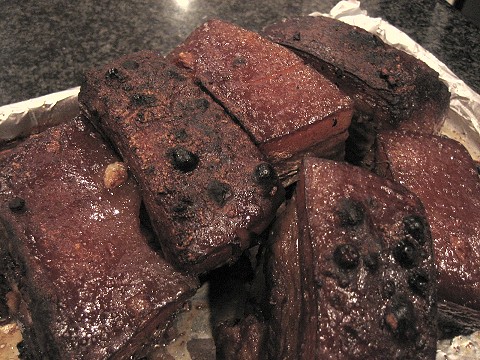
Although it looks nice and crackled, the skin didn't really get crispy. Maybe one really does need to deep-fry the bellies for that to happen? Oh well.
It was still fantabulous, nevertheless. Onto rice it went, with the sauce, of course.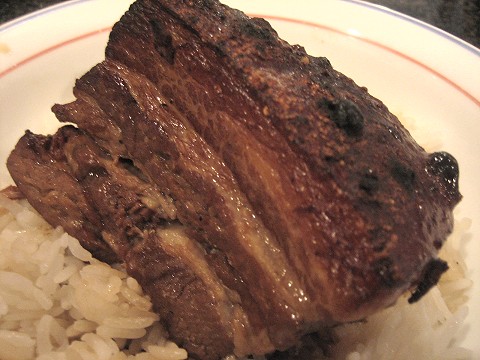

Tamarind Series, Post #3
This is also a dump-everything-into-a-pot dish. (We have quite a number of those in our repertoire.) The duo of pork bellies simmered side by side on the stove. How sweet.
tamarind pulp (pulpification seen in our pad thai post)
soy sauce
garlic
ginger
chile peppers
star anise
black pepper
cinnamon
ground coriander
(The above spices is me faking five-spice powder.)
After simmering for about the same time and the requisite fat-skimming, it was done. This dish -- which has no name -- had a thicker, more luxurious sauce because of the texture of the tamarind pulp.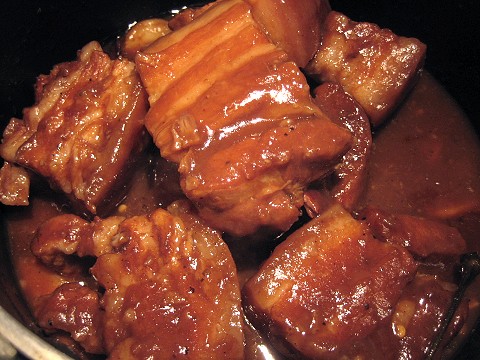
I didn't bother doing the broiling, since it failed miserably for the adobo. Again, onto rice it went.
This was also good; milder, sweeter. I was surprised that it wasn't that tart at all. It tasted more like Chinese "hong ma/hom ba" in that gelatinous pork hock way. The pull of the adobo was too strong for everybody to resist, though. Everybody ate the adobo first before even casting a glance in the direction of this second dish. I myself also liked the adobo better because of the way the acid definitely neutralizes or complements the fat from the pork. But, you say po-TAY-to, I say po-TAH-to...
Tamarind Series:
#1 Pad Thai
#2 Sinigang
#3 Pork Belly, Two Ways
eatingclub vancouver adobo posts:
Chicken Adobo
Pork Belly, Two Ways
Adobo Kangkong (Adobo Water Spinach)
Adobo Mushroom Tart
"Chinese Adobo" Clams and Oysters
Chicken Adobo in Coconut Milk (Adobo sa Gata)
Coconut Adobo Halibut Tails (Adobo sa Gata)
Roast Chicken Adobo
Brown-braised Pig's Feet
Adobong Baka (Philippine Beef Adobo)
eatingclub vancouver Filipino food
Bibingka
Mama's Ampalaya (Bitter Melon)
Faux Kamote-Que
Philippine-Style Chicken "BBQ"
Fried Hasa Hasa (Mackerel)
"Savory" Chicken Wings
Sinamak (Chile-infused Vinegar)
Pan-roasted Halibut w/ Fava Beans, Potato-Onion Cakes & Bagoong Butter Sauce
Bulalo & Bangus: an even simpler Filipino meal
Baked Tahong (Mussels)
Adobo Kangkong (Adobo Water Spinach)
Oyster Torta (Oyster Omelette)
Chicken Tinola (Chicken Soup w/ Green Papaya & Pepper Leaves)
(Chinese) Roast Pork Belly / Lechon
Tilapia wrapped in Banana Leaves
Pork Belly, Two Ways
Chicken Adobo
Embutido
Salabat (Ginger Tea)
Lechon Manok (Philippine Roast Chicken) & Lechon Sauce
"Chinese Adobo" Clams and Oysters
Bistek (Citrus Beef with Caramelized Onions)
Beef Kaldereta (Beef Stew with Bell Peppers)
Atsara (Green Papaya Pickle)
Showing posts with label tamarind. Show all posts
Showing posts with label tamarind. Show all posts
Wednesday, April 09, 2008
Pork Belly, Two Ways


Friday, March 21, 2008
Sinigang (Tamarind Series, Post #2)
[js]
I had fallen out of love with sinigang more than ten years ago.
Or perhaps I was not in love with it to begin with?
[js]
Sinigang is a soured soup and it is *the* Filipino national soup, just like adobo is *the* Filipino national dish. Everybody I know who grew up in the Philippines seems to be quite enamoured with sinigang, in all its variations: sinigang na bangus (milkfish), sinigang na baboy (pork), sinigang na hipon (prawn) and so on and so forth.
I recall Yaya (our cook) doing our sinigang with tamarind juice that she extracts from the tamarind pods. I don't recall when she stopped doing all that work and started using the sinigang packets so ubiquitous nowadays.
It was those sinigang packets that ruined the dish for me.
That and the spree of sinigang-cooking that we had approximately twelve years ago. We had sinigang once a week for almost two months. By the end of it all, I dreaded even the smell of it cooking. When I braved the smell and ventured into eating it, I recoiled from the aftertaste. See, on a sip, the first hit of the sourness would be welcome, but after that, there was usually a weird-ish, sweet-ish, off flavour that I can't quite place. Given that the constant in all these sinigangs is the packet, I'll blame the packet.
When we thought about our tamarind series, the first dish to come to mind was, of course, sinigang. Perhaps by going back to the "traditional," "old-fashioned" way of making a sinigang, we can redeem it. Perhaps I can even fall in love with it. Again. Or for the first time.
[ts]
Of course, we had no idea how to make sinigang using real tamarind. Everyone we know uses the packet mixes! So, winging it was the order of the day.
We had bags and bags of shrimp shells in the freezer. According to JS, we have about 12 bags in there. I didn't bother to look for all of them. I pulled out 4 and dumped them into cold water.
I added the limes leftover from our pad Thai.
While waiting for that boil, I prepped a couple of onions. We didn't have "real" tomatoes, just these mini ones. So I just washed them.

I believe that these Chinese long beans are sitaw, but I'm not sure. In any case, sitaw is a traditional ingredient in sinigang, I think. But, we've been using green beans for the longest time.

After the stock came to a boil, I turned the heat down and let it simmer for a little while. I don't remember exactly for how long, but let's say it was 20-30 minutes.
After straining the stock, I added the onions and the tomatoes. Oh, and of course, the tamarind pulp. We had about half of the amount leftover from our pad Thai. So that would be 1/2 block of tamarind. (Click here for block tamarind "pulp-ification".) 

At this point, I was starting to be afraid. When I tasted the liquid, it just had a very one-dimensional taste. Basically it tasted like water with some things added to it! Not a broth at all. So, to rectify this, I started thinking of other ingredients to add.
Fish sauce, one tiny piece of ginger, vinegar...


That vinegar is our homemade chile vinegar (made by plopping chile peppers into a bottle of coconut vinegar). Later on, however, my sister insisted that we use cane vinegar instead. It's not pictured here, but our cane vinegar is the same Silver Swan brand.
We added fish sauce and vinegar to the liquid throughout this uneasy, unsettling, fear-ridden time. Finally, to end the delay and because I had no choice but to forge ahead with this not-soup liquid, I added the shrimp. They were washed but unpeeled.

After many tastings of the liquid, we decided that we needed more tamarind! So, I had to pulp-ify a new brick of tamarind. The resulting sinigang therefore had one and a half bricks of tamarind.
The long beans were added last. Relief, they added a much-needed layer of flavor and a very nice "green" aroma.
However, I didn't know that long beans took longer to cook than regular green beans! The soup -- yes, it was a soup, at long last -- was already ready, but the long beans were a bit too "crunchy". This was remedied after subsequent heatings of the soup.
Here it is! Not at all labor-intensive like those sinigang packet commercials would have you believe. (It is, still, after all, dumping things into a pot and just leaving them there.)
[js]
This was very good -- and NONE of the weird aftertaste that our other sinigangs have suffered from. Perhaps I was right: it was those sinigang packets ruining this whole dish for me. My only complaint was the string beans. It wasn't tender enough by the time the soup finished cooking. It could have gone earlier into the broth.
We'll make this again. I can already think of the possibilities! I can't wait to have a version with fish and/or kangkong.
[ts]
I think I would like a beef sinigang next. I added some slices of the roast beef we made and it was even better!
Tamarind Series:
#1 Pad Thai
#2 Sinigang
#3 Pork Belly, Two Ways
[eatingclub] vancouver Filipino food
Bibingka
Mama's Ampalaya (Bitter Melon)
Faux Kamote-Que
Philippine-Style Chicken "BBQ"
Fried Hasa Hasa (Mackerel)
"Savory" Chicken Wings
Sinamak (Chile-infused Vinegar)
Pan-roasted Halibut w/ Fava Beans, Potato-Onion Cakes & Bagoong Butter Sauce
Bulalo & Bangus: an even simpler Filipino meal
Baked Tahong (Mussels)
Adobo Kangkong (Adobo Water Spinach)
Oyster Torta (Oyster Omelette)
Chicken Tinola (Chicken Soup w/ Green Papaya & Pepper Leaves)
(Chinese) Roast Pork Belly / Lechon
Tilapia wrapped in Banana Leaves
Pork Belly, Two Ways
Chicken Adobo
Embutido
Salabat (Ginger Tea)
Lechon Manok (Philippine Roast Chicken) & Lechon Sauce
"Chinese Adobo" Clams and Oysters
Bistek (Citrus Beef with Caramelized Onions)
Beef Kaldereta (Beef Stew with Bell Peppers)
Atsara (Green Papaya Pickle)
Sardinas na Bangus (Milkfish in the style of Sardines) and Pressure Cooker Fear
Thursday, March 13, 2008
Pad Thai (Tamarind Series, Post #1)
psst... pssst... PSSSSST!!!!
That was the pad Thai calling to us throughout that evening.
[js]
For the longest time, I had been immune to the call of 'pad Thai.'
My experience with Thai food had been very limited. When we were growing up, we used to visit a Thai restaurant in Makati, the details of which I really cannot remember now. I don't know how authentic the food there was, but after several visits, we've pretty much stopped visiting it. I had written Thai food off as something that's always sweet and always with peanuts.
Back in Vancouver, I can pretty much count the number of times we went to a Thai restaurant. I remember going with Grace once to Thai House in Richmond and the group ordered pad Thai. I had a bite of it and thought it was awful. It had a stale taste, like stale rice, but even worse. I thought I had the faintest taste of a naphthalene ball, those little white balls we used to get rid of vermin. Ugh. Add to that flavour the slightly rancid taste of the peanuts, with the sweetness of something red (like ketchup) -- it was enough to make me swear off Thai food forever.
It wasn't until I exiled in LA that I re-discovered the glory that is 'pad thai.' The name does not mean anything: translated it says, "Thai noodles." I've read somewhere that if you go to Thailand and order a 'pad Thai,' they wouldn't even know what you are talking about because there's no such thing. Back there, they're all PAD THAIs. They're all Thai noodles! In North America though, it has taken on iconic status. Every Thai restaurant has their own version of pad Thai.
I've visited several restaurants in LA and partook of their versions of the dish. My favourite pad Thais of them all are the ones that don't look bright orange (because I fear ketchup) and are sticky-sourly-sweet, redolent of fish sauce. Pad Thai, when done right, is a whole lot of comfort, something soul-satisfying, even if one's soul isn't Thai. Just Thai enough, I suppose.
For a long time, 'pad Thai' has always been something elusive, something to be had only in Thai restaurants. Of course, we don't really frequent Thai restaurants in Vancouver. That makes the dish even more elusive to us.
It's something that needs to be remedied, we thought.
Armed with the desire to cook pad Thai, we brushed up on pad thai techniques (see below for clarification). Particularly helpful are these pages below.
At cook-eat-FRET:
http://www.cookeatfret.com/asian/2007/09/17/the-pad-thai
At chez Pim's:
http://chezpim.typepad.com/blogs/2007/01/pad_thai_for_be.html
The pictures they have seem closer to the ideal authentic pad thai, so I gave TS the sites. (Because, you know, she's the one who needs to brush up on the pad thai technique.) I saw Alton Brown do a pad thai once on his show Good Eats but his look too pale to be authentic pad thai. Too pale and does not have that sticky brownish sheen of the other pad thais that I have loved.
[ts]
We already had the idea of doing a tamarind series, as it's an ingredient that we haven't worked with before. Everybody and their grandmother seemed to be making sinigang using the packet mixes, so that was the first dish we thought of.
Of course, pad Thai was the second.
I looked at the pad Thai post at the chez pim blog. It made perfect sense to me since I'm used to cooking with the principles of a dish in mind, and not exact recipes. Reading the post, I was armed.
Making pad thai is all about prep.
First, making the sauce. I soaked a block of tamarind pulp in boiling water.


I had to wait until the water was cool enough to touch. In the meantime, I prepped the other ingredients.
Shallots and garlic:

Green onions and chili peppers:

Lime wedges to serve with the finished dish:

I roasted & chopped some peanuts. (I made lots since Letty loves nuts of all sorts. Also, this would also come in handy as a topping for other dishes.)


That's JS peeling some LARGE shrimp:

Got my eggs ready. (Again, they're so pretty!)

Sadly, our pad thai won't be a truly authentic pad thai because we were missing:
garlic chives
preserved turnips
firm tofu
dried shrimp
Anyway, now for some tamarind fun.
I had to get my hands in there and squeeze and mash the pulp into the water. Lovely. ;P


Then, into a strainer to push as much tamarind goodness through as possible.


When that was ready, sauce-making could begin. Following chez pim's ratios, I tried doing 1 part each of tamarind, fish sauce, and palm sugar. (That there is a disc of palm sugar.)

However, I found that it was too salty. I added more tamarind and more palm sugar. I let the mixture boil to completely dissolve the sugar.
Sauce done!
Now, the noodles. Again with the soaking!


One was supposed to soak the noodles only until they were pliable, not "soft" or ready to eat. However, I was busy tending to other things that I let the rice noodles soak too long. But, that was easily remedied by adding the noodles later in the sequence of ingredients when frying. No biggie. But, I'm getting ahead of myself.
My pad thai set-up: my sauce and the rice sticks to the right, and the other ingredients to the left. Oh yes, we had bean sprouts as well.


The moment of truth.
I followed chez pim's instructions of only frying up 2 servings at a time. This is now supposed to go fast and furious.
First attempt:

Hot oil. Then, the shallots, garlic & chiles.


A handful of noodles and a ladle of sauce...

...then a couple of eggs, followed by the huge shrimp.

The green onions and bean sprouts were next.


And done!
Hm.... it don't look so good.

Well, good thing we did this batch-cookery style. For our second and subsequent batches, I was aiming for "perfection"!
Things we learned:
The shrimp (fine, prawns) were way too large to go in that late in the game.
The noodles don't have to go in that early as they were already soft.
Wait until the eggs set!
One small ladle of sauce is not enough.
OK, here goes. Before I started, I decided to beat the eggs.

Oil.

The jumbo shrimp went in almost immediately after the aromatics.


The beaten eggs had time to set and bubble nicely.


The noodles went in, followed by a LARGE ladle of sauce.


Then, the green onions and bean sprouts.


Plated with ground peanuts and lime wedges.

[ts]
I don't know what to say. It was so good. I've outdone myself! There was quite a bit of pad Thai so I was hoping to eat some more the next day. But the next day came, and there was no pad Thai in sight.
[js]
Our home version is definitely close to all the pad thai noodles that I have loved! The one thing it did not have was the "spirit of the wok" as we didn't use a wok and there was really no way that our stove could get the requisite firepower for our wok to exude said spirit.
Yes, I too was hoping for some pad Thai the next day, but when I came home from work, there was none! It was calling to me all night, but I resisted and resisted and for my patience I get nothing! We definitely have to do this pad Thai again.
We will be using smaller shrimp for the next version (I thought the shrimp we had were too large for the pad Thai purposes) and I'm trying to get TS to have the sauce a little stickier and more savoury. Perhaps we might douse a little bit of fish sauce once the noodles are stir-frying around in the pan. Or perhaps the other ingredients (dried shrimp, preserved turnips, etc) would be enough to add a little funkiness to our pad Thai, as all the other pad Thais I have loved did have a touch of a little funkiness.
[ts]
And what do you know! I peeked in the fridge and found suspiciously pad Thai-y ingredients! Bean sprouts, garlic chives, firm tofu... Now all we need are preserved turnips and dried shrimp and we're good to go.
Joy!

Thai creations at [eatingclub] vancouver:
Pad Thai (Tamarind Series, Post #1)
Waterfall Beef Salad
Thai Basil Stir-fry
Thai-marinated Fried Chicken (and the Ultimate Compliment)
Thai Meatballs
Thai Basil Tofu Stir-fry
Tamarind Series:
#1 Pad Thai
#2 Sinigang
#3 Pork Belly, Two Ways
Subscribe to:
Posts (Atom)


