


[js]
This is another one of our favourite restaurant dishes.
We almost usually order this dish when eating at our favourite Hongkong-style noodle houses. Sometimes we would have it served on top of rice. Sometimes, on top of some noodles in soup.
I can't quite decide which way is my favourite, so when we set about trying to recreate this dish at home, we decided to do both.
The cut of beef known as "beef brisket" has been a source of confusion for me for a long time.
I thought we figured out the mystery behind the term (see Dancing Cilantro Beef), but I've come to accept that sometimes the name might refer to any of the following cuts: brisket of beef, the shin of beef, or veal breast.
For this dish, I chose veal breast. It had the right mix of tender meat, fatty bits, and chewy layers. I don't know exactly what this chewy layer is called in English: most probably, it would be discarded as "gristle."
The "gristle" is quite essential to the enjoyment of the beef and I can never be bothered to trim the gristle. Because -- well, you know.
I've been searching for a recipe for Cantonese-style braised beef brisket for some time. I figure it was braised in a soy sauce mixture, with the usual aromatics (ginger, green onion, garlic), and I figure it must have some five-spice powder in it, or at the very least, cinnamon (or cassia) and star anise.
But there was something missing when I cooked up a batch of beef brisket. I mean, it was pretty good but it lacked a certain note.
Something. . .
something. . .
something. . .
Chu Hou Paste
[js] I trolled the Internet again and discovered Chu Hou paste as the essential ingredient.
I have no idea what Chu Hou paste is made out of.
All these Chinese pastes, sauces, and "bean things" in jars look the same to me. Reading through the ingredient list does not help, because it would list the usual ingredients (soybeans, water, salt and so on and so forth) with nary a variation between different jars.
Nevertheless, I decided to purchase a jar and see if it will work.
(I don't recall the brand I used; there are quite a number of them.)
To make a long story longer, it did work!
When one bit into the beef (or veal), one can definitely taste the chu hou paste. It adds more of that licorice-y, anise-y bite to the beef. The licorice-y note is more focused, which is why I think to attribute it to the paste than the star anise in the braising liquid. Besides, I find that adding too much star anise in the liquid makes my head spin in a not so pleasant way. I find it much too overpowering.
We're all out of the paste now. Of course, I'll buy another jar, but I also want to try this dish without the paste. If anybody knows for sure what the ingredients are in Chu Hou paste, please pass the information along.
"Recipe"
[js]
This dish is our usual dump-into-a-pot deals. The "recipe" below assumes the use of Chu Hou paste.
1. Cut beef in cubes. I usually do biggish pieces (1.5 inch x 1.5 inch) because I braise to tenderness and the pieces always end up smaller than the original.
2. Brown beef, if you are feeling industrious and there are no taped Law and Order or House on the DVR that you need to watch.
3. Otherwise, heat up some oil in a pot. I like to add a dash of sesame oil to whatever oil I'm using (usually canola although peanut would be nice).
4. Add ginger and green onions. Saute.
5. Add minced garlic.
6. Add beef cubes. If the cubes are not browned because of that new Law and Order episode, then, per Mama, just cover the pot with a lid and let the beef steam until not bloody anymore.
7. Add a dash of Shaoxing wine, for "that depth of character, a roundness" (as we have discovered Kylie Kwong to say a lot). Cook out the wine a tad.
8. Add the Chu Hou paste (two to three tablespoons is enough for about 4 pounds of beef).
9. Stir around the beef and coat with the paste.
10. Add soy sauce, approximately half a cup, plus water.
11. Add one star anise and a cinnamon or cassia bark.
12. Add a little bit of sugar, to taste. (White, brown, rock, palm; all are welcome.)
13. Braise until tender. Check for seasoning.
14. Upon serving, to make it more "restaurant-like," take out the beef pieces and strain the braising liquid.
15. Thicken sauce with a cornstarch slurry.
Your Cantonese Braised Beef Brisket is now ready!
Cantonese Braised Beef Brisket: On Rice
[js]
In our restaurtant-ordering experience, ordering this "on rice" usually entails a circular dish with the beef brisket in the middle and a bok choy border. That's what TS tried to recreate here.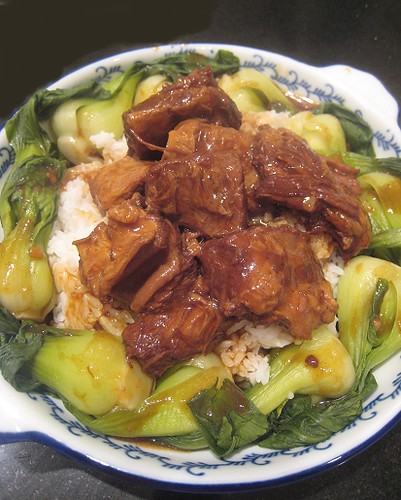
Cantonese Braised Beef Brisket: "Wonton Noodle Soup"
[js]
I, myself, wanted my beef brisket on top of some egg noodles so I bought some from the supermarket.
I made a quick broth for my egg noodles. I learned from Annie (of House of Annie) that one can use dried anchovies steeped in water for stock. I did just that and added some dried shrimp for the "shrimpy" taste of wonton soup broth.
I added some Shanghai bok choy to the broth, put in the blanched noodles, and topped the whole thing with some of the beef brisket.
It was delicious! Tasted very authentic, like what I get from the noodle house.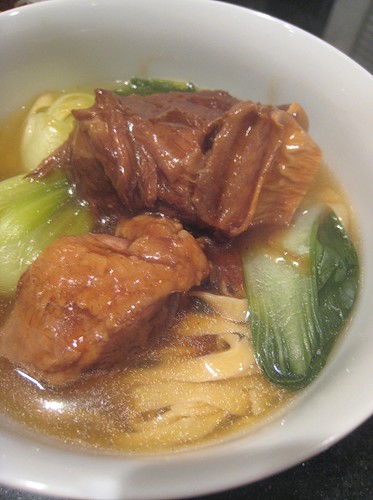
[js]
And that's it! Another "mysterious" Chinese restaurant dish tackled!
______________________
Mochachocolata-Rita also made Cantonese Braised Beef Brisket. And in a very entertaining fashion, too. Be prepared to be amused. Read it here: ...And I Now Pronounce you Mr & Mrs. Brisket Daikon
House of Annie's Wonton Soup
_______________________
eatingclub Hong Kong/Cantonese
Chicken Chow Mein
Cantonese Braised Beef Brisket, Two Ways
Lobster Congee from a Lobster Feast
Chinese Roast Pork Belly
Gailan (Chinese Broccoli) with Oyster Sauce, Two Ways
Chinese Pork Bone Soup with Carrots and Water Chestnuts
Hong Kong-style Curry Cuttlefish
Dimsum Seafood Trio: Black Pearl Prawn Toast, Scallop in Nest, Jewelled Rice Cup
Hong Kong-style Singapore Noodles (星洲炒米)
Hong Kong-style Stir-fried Water Spinach with Shrimp Paste (蝦醬通菜)
Hong Kong-style Stir-fried Rice Noodle with Beef (乾炒牛河)
Sweet and Sour Pork
Hong Kong-style Curry Beef Brisket (咖喱牛腩), 1st Attempt
Monday, January 19, 2009
Cantonese Braised Beef Brisket, Two Ways


Subscribe to:
Post Comments (Atom)


I make this dish too. Pretty much the same way. Chou Hou sauce is the vital ingredient.
ReplyDeleteI Will be making it for the CNY reunion dinner on Sunday.
jeez ~ looks amazing!!! and i agree w/ you about the collagen in anything to be braised/stewed: it's the best part!!!
ReplyDeletemmm... This looks fantastic. The star anise really shines in beef dishes, doesn't it?
ReplyDeleteLove the ease of this!
It looks great both ways. I've never heard of beef brisket being anything than a specific cut of beef
ReplyDeleteoh, thank you thank you for taking the mystery out of this dish, it's my favorite as well. Now I can make it at home. Gotta get some chu hou paste now!
ReplyDeleteFunny you posted this - I was at the market earlier today and came across this very brand you posted and wondered at the store what this could possibly be used in! Now I know and I have a reason to go back and pick it up! I've had the braised beef at the restaurants and thought the same things you did as far as ingredients it included. I hope to make this soon using pork!
ReplyDeleteI have to look for this sauce... can u believe it's the first time I am hearing it? ;p this dish looks very comforting and I love both ways of serving :)
ReplyDeleteSo this is the trick! I've been wondering what was missing too!Thanks.
ReplyDeleteWow! An excellent recipe. Looks great too.
ReplyDeleteNo idea on the ingredients that contains the sauce... but the pictures are really amazing!!!! I wish I could grab some now! It looks fantabulous :D
ReplyDeleteOh braised beef, what can't you do?
ReplyDeleteGreat job! I always like to get the braised beef noodle dish when we go out for Hong Kong style soup noodle.
ReplyDeleteI think the star anise is absolutely essential.
Seriously this is one awesome dish. I would love to have a nibble followed by a full serving!
ReplyDeleteDelicious and easy. Yum!
ReplyDeleteThose photos of the tender hunks of beef has me drooling. I have a bit of a sauce fetish and at any given time my fridge is about half full with sauces, so I'm totally going to buy some chee hou the next time I'm in Chinatown.
ReplyDeleteAll the different bean based sauces do get really confusing. Glad you found the one you were looking for so you could make that beautiful dish!
ReplyDeletelooks great - good thing you figured out how to purchase that "certain something" that was missing. I"m going to look out for this in the shops next time I'm in Chinatown. maybe i could find it there.
ReplyDeleteLooking really yummy!
ReplyDeleteI love the sound of this!
ReplyDeleteThat braised beef looks tasty!
ReplyDeleteChu Hao paste, huh? thanks for sharing the "secret" ingredient. :)
ReplyDeleteKits Chow:
ReplyDeleteEven though we;ve used it, I still don't know *exactly* what it is! ;)
chef_the_city:
Lo:
Thanks! And it really was very, very tasty.
kat:
I think it's just one of those "lost in translation" things. We try to explain what we want but sometimes the non-English-speaking butcher just doesn't understand us. =)
Caroline:
Joelen:
Let us know how your dishes turn out! =)
noobcook:
Oh, we are even more "noob" in terms of those Chinese sauces and bean things, fermented pastes, etc etc, etc. =)
pigpigscorner:
These Chinese things are so mysterious, haha.
MrOrph:
Núria:
Nate-n-Annie:
Thanks!
Heather:
Haha. Braised beef is magic.
noble pig:
Thanks! Know what, we would love to see something like this on your blog! =)
Marc @ NoRecipes:
We'd love to see what you do with chu chou paste. Something cool and different, no doubt. =)
Jessica@Foodmayhem:
Thanks!
we are never full:
We'd love to see what you do with chu hou paste! (After making Cantonese Brasied Beef brisket first, of course.)
Indonesia-Eats:
Pam:
Kevin:
Thanks!
Ning:
We'd love to see your version now that you know the "secret"! ;)
Oooh, I love slow-cooked brisket, although this way of serving it is new to me (clearly we don't hang out in the same restaurants ;-)) Glad you found the Missing Mystery Ingredient!
ReplyDeleteWow what a meal. I've never heard of Chu Hou Paste. Don't know if I can find it in Comox Valley. They have so many different sauces that we never know which one is is a dish. Great job on this one.
ReplyDeleteJeanne:
ReplyDeleteSupposedly, there are other/more "mystery" ingredients for this dish as well. One day we will find out what it is (or, they are)!
Helene:
I think most Asian supermarkets would have it. We just never bothered to look for it before. =)
Thank you for this recipe! I just tried making it according to my dad's recipe, but as with most Asian cooks, he was very bad about including any actual measurements. I ended up using an entire bottle of bean sauce for a small batch - needless to say, it was disgustingly salty and not at all like the real thing. I will use your recipe and play around with it, knowing now all I need is Chu Hou paste! (and only a few tablespoons of it!)
ReplyDeleteJo:
ReplyDeleteApparently, there is supposed to be MORE "secret ingredients" that go into this dish. But, we were pretty happy with our fake version. ;)
looks fantastic. wife and i just made something similar from a book by ken hom, but it called for dark soy sauce and fermented red bean curd instead of chu hou (probably similar though), as well as some dried chilies which gave a slight, and very welcome, afterburn. and the "gristle" i think you are referring to is probably delicious tendon
ReplyDeleteExcellent recipe, thank you! Does anyone have any idea how long this takes to cook until tender? I only have about 4 hours up my sleeve and am worried it will still be tough! Thanks!
ReplyDeleteHi Kate! I think 4 hours should be enough in terms of braising time, especially if they're already cut up into the smaller pieces.
Delete