Tuesday, January 12, 2010

Lengua Estofada (Beef Tongue Braised in Red Wine and Veal Stock)


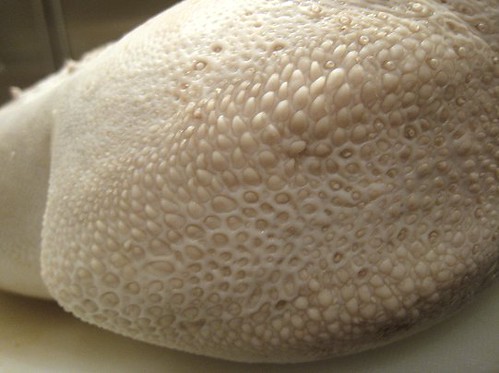
Looks like a white strawberry, the texture. Doesn't it?

[ts]
After a Christmas gathering at our cousin's house where lengua was served, I decided that we should serve it during one of our parties at home.

When we chose Spanish as the theme for our New Year's Party, I thought, perfect! After all, "lengua" is Spanish. ;)

[js]
I remember lengua being a "festive" dish, that is, it always seemed to be a fixture in Philippine holiday parties. I remember liking lengua, but I don't recall if TS ever eating lengua herself.

Which is why I was a tad surprised when she was so insistent on doing lengua for the party. She isn't a "variety meat" kind of gal.

[ts]
I don't get why tongue is classified as offal.

It's still just muscle, people, it's not innards!

We were counting on buying cleaned and peeled beef tongues for the party, but couldn't find them. My mind was still set on serving lengua, however, so we went ahead and bought the available frozen, unpeeled tongue. How hard could cleaning it be, right?

I read up on tongue cookery in 1080 Recipes(the Spanish equivalent of The Silver Spoon), and even looked at The Silver Spoon as well.

I was ready.

Lengua Prep
[ts]
We left the tongue in the fridge to defrost for about a day, then soaked them in cold water. They weren't totally defrosted yet, but we didn't have the time to wait for that. Besides, the soaking in water would help in the defrosting anyway. They soaked overnight; actually, for about 12 hours.

Then, they were ready.

According to 1080 Recipes, one can either peel tongue before braising them or after braising them. I opted to do the former as I was afraid the flavors would not be infused into the meat with its skin still on.
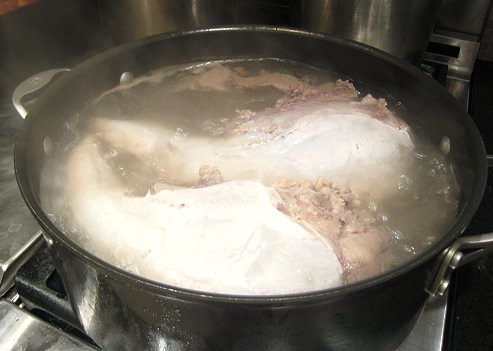

"cleaning" the meat by blanching

[ts]
I brought a pot of water to boil, then plunged the tongues in for about 15 minutes. I had to do this in two batches as we had no pot big enough to contain four tongues. I imagine this is to "clean" the tongue; this technique is often used in Chinese cooking as well.
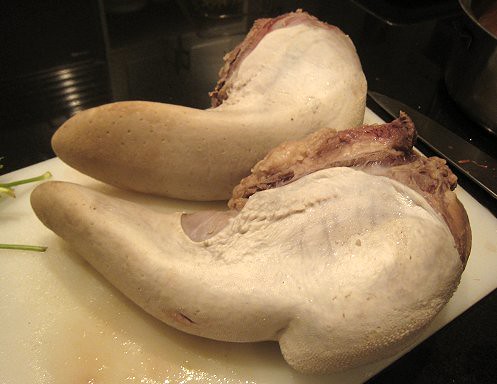

The tongue is a huge muscle! Look at that back end.

[ts]
When they were cool enough to handle, I started the task of peeling them. Well, I thought it would be like peeling the peel off of bananas, but no! Apparently, that only happens if I had peeled them after braising.

Basically, I had to peel the tongue by shaving off the skin with a boning knife. It was a little time-consuming -- the skin was a little tough and my knife could be sharper -- but I guess I got better with practice. =)
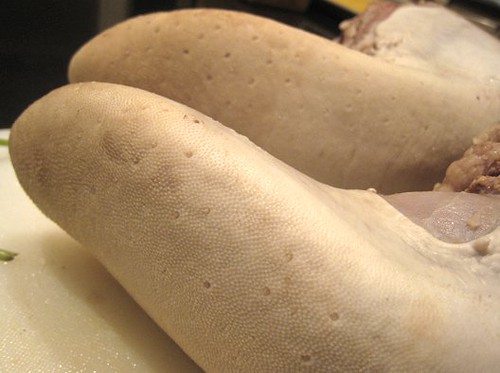

Behold, papilae!

[js]
The peeling is not the task for me. If it were me trying to peel the tongue, I would have just sliced off big slivers of tongue-skin with tongue-meat still attached to make my life a whole lot easier. We would have been left with rectangular blocks of beef tongue.

[ts]
The peeling was the most difficult part. After that, it was basically a shove-everything-into-a-pan-and-forget-about-it recipe.

Veal Stock

[ts]
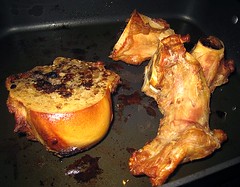
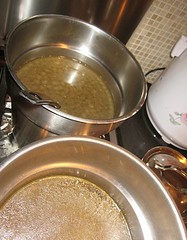
We made veal stock the night before. JS simply roasted some bones until nice and brown, and placed the bones in a pot with some cold water. We simmered the bones overnight.

Braising
[ts]
In my braising pan (which in our case, was the largest roasting pan we owned), I sweated some onions and carrots. I didn't add celery because from perusing 1080 Recipes, it seems that the Spanish, or at least this cookbook author, do not use a lot of celery in their flavor base. I also added some tomatoes, but just a small amount. This dish wasn't intended to be a tomato-based one.

The tongues went in, along with the rest of the flavorings: black peppercorns, parsley, bay leaves and thyme. I also added a pinch of ground cinnamon and a couple of cloves for a little something-something. We also had half a can of anchovies lying around so I threw those in to use them up.

For our braising liquid, we did a combination of red wine (because we had about half a bottle that was in danger of turning to vinegar) and veal stock.

I added the liquids to the roasting pan, brought the mixture to a boil, then covered the pan and placed it in the oven. I let the lengua braise for about 3 or 4 hours, until they were tender.


Braised lengua in their braising liquid, cooled.
That's congealed beef fat encasing them. Beef fat! Nice.

[ts]
In our case, we braised these tongues the day before the party. That only served to intensify the flavors, we believe. They were left to cool in the braising liquid.

The next day, I took the lengua out of the liquid and sliced them. We strained the braising liquid and reduced it, adjusting the seasoning at the end.
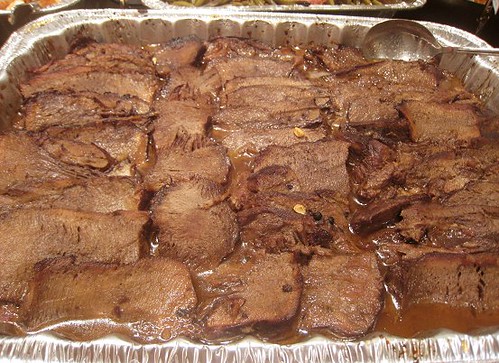

Bad photo of sliced lengua with its sauce.

[js]
The transformation!

Sliced, they don't look anything like the tongue they started out in life as. In fact, they just look like regular old beef, except much more tender and much more flavorful.

There is nothing quite like the tenderness of the tongue: for some reason, tongue still retains a very nice chew even when very tender. It keeps its integrity and doesn't shred like brisket or short ribs, for example.

I was a little apprehensive how the lengua was going to be received at the party. Going in, I knew some people (like my father) love lengua, but given that it is not a common cut in Vancouver, I was afraid that some guests would not even be persuaded to try it.

Judging by the leftovers (we only had a few pieces left at the end of the night), I would say it was quite a success.
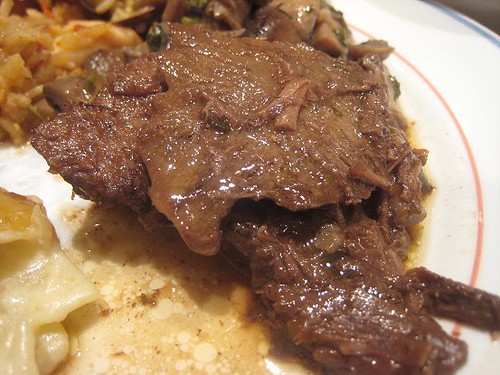


[ts]
The photos do not do this dish justice. So tender, so flavorful, so good!

See the rest of our Spanish-themed New Year's Eve Menu here.


Enjoyed this post? Why not subscribe to our blog? Subscribe via reader or subscribe via email. Thank you!

Recipe
Lengua Estofada (Beef Tongue Braised in Red Wine and Veal Stock)

This was the proportions I used for our party. Feel free to halve or even divide the recipe by 4. Our beef tongues were about 3-4 pounds each.


4 beef tongues (approx. 3-4 lbs each)

3 ripe tomatoes, large dice
2 large onions, large dice
4-6 carrots, large pieces
handful black peppercorns
10 sprigs to 1 bunch parsley
4 bay leaves
5-8 thyme sprigs
anchovies (optional)
pinch ground cinnamon
2 cloves

red wine
veal or beef stock

Use as much or as little of each liquid, as long as there is enough liquid to cover the meat.

Soak the tongues in water overnight.

Bring a large pot of water to boil. Add the tongues and boil for about 15 minutes. Take out of the water and let cool until cool enough to handle. Discard water. Peel the tongue using a knife.

Alternatively, one can peel the tongue until after braising.

In a large pot, heat oil over medium heat. Add the onions and carrots and sweat. Add tomatoes and cook for a few seconds. Add tongues into the pot, and cover with red wine and/or stock. Add the rest of the ingredients. Bring the liquid to a boil, then turn the heat to low. Cover the pot and simmer for about 3 hours, or until the tongues are tender.

Alternatively, one can also braise the tongues in the oven. Turn the oven to 350F. Place covered pot or roasting pan into the oven and braise for about 3 hours, or until the tongues are tender.

Take tongues out of braising liquid. Slice.

Strain the braising liquid. In a saucepan over medium heat, reduce the braising liquid until desired thickness. Adjust seasoning. Serve sauce with the sliced tongue.


[eatingclub] Spanish
Tortilla de Patatas (Spanish "Omelette")
Roast Duck and Orange Crêpes with Orange-White Wine Sauce
Sardinas na Bangus (Milkfish in the style of Sardines)
Red Wine-braised Squid with Potatoes and Chorizo
Philippine Beef Salpicao (and a Spanish variation)
Stewed Tripe, Spanish-style
Lengua Estofada (Beef Tongue Braised in Red Wine and Veal Stock)
Bacalao con Patatas (Baked Salt Cod and Potatoes)
Salsa Romesco ("Queen of the Catalan Sauces!")
Grilled Calçots (Green Onions) with Salsa Romesco
Empanada de Pavo
(Galician-style Meat Pie with Turkey Filling), plus Turkey Cracklings!

Fideuá (Spanish Seafood Noodle "Paella")... and Paella
Cocido (Spanish Stew with Various Pork Cuts)
Slow-Roast Pork Shoulder, Two Ways

Friday, January 08, 2010

Pancit Canton (Philippine Braised Egg Noodles)


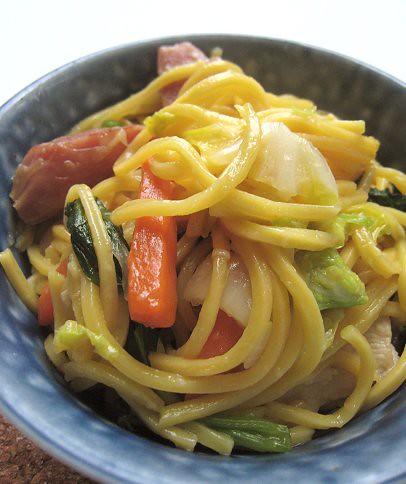
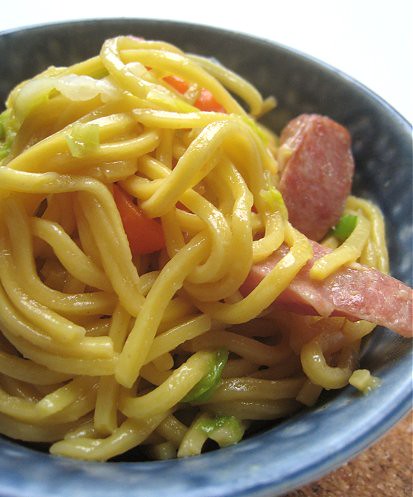
For us, a small -- very small -- bowl of pancit canton.

[js]
It seems like we've discovered another family favourite.

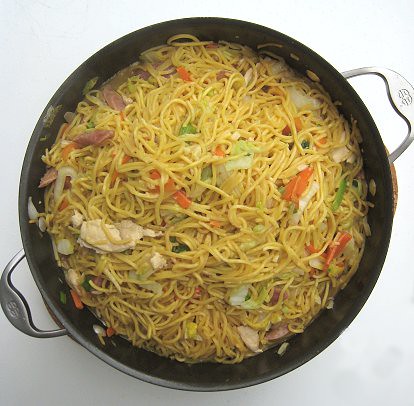
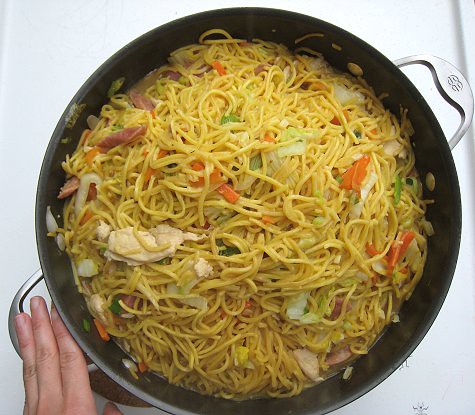
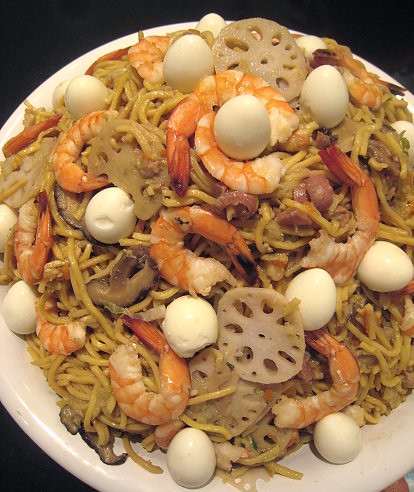
I never knew how much people liked Pancit Canton until I made one big batch for a gathering we had some time ago. Big as the batch was, there were no leftovers at the end of the night.


a big batch

[js]
I approached the task of cooking pancit canton with some trepidation. Pancit canton was a staple of birthday parties we attended from our long-gone and mostly-forgotten childhoods, where it was always served with neon-pink quail eggs.

There were always not enough neon-pink quail eggs, since I remember vaguely having to duke it out with other eager and greedy kids.


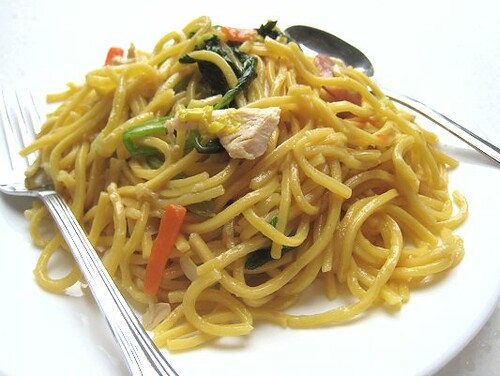
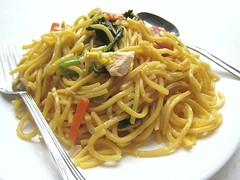
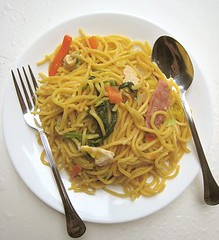
pancit canton on a plate, with spoon and fork

[js]
As with most Chinese noodle dishes, to which this dish alludes to (hence, "canton"), pancit canton is a hodgepodge of meat, seafood, and vegetables.

For the meat, I usually use a combination of chicken and Chinese sausages. If I have shrimp, I add shrimp. If I have quail eggs, I add quail eggs. For the vegetables, I usually use shreds of carrots, Napa cabbages, and Chinese celery.

[ts]
There really is no set recipe for pancit canton. I think of it like making fried rice. Here's a step-by-step look at one version we made. Recipe/Guide at end of post.

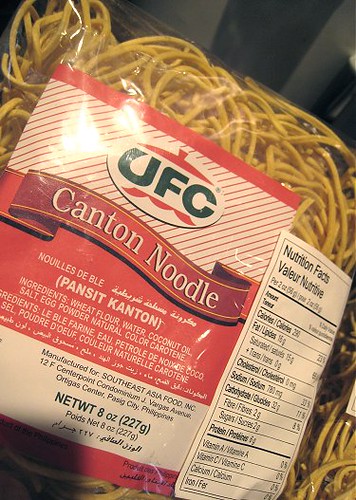
Canton Noodles / Egg Noodles


[ts]
First of all, one needs canton noodles! These noodles need to blanched very briefly in boiling water to cook them.

Alternatively, an even easier method is to buy cooked egg noodles (from the Asian supermarket) and use those instead. We've used both types of noodles.

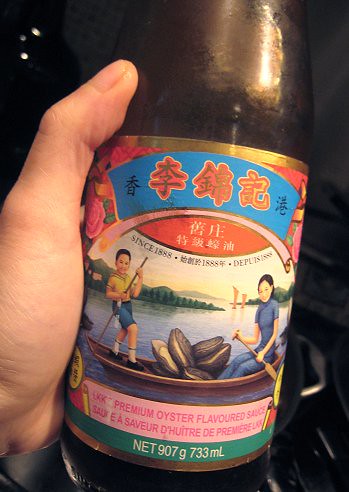
Oyster Sauce


[ts]
There's nothing like oyster sauce for that unmistakable "Chinese" flavor. I suppose one can just use soy sauce, but it's really not the same.

Stuff

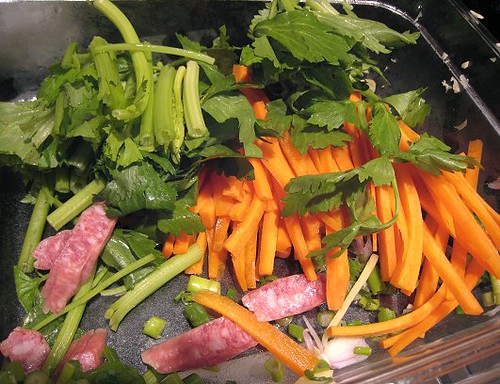
Chinese celery, Chinese sausage (lap cheong), carrots, green onions. Garlic, shallots and ginger have already vacated the container.

[ts]
Whenever we make pancit canton, JS is kind enough to do all the prep work for me, cutting up the vegetables, slicing chicken, etc. All I need to do is show up for the rock-star task of putting it all together.

That above was a container filled with sliced shallots, green onions, garlic, and the tiniest amount of sliced ginger. I've already put those in the pan before realizing I should take a picture. Also in there were carrots in strips, Chinese celery and Chinese sausage (lap cheong).

http://en.wikipedia.org/wiki/Chinese_sausage


[ts]
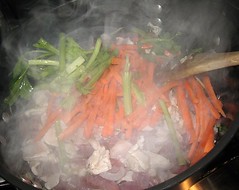
Since the ingredients are ever-changing, I put them into the pan from the longest to cook, to the quickest to cook. But, always first to go in are the aromatics.

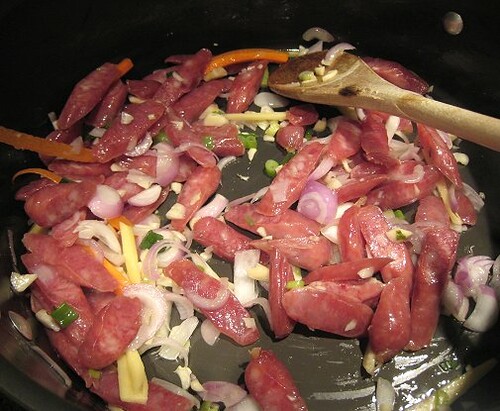
Into some hot oil went the sliced Chinese sausage, sliced garlic, sliced shallots and ginger.


[ts]
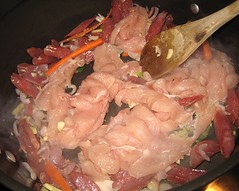
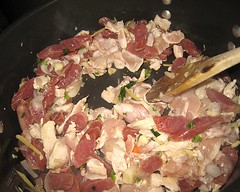
This time, we had chicken. I added them and stirred until they were 80% cooked through.

The Chinese celery and the carrots went in next.

Stock


[ts]
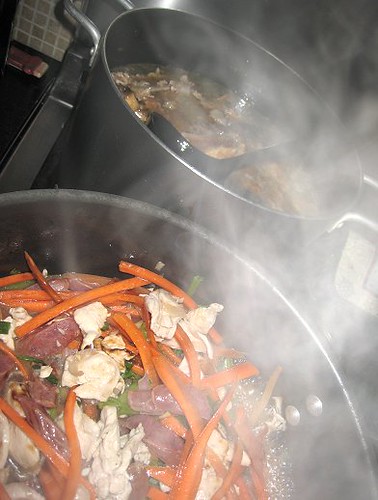
See that pot there in the back? That's our stock. JS put some chicken carcasses in a pot, added water, and that was that. One can use any type of stock: chicken, beef, even shrimp stock or fish stock.

I started ladling stock into our pancit canton pot. I usually stop at this point and just the let pot simmer on low while I concentrate on boiling the noodles. We would've set a pot of water to boil at the beginning of all this.


[ts]
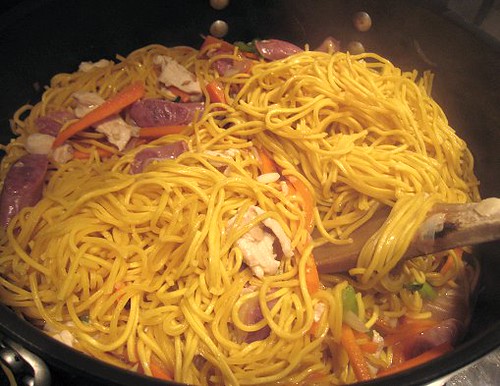
The cooked egg noodles went in next. At this point, care is needed to mix up the ingredients in the pot, as one doesn't want the noodles in little broken pieces. Add oyster sauce to taste. Once can also add some soy sauce.


The set-up.

[ts]
On the bottom left is a big pot of pancit canton in the making. Next to it is a smaller pot, also of pancit canton in the making, because the big pot was not big enough for the quantity we were making. At the back is our big pot of chicken stock. The bowl with the tongs contained the boiled/cooked noodles.


[ts]
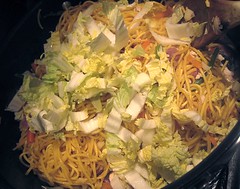
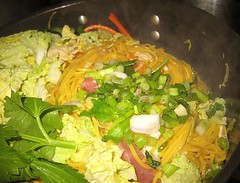
After the noodles and stock and the rest of the ingredients simmered for a bit, the shredded Napa cabbage went in. They don't take too long at cook at all. To finish the dish, I added green onions (and some stray Chinese sausage and Chinese celery leaves that I failed to add in the beginning) and made final adjustments of the seasoning.

And that's it!


[ts]
Pancit Canton is a real favorite of CSC's. The mere suggestion of making the dish sets her eyes a-twinkling.

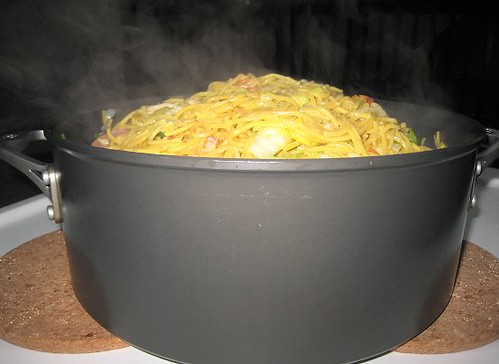
So, when we make it, we make a big batch.

How big?

This big.


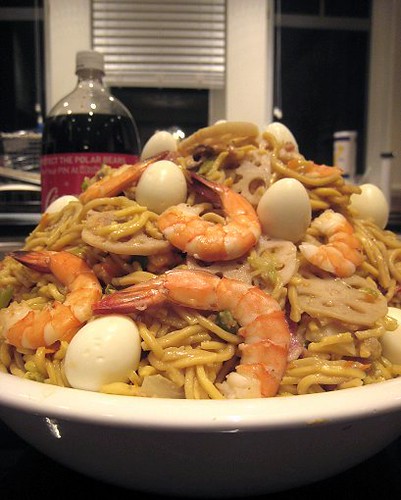
This big.


This version has shrimp, mushrooms, Chinese sausage, lotus root, and quail eggs (not hot pink, though). How big was this batch?


That's a 2L Coke bottle beside it.

[ts]
So, try making pancit canton and it could become your family's favorite.


Enjoyed this post? Why not subscribe to our blog? Subscribe via reader or subscribe via email. Thank you!

Recipe
Pancit Canton (Philippine Braised Egg Noodles)


Please adjust the quantities to fit your requirement, much like making fried rice.

Ingredients
uncooked egg noodles, or cooked egg noodles

garlic, sliced
onions and/or shallots, sliced
ginger, minced or julienned (optional)

Any or all of the following ingredients:
Chinese sausage (lap cheong), sliced
chicken, pork or beef, sliced
mushroom, sliced
carrots, sliced
Chinese celery stalks and leaves, sliced
shrimp, raw or cooked
perhaps clams or mussels, raw or cooked
Napa or savoy cabbage, sliced (or regular cabbage)

green onions, sliced
hardboiled quail eggs

(Any other vegetables you may have on hand would be all right.)

oyster sauce
soy sauce
stock (chicken, pork, beef, seafood or fish, vegetable)

Method
If using uncooked egg noodles, bring a large pot of water to boil.

In the meantime, heat oil in another pot. Add garlic, onions and/or shallots, and ginger. Sauté until fragrant, about 30 seconds. Add Chinese sausage and sliced raw meat. Cook until meat is about 80% cooked.


Add "longer-cooking" vegetables such as carrots, mushrooms, and Chinese celery. If using regular cabbage, add it now. Also add any uncooked seafood.

Ladle stock into the pot. Simmer on low.

If using uncooked noodles, add them to the pot of boiling water and cook until done (al dente). Drain.

Add cooked egg noodles to the simmering pot. Season with oyster sauce and soy sauce. Add more stock if desired (the mixture should be just be slightly "wet" at this point).

Add in any cooked seafood, the Napa cabbage and the quail eggs. Cook for about 5 to 10 minutes. Adjust seasoning (adding more salt, oyster sauce and/or soy sauce).

Serve.

Wednesday, January 06, 2010

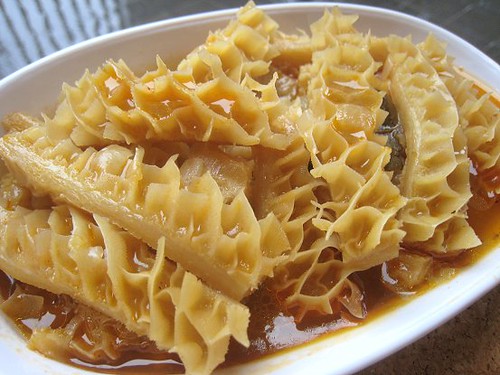
Stewed Tripe, Spanish-style


[js]
Some people have lobsters for New Year's Day, I hear.

We had stewed tripe this year.

[js]
Since we always have our "big" party on New Year's Eve (see menu here), and our guests stay late, some even up to 3 or 4 in the morning, I am usually too tired to do anything on actual New Year's Day save lounge around in my pajamas and eat leftovers.

This year, after the clock struck midnight and we had our champagne drinks, I went to bed at around 12:30am on January 1st. I had been feeling under the weather the day of our party, with a very scratchy and achy throat.

With an "earlier" bedtime than most, I woke up earlier on New Year's Day than most. I looked around our kitchen and decided to clean up a bit.

Once the kitchen was in a semi-orderly condition, I scrounged around in the refrigerator for my prize: about a pound of honeycomb tripe I threw into our basket when we were shopping for pig parts for our New Year's Eve party.

I had planned to throw together a tripe dish into our menu -- and hence, enraging TS who had already prepared all the labels for the party -- but we had been so busy with the other dishes that I did not have the time. Besides, all I had was a pound of tripe and that probably wouldn't have been enough for 50 people.

I decided to go Spanish with my New Year's tripe dish -- we still had all the ingredients from shopping for the party, after all. I used white wine and veal stock for my stewing liquid, and bay leaves and smoked paprika for my flavouring agents. Recipe below.


[js]
This was a very satisfying dish. It's a gift to myself, let's say. I ate this with a new batch of seafood paella I made with our leftover ingredients from the night before.

Actually, I made two new batches of seafood paella; we really had quite a lot of leftover ingredients -- prawns, clams, mussels, squid, etc -- that were unused when we made our fideuá for the previous night. Fideuá post here!

Needless to say, we had to call some people over to partake in all the food!

[eatingclub] Spanish
Tortilla de Patatas (Spanish "Omelette")
Roast Duck and Orange Crêpes with Orange-White Wine Sauce
Sardinas na Bangus (Milkfish in the style of Sardines)
Red Wine-braised Squid with Potatoes and Chorizo
Philippine Beef Salpicao (and a Spanish variation)
Stewed Tripe, Spanish-style
Lengua Estofada (Beef Tongue Braised in Red Wine and Veal Stock)
Bacalao con Patatas (Baked Salt Cod and Potatoes)
Salsa Romesco ("Queen of the Catalan Sauces!")
Grilled Calçots (Green Onions) with Salsa Romesco
Empanada de Pavo
(Galician-style Meat Pie with Turkey Filling), plus Turkey Cracklings!

Fideuá (Spanish Seafood Noodle "Paella")... and Paella
Cocido (Spanish Stew with Various Pork Cuts)
Slow-Roast Pork Shoulder, Two Ways
Enjoyed this post? Why not subscribe to our blog? Subscribe via reader or subscribe via email. Thank you!

Recipe
Stewed Tripe, Spanish-style

1 lb honeycomb tripe, cleaned and cut into strips
1 onion, diced
4 cloves garlic
1 tsp smoked hot paprika, preferably Spanish
1/2 cup white wine
1 1/2 cup beef stock
1 bay leaf
salt and pepper

Fry garlic in oil until brown but not burnt. Scoop out garlic. Add onion and sauté until translucent.

Add tripe, wine, beef stock. Add other ingredients.

Stew until tripe is to desired tenderness.

LinkWithin Related Stories Widget for Blogs